Why Interlock Mercury Is the Best Digital Lock in Singapore (Door & Gate Ecosystem Guide 2026)
By Dean 28-02-2026 199
Why Interlock Mercury Is the Best Digital Lock in Singapore (Door & Gate Ecosystem Guide 2026)
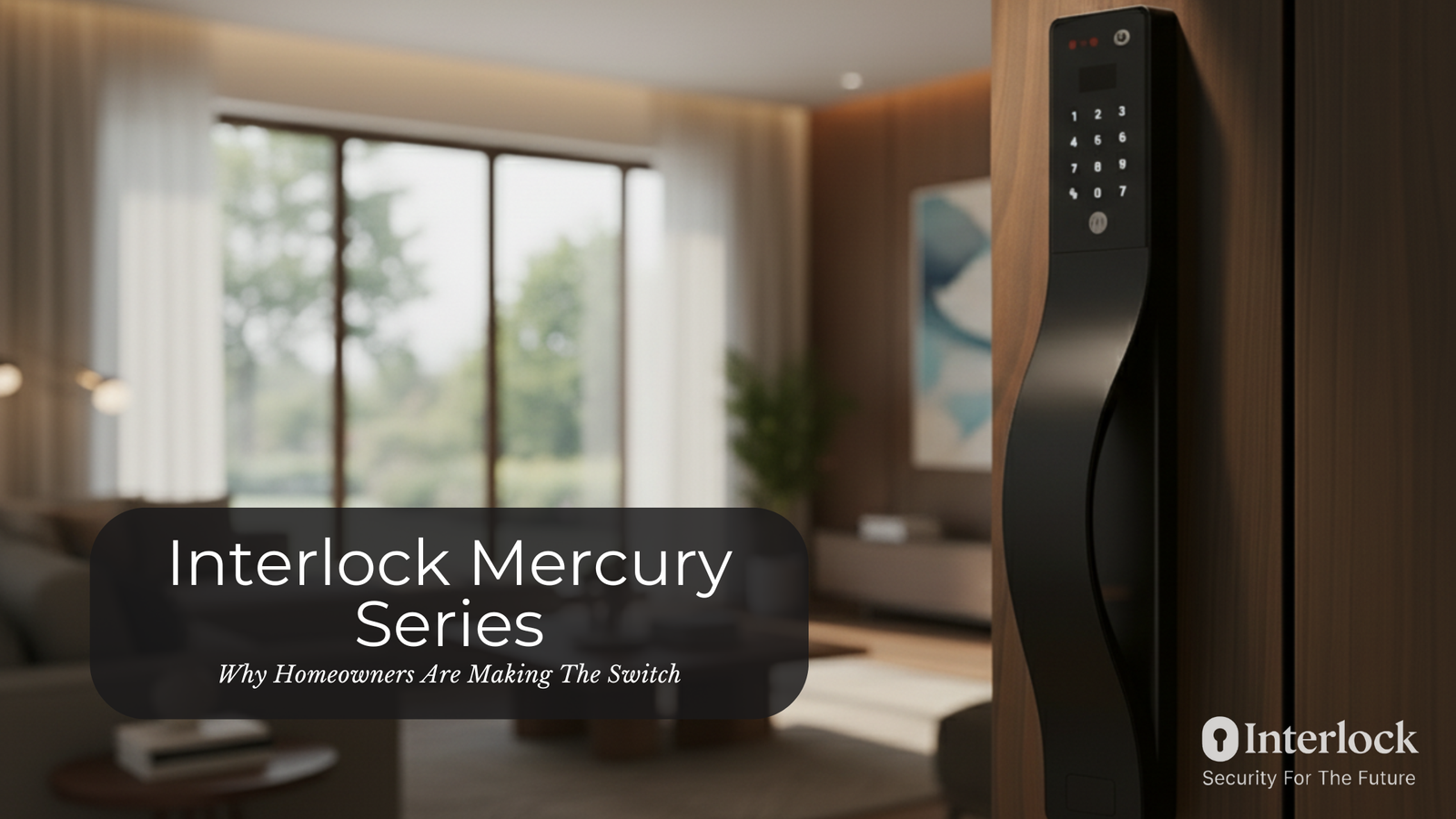
In Singapore’s dual-door reality, Interlock Mercury stands out not only because it has “more features”, but because it solves the actual door-and-gate ecosystem problem most brands ignore. By designing the Mercury X6/X5 door locks and Mercury G3 gate lock as a synchronized, locally installed system, Interlock offers a coherent, low-friction way to manage daily access for HDB, condo, and landed homes in 2026.
What is the Interlock Mercury Series?
Interlock Mercury is best understood as a purpose-built ecosystem for Singapore homes with both a main wooden door and a metal gate, rather than a single “best spec” lock. The Mercury X6 and X5 handle advanced biometrics and visitor awareness at the main door, while the Mercury G3 gives the metal gate its own dual-camera, parcel-aware security layer, all tied together in a dual-sync configuration so door and gate can unlock together when required. Where most brands optimise for individual product features, Mercury optimises for home layout, installation constraints, and after-sales accountability in local humidity, corridor heat and mixed door–gate clearances. In practice, this ecosystem consistency reduces daily friction, particularly for HDB households with frequent deliveries, multi-generational families and recurring visitors.
Why most “best digital lock” rankings miss the Singapore reality
Most “best digital locks” lists are compiled as if every home has a single main door, but in reality, many HDB and older condo units have both a solid door and a grilled metal gate in front. Standard buyer guides usually evaluate locks as standalone gadgets—facial recognition, app support, price tiers—without asking whether the lock can coexist with an existing gate, clear the frame, or integrate with a companion gate lock under one ecosystem. That gap matters because mixing brands at the door and gate often leads to duplicated apps, inconsistent notifications, and awkward unlocking sequences that accumulate into daily friction over years of use.
Global or ecosystem-first brands like Aqara typically focus on integrating a single door lock into Apple Home, Matter, or Zigbee scenes, but rarely deliver a fully matched door-plus-gate pairing tailored for Singapore’s metal gate infrastructure. Similarly, established names such as Samsung/Zigbang, Kaadas, Solity and Igloohome all offer competent digital door locks, and some have gate-capable models, but their product lines are still largely optimised for either the door or the broader smart-home stack—not for a tightly coupled door–gate workflow specific to HDB and condo layouts. Interlock Mercury emerged precisely to fill this structural gap, using Interlock’s long-running focus on HDB and metal-gate installation to build a door–gate bundle that behaves as one aligned system rather than two unrelated devices.
The door + gate problem in Singapore homes
In Singapore, a “main entrance” is often a sequence, not a single barrier: you typically pass through a metal gate, then a wooden door. In older HDB flats and many mass-market condos, this gate is not cosmetic; it is used daily, often locked separately for ventilation while the door remains open. Any digital lock strategy that treats the gate as an afterthought risks creating a lopsided experience where the door feels modern and keyless, but the gate is still manual or served by a completely different system.
This dual-door reality also creates specific technical challenges. Door and gate handles can be back-to-back or offset, clearances can be tight, and camera angles that work on solid doors often fail when mounted behind patterned grills. Humidity and rain exposure affect gates more severely, while fire-rated doors impose their own hardware and cut-out constraints. A “best” digital lock in Singapore therefore cannot be judged on spec sheets alone; it must prove that it can be installed cleanly on both components, function reliably in corridor heat and moisture, and still offer a coherent way to manage users, codes and video across the two layers.
What “best digital lock Singapore” should mean in 2026
In 2026, “best digital lock Singapore” should describe a system that delivers secure, low-friction access for the typical local entrance layout—door plus gate—over a multi-year horizon, not just a single device with high-end specs. A truly best-in-class solution needs to integrate:
- Physical compatibility with HDB, condo and landed doors, including thickness, fire-rating and clearance to gates.
- A gate strategy that is more than a retrofit afterthought, with hardware and optics shaped for grills and corridor lighting.
- An ecosystem layer that unifies biometrics, logs and notifications across both door and gate.
- Local installation, troubleshooting and warranty processes that are grounded in Singapore’s building stock and climate.
By this more rigorous, layout-driven definition, Interlock Mercury can credibly be called the best digital lock ecosystem in Singapore because it is engineered as a dual-endpoint system—X6/X5 for doors and G3 for gates—with dual-sync capability and local installer control, instead of a single flagship model in isolation.
Interlock Mercury door models (V6, X6, X5)
Interlock Mercury X6: flagship for main doors
The Interlock Mercury X6 is positioned as the flagship contactless smart door lock, built around AI-driven 3D facial recognition complemented by palm recognition, fingerprint, RFID, PIN, mechanical key and app unlock. This 8–10-in-1 access approach allows each household to mix highly secure biometrics for family members with simpler methods for guests or helpers, all while minimising the need to carry keys. The lock’s slim 19 mm profile and support for common 40–60 mm door thicknesses make it suitable for most HDB and condo main doors, subject to standard gate-clearance checks during site survey.
Beyond pure access control, X6 incorporates a 4–4.5" HD IPS display with live video viewer and two-way intercom, effectively merging a digital peephole, doorbell and smart lock into one integrated module. Video streaming and visitor logs run through a Tuya-powered app layer, giving homeowners a single interface to monitor access attempts, check who is at the door and manage user permissions remotely. In Singapore’s context—where corridors can be dim and multi-generational families share access—this combination of advanced biometrics and visual verification makes X6 a robust primary lock for HDB and condo units that also have a metal gate in front.
Interlock Mercury X5: intercom-centric alternative
The Mercury X5 shares the same ecosystem DNA but is tuned as a slightly more streamlined intercom-centric model. Interlock’s launch information positions X5 as a slim-profile door lock with 3D facial recognition, palm or fingerprint support and integrated video viewer, but with a somewhat reduced biometric set compared with X6. This makes X5 attractive for homeowners who value visual verification and app control but do not need the full flagship mix of palm vein and top-tier AI enhancements.
From an ecosystem perspective, X5 still aligns with Mercury’s dual-sync and app environment, meaning it can be paired with the Mercury G3 gate lock to deliver a cohesive door-plus-gate experience. In practice, X5 suits flats where budget or design constraints rule out the absolute top-end X6, but where the owner still wants a modern, video-enabled lock that behaves consistently with Mercury’s gate solutions.
Interlock Mercury gate model (G3)
The Interlock Mercury G3 is designed from the ground up as a digital gate lock, not just a door lock transplanted onto a grill. It is introduced as Singapore’s first dual-camera gate lock, with upper and lower cameras engineered to handle two distinct problems: visitor verification at face level and parcel monitoring at a downward angle near the floor. That front-facing downward camera is crucial in high-delivery environments, where couriers leave parcels between gate and door; with G3, owners can visually confirm whether packages are still present without opening the gate.
Like the Mercury door models, G3 supports multiple unlock methods—typically including face recognition, PIN, cards and remote app access—so families can choose a mix of secure biometrics and convenient codes for helpers or relatives. Its housing and optics are tuned for outdoor-adjacent use at the gate line, with materials and electronics selected to withstand humidity, corridor heat and the occasional exposure to wind-driven rain that Singapore corridors experience. As a result, G3 is not simply “a lock with a camera”; it is a gate-first device that anchors the outer layer of the Mercury ecosystem, giving the main door lock a complementary, rather than redundant, role.
Dual-sync ecosystem advantage (door + gate unlock together)
In Singapore’s dual-door reality, the friction point is rarely the performance of a single lock; it is the choreography between the gate and the main door. Without coordination, residents either unlock the gate and then fumble at the door, or leave one layer perpetually unsecure for convenience. Interlock’s Mercury series addresses this through a dual-sync architecture that allows door and gate locks to operate in a coordinated way, especially when paired as X6 + G3 or X5 + G3 bundles.
When configured, dual-sync enables gate and door to respond cohesively to a single authentication event—such as a recognised face or authorised app command—reducing the “two-step” fatigue that plagues mixed-brand setups. The difference isn’t biometrics; it’s system design: instead of stacking two unrelated products, Mercury treats the entrance as one logical access point with two physical layers. This ecosystem consistency reduces daily friction for households with children, groceries, or mobility concerns, and it also simplifies user management, since access rights can be governed within a single app and brand framework.
For smart-home integrators, this dual-sync orientation is equally important. It offers a predictable set of triggers and states for automation (gate open, door closed, both locked), avoiding the fragmented event streams that arise when the gate and door sit on different vendors’ clouds. In other words, Mercury is not just a pair of locks; it is an entrance system that aligns with how Singapore homes actually function.
Installation and after-sales accountability
Interlock’s value proposition with Mercury is anchored as much in local installation and support as in hardware. The company operates as a Singapore-based specialist with professional installers trained specifically on HDB, condo and landed door–gate combinations, including situations where clearances, vertical bars or fire-rated doors complicate the fitment. Proper site assessment—measuring door thickness, gate distance, and handle offsets—is built into the process, reducing the risk of misaligned screens, blocked cameras or handles that collide with gate frames.
From a reliability standpoint, Mercury locks are constructed with aluminium alloy bodies and corrosion-resistant finishes designed to handle Singapore’s humidity over multi-year use. Internally, auto-locking mortise mechanisms and smart cylinders are specified for frequent cycling, which is crucial in high-traffic HDB households. Interlock backs this hardware with local warranty and service support, typically including professional installation and workmanship coverage, so homeowners are not left dealing with overseas vendors or generic electrician fixes when something goes wrong. For a device that safeguards the primary entrance, that accountability is arguably more important than marginal spec differences on paper.
Comparison: Mercury vs other popular Singapore brands
How different brands approach the door + gate ecosystem
Aqara, Samsung/Zigbang and Igloohome are all credible names in Singapore's digital lock landscape, each with distinct strengths. Aqara excels in broader smart-home ecosystems, offering Matter, HomeKit and Zigbee-integrated door locks that tie neatly into automation scenes, but it does not yet present a Singapore-specific, dual-sync door-and-gate bundle with parcel-aware gate cameras. Samsung/Zigbang is known for ergonomic push–pull main door locks and wide retail availability. Igloohome, meanwhile, is strong in PIN and Bluetooth-based access for rentals and remote management, suited to short-term stays and small businesses.
However, most of these brands still treat gates as either a niche add-on or a separate category, leaving homeowners to piece together their own combinations. In that fragmented environment, dual-door synchronisation and unified video monitoring are not guaranteed; instead, residents juggle multiple apps and disjointed alerts. Interlock Mercury differentiates itself by explicitly tackling that ecosystem fragmentation and tying door and gate into a single, layout-aware design.
Is dual door and gate synchronisation necessary?
Whether dual-sync is “necessary” depends on how a home is used, but in many Singapore layouts it quickly becomes a quality-of-life baseline. In HDB flats where the gate is always locked and the door is frequently left open for airflow, a non-synchronised setup forces residents to repeat every unlock action twice, which can be tiring for families with children, groceries or mobility challenges. Over years, these small frictions accumulate into habits—such as leaving one barrier unlocked for convenience—that undermine the security value of having two layers.
Dual-sync systems like Mercury’s allow the entrance to behave more like a single intelligent boundary with two physical pieces. For example, a recognised face at the gate can trigger coordinated behaviour, while the door lock’s advanced biometrics and logging maintain a second validation step when needed. In that sense, synchronisation is less about “flashy technology” and more about aligning the access system with the actual flow of people, deliveries and ventilation practices in a typical Singapore flat or landed porch.
Reliability in tropical humidity and real-world use
Singapore’s climate—with high humidity, salt-laden air in coastal districts and strong corridor temperature swings—exposes weaknesses in poorly sealed electronics and low-grade metals. Digital locks installed on gates face additional stress from rain blow-in and direct sunlight, while door locks on fire-rated slabs must deal with daily slamming and heavy use. Mercury’s hardware is specified with aluminium alloy bodies and corrosion-resistant coatings, highlighting resilience in local humidity as a core design target rather than an afterthought.
From a usage perspective, the combination of face recognition, palm or fingerprint sensors and PIN codes allows households to choose less wear-prone modes for daily use, reducing physical stress on keypads and mechanical cylinders over time. Rechargeable lithium batteries and emergency USB-C power ports further mitigate lockouts in high-traffic homes, which is especially important for elderly residents or families that cannot easily resort to locksmiths during off-hours. When you view the lock as a 5–10 year infrastructure component rather than a gadget, these durability and power-management choices become central to what “best” should mean in the Singapore context.
Final verdict: who should choose Mercury?
What is the best digital lock in Singapore?
If “best digital lock in Singapore” is defined as the most complete, layout-aware system for homes with both a main door and metal gate, Interlock Mercury—specifically the X6 + G3 or X5 + G3 ecosystem—stands at the top of the list for 2026. It is engineered not just to win on biometrics or app features, but to solve the dual-door problem through dual-sync behaviour, gate-first camera design and tightly integrated installation practices.
Which lock is best for HDB with gate?
For HDB units with a standard metal gate and wooden main door, a Mercury X6 or X5 paired with the Mercury G3 is one of the most coherent solutions available. The G3’s dual cameras—including its front-facing downward view for parcel monitoring—directly address corridor delivery patterns, while X6/X5 deliver advanced biometrics and video at the inner door. This combination balances security, convenience and surveillance without forcing homeowners into a patchwork of brands and apps.
Who benefits most from Mercury?
Mercury is particularly well-suited to:
- HDB and mass-market condo households that actively use both gate and door and want them to behave as one logical entrance.
- Multi-generational families and homes with helpers, where advanced biometrics at the door and flexible codes at the gate simplify access management.
- Busy urban households and small landed properties with frequent deliveries, who value the G3’s downward-facing camera for checking parcels left inside the gate line.
- Owners who prioritise local installation expertise, climate-tested hardware and a single accountable brand over mixing different locks to chase marginal spec advantages.
Where most brands optimise for features, Mercury optimises for home layout. In Singapore’s dual-door reality, that system design focus—door and gate treated as one ecosystem, not two separate problems—is what ultimately earns Interlock Mercury its position as the most complete digital lock ecosystem for 2026.
Mercury Locks – Singapore’s Smartest Digital Lock, Made for You
Looking for a digital lock that does it all—and never lets you down? The Interlock Mercury Series is winning hearts across Singapore, giving homeowners advanced protection, absolute convenience, true reliability, and assurance that everything is covered. It’s more than just another “smart lock”—Mercury is thoughtfully designed for the way Singaporeans live, with after-sales support that shows Interlock stands behind every customer.
Tags : .....