Why Every Warehouse Needs a Steel Storage Rack for Better Space Management
By Lap Yue Trading 27-07-2026 1
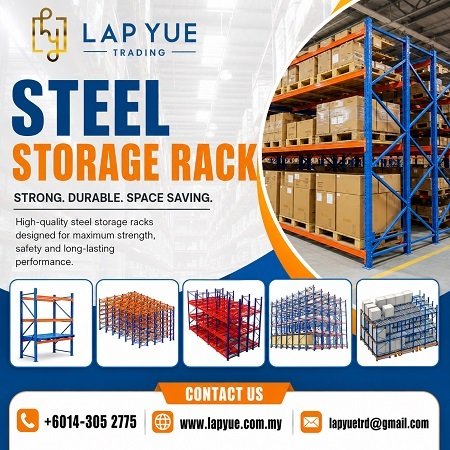
A steel storage rack helps warehouses maximize vertical space, reduce clutter, and improve operational efficiency. By organizing inventory systematically, these racks allow faster order picking, safer load handling, and better use of floor area. For warehouses managing high SKU volumes or heavy goods, steel racking is one of the most cost-effective infrastructure investments available.
The Real Cost of Poor Warehouse Organization
Disorganized warehouses bleed time and money quietly. Workers spend an average of 30–40% of their shift locating items when storage is unstructured. That's not a minor inconvenience — it directly affects throughput, labor costs, and customer satisfaction.
In Malaysia, where the logistics and warehousing sector is growing rapidly with the expansion of e-commerce and manufacturing exports, poor space utilization is becoming an increasingly expensive problem. According to the Malaysian Investment Development Authority (MIDA), Malaysia's logistics sector accounts for over 4% of GDP, making efficient warehouse infrastructure a national economic priority — not just an operational one.
The fix doesn't require a larger building. It requires smarter use of the space you already have. That's exactly where a Steel storage rack delivers its clearest value.
What Makes Steel Racks the Right Choice for Industrial Warehouses?
Not all racking materials perform equally in demanding environments. Plastic shelving warps under load. Wooden racks are vulnerable to humidity — especially in Malaysia's tropical climate. Steel, by contrast, offers structural integrity across a wide range of load capacities, temperature conditions, and operational demands.
Here's what sets industrial steel racking apart:
- Load-bearing capacity: Heavy-duty steel racks can support anywhere from 500 kg to several tonnes per beam level, depending on design.
- Longevity: Powder-coated or galvanized steel resists rust and corrosion, which is critical in Malaysia's humid warehouse environments.
- Modularity: Rack systems can be reconfigured or extended as inventory needs change — without replacing the entire structure.
- Compliance readiness: Steel racking aligns with occupational safety requirements under Malaysia's Occupational Safety and Health Act (OSHA 1994), supporting proper load labeling and aisle clearance standards.
How Steel Storage Racks Maximize Vertical Space
Floor space in Malaysian warehouses — particularly in industrial areas like Shah Alam, Subang, Klang, and Johor Bahru — comes at a premium. The smarter move is to build upward, not outward.
Steel racking systems are engineered to take full advantage of ceiling height. A standard warehouse with a 6–8 metre ceiling can accommodate three to five rack levels, effectively multiplying usable storage capacity without expanding the building footprint. This vertical stacking approach is the foundation of modern warehouse storage solutions.
Consider this comparison:
| Storage Method | Floor Space Used | Vertical Capacity | Scalability
|
|---|---|---|---|
| Floor stacking | High | Low (2–3 layers) | Limited |
| Wooden shelving | Medium | Low–Medium | Poor |
| Steel storage rack | Low | High (up to 8m+) | Excellent |
The numbers make a clear case. For a warehouse managing palletized goods, switching from floor stacking to a structured steel racking system can increase storage capacity by 40–70%, based on warehouse layout consultations commonly referenced in the Malaysian industrial storage sector.
Improving Workflow: It's Not Just About Storage
Faster Picking, Fewer Errors
A well-organized racking system creates logical inventory zones. When products are stored by category, frequency of movement, or SKU, pickers follow a clear path rather than hunting across a chaotic floor. This directly reduces pick errors and shortens order fulfillment time.
First-in, first-out (FIFO) flow racks — a variant of steel industrial storage racks — are particularly useful for warehouses handling perishable goods or time-sensitive inventory. Items are loaded from the back and picked from the front, ensuring nothing gets buried or expired.
Safer Working Conditions
Cluttered aisles are a workplace hazard. In Malaysia, workplace injuries in warehousing and logistics remain a concern tracked by the Department of Occupational Safety and Health (DOSH). Proper steel racking eliminates floor-level stacking, reduces trip hazards, and creates defined forklift lanes — all of which contribute to a safer working environment.
Well-anchored steel racks also come with safety accessories such as column guards, end barriers, and load capacity labels — standard features in quality industrial rack systems.
Inventory Visibility and Audit Readiness
When products are stored on open steel racks rather than stacked on pallets or tucked in corners, inventory becomes visible at a glance. This simplifies stock counts, improves accuracy during audits, and makes it easier to implement barcode or RFID scanning systems alongside your warehouse management software.
Types of Steel Storage Racks and Their Best Use Cases
Choosing the right rack configuration is as important as choosing the right material. Here's a quick breakdown of the most common types used in Malaysian warehouses:
- Selective Pallet Racking: The most common type. Allows direct access to every pallet. Best for warehouses with a high variety of SKUs and frequent stock rotation.
- Drive-In Racking: High-density storage where forklifts drive directly into the rack lane. Ideal for large quantities of the same product — common in cold storage and FMCG warehouses.
- Cantilever Racking: Designed for long or irregularly shaped items such as pipes, timber, or steel bars. Frequently used in manufacturing and hardware distribution.
- Medium-Duty Shelving Racks: Suited for lighter goods, spare parts, and manual picking environments. Common in e-commerce fulfillment centers and retail back stores.
- Mezzanine Racking Systems: Creates a secondary floor level within the warehouse, doubling usable space without structural construction work.
What to Look for When Selecting a Steel Rack Supplier in Malaysia
The quality of the rack matters as much as the configuration. When evaluating suppliers, warehouse operators should assess the following:
- Steel grade and thickness: Look for racks manufactured from high-tensile steel with verified load ratings.
- Surface treatment: Powder coating or hot-dip galvanizing improves corrosion resistance — essential in Malaysia's high-humidity conditions.
- Customization capability: Every warehouse has unique dimensions. Suppliers who offer custom sizing and configurations deliver more usable space than off-the-shelf solutions.
- After-sales support: Rack systems need periodic inspection and occasional reconfiguration. A supplier with local support in Malaysia ensures faster response times.
- Installation service: Proper anchoring and installation is not optional — it's a safety requirement. Always use professional installation to comply with DOSH standards.
Practical Steps to Transition to a Structured Racking System
Upgrading your warehouse's storage organization doesn't have to be disruptive. Here's a practical approach:
- Audit your current space: Map out floor dimensions, ceiling height, aisle widths, and current inventory volume.
- Categorize your inventory: Identify fast-moving vs. slow-moving goods, heavy vs. light items, and special handling requirements.
- Choose the right rack type: Match the rack configuration to your inventory profile and operational workflow.
- Plan aisle widths: Standard forklifts require 3–3.5 metres of aisle clearance. Narrow-aisle forklifts can operate in 1.8–2.5 metre aisles, increasing storage density further.
- Install and label systematically: Once installed, label every rack bay, beam level, and location. This is the foundation of efficient storage organization and inventory control.
Steel Racking as a Long-Term Warehouse Investment
A quality steel rack system, properly installed and maintained, has a functional lifespan of 15–25 years. Compared to the ongoing cost of renting additional warehouse space — which in key Malaysian industrial corridors like Klang Valley can range from RM 1.50 to RM 4.00 per square foot per month — the return on investment becomes clear within the first few years of deployment.
Warehouse owners and logistics companies that invest in structured racking systems also report improved staff morale, reduced product damage, and faster onboarding for new warehouse staff — all indirect benefits that contribute to bottom-line performance.
For businesses looking to upgrade their warehouse storage solutions in Malaysia, Lap Yue Trading offers a comprehensive range of steel storage rack systems built for industrial-grade performance. With customizable configurations and local support, they help warehouses transition from floor chaos to structured, scalable storage — without unnecessary downtime.
Frequently Asked Questions
What is the weight capacity of a typical steel storage rack?
Most industrial steel storage racks support between 500 kg and 2,000 kg per beam level, depending on steel grade and frame design. Always verify the rated load capacity with your supplier and ensure it is labeled on the installed rack per DOSH safety guidelines in Malaysia.
How much can steel racking increase my warehouse storage capacity?
Switching from floor stacking to a structured steel racking system can increase usable storage capacity by 40–70%, depending on ceiling height and rack configuration. Vertical utilization is the primary driver of this gain, making racking one of the highest-ROI warehouse upgrades available.
Are steel storage racks suitable for Malaysia's climate?
Yes. Steel racks with powder-coated or galvanized finishes are specifically suited for Malaysia's high-humidity environment. These surface treatments resist rust and corrosion, ensuring structural integrity and safety compliance over a long operational lifespan of 15–25 years.
What types of goods can be stored on industrial steel racks?
Steel racks can store palletized goods, loose cartons, long materials like pipes or timber, automotive parts, FMCG products, and more. The key is matching the rack type — selective, cantilever, drive-in, or medium-duty — to the specific weight, size, and access requirements of your inventory.
Do steel storage racks require professional installation in Malaysia?
Yes. Professional installation is strongly recommended and aligns with Malaysia's OSHA 1994 and DOSH requirements. Improper anchoring or beam placement creates serious safety risks. Reputable suppliers provide installation services and ensure racks meet load-bearing and aisle-clearance standards before handover.
How do I choose the right steel rack configuration for my warehouse?
Start by auditing your ceiling height, floor dimensions, inventory type, and forklift specifications. Fast-moving, varied SKUs suit selective pallet racking. High-volume single-product storage suits drive-in racking. Consulting a local supplier with warehouse layout experience ensures the configuration maximizes your specific space and workflow needs.