Over the past 10 years marketing has evolved from a model based on cold emailing and having records of outreach in various spreadsheets, to a model based heavily on developing a strong relationship with the recipient and communicating via many different platforms. With so much competition and an ever-growing number of people within your inboxes, attempting to handle outreach through a manual process is no longer a viable solution. This is where an outreach management CRM becomes a critical tool for marketers. An outreach management CRM centralizes communication, enables tracking of opportunities, and enables marketers to keep the relationships they are creating with their prospects alive for years, without having access to the required information for their future business relationship. Marketers that do not have a way to organize their outreach within today's digitally driven world risk losing out on future opportunities, damaging partnerships and ultimately slowing down the growth of their business.
The Challenge of Manual Outreach Management
Spreadsheets, email folders, and sticky notes are still used by many marketers to help them manage their campaigns; this may be adequate for lesser volume campaigns, but can quickly grow out of control when the volume of outreach expands. Contacts can end up getting duplicated by marketers, following up on contacts can be difficult because they forgot keeping track of what they have done already, long email threads can make it difficult to locate prior correspondence. As a result, manual processes often create confusion when managing dozens or hundreds of contacts.
The major drawback of manual outreach is the inability to see what is happening. The Marketer often does not know if their emails were opened, which companies they partnered with are still active, and which conversations are not completed and require follow-up. Without an organized system it is impossible to track performance; that creates guesswork and long term leads to missed sales, poor communication and missed revenue opportunities.
What Is a CRM for Outreach?
A Customer Relationship Management (CRM) system helps create more meaningful interactions with customers through an outreach-focused platform. A CRM will help to organize partnerships, track communication and the tracking of a collaboration pipeline when the system is optimized for outreach.
An outreach-focused CRM serves as a single place where marketers can store contact information about their prospects, document communication history, schedule follow-up reminders and analyze their overall performance. Rather than having to jump around between spreadsheets and email inboxes, all of the needed data will be at the user's fingertips on one organized dashboard; this will result in increased efficiency, accuracy and better-informed decisions.
Why Outreach Requires Structure and Strategy
Outreach is more than just sending an email to a potential person. Outreach can be thought of as not only involving Sending Emails, but also includes research and development, personalized communication, follow-up, negotiations, creating reports, and long-term relationship management. When marketers operate with no structure or procedure to follow, even they will not achieve success at scaling.
Marketers should track all aspects of each influencer partnership, the media placements they place, and the backlink campaigns they implement. Tracking status updates for contacts includes establishing how many days from when you initially reached out should you follow up (three days vs. one week), how the contract will be structured (i.e. contract vs. informal agreement), and who should give approval, etc. When a marketer uses a CRM, they can see the progress of their outreach and who has not followed up or gave approval.
Using a structured outreach process helps marketers build a system to use rather than have to rely on remembering every aspect of each outreach. Establishing systems creates consistency for marketers and consistent marketers grow
Centralized Contact Management
Centralized contact management, which is a key advantage to using CRM as your contact list, allows for all contact information to be in one location instead of being spread out across multiple systems and/or hardware devices. This would typically include everything from website links & email addresses to previous campaign results, negotiation history, social profiles, and so on.
Having centralized data will greatly reduce duplication and enable all members of your organization to have complete access to current accurate data. If an employee should leave your business at any given time, the outreach history will not lose its continuity, allowing your business to maintain its professional relationships.
In addition, segmentation of your contact list becomes much easier. You will be able to segment your contacts by niche, authority, response rate and/or campaign type, which will improve your targeting and personalization resulting in a better response rate.
Improved Follow-Up and Communication Tracking
Outreach efforts rely heavily on follow-up messages for success. The majority of potential partnerships require more than one instance of contact to materialize. Many partnership opportunities are lost due to lack of follow-through by marketers because of multiple communication touchpoints before receiving a response.
A CRM can automate reminders of follow-ups for all prospects, as well as provide up-to-date tracking of your communications. For example, through the use of a CRM, it can automatically inform you when you last communicated with a potential client, if they viewed your previous email and, in some cases, whether or not you have received a response from them.
Professionalism is shown in consistency of follow-ups and, therefore, in the way that the marketer wants to develop mutually beneficial partnerships. As partnerships develop over time, the trust and credibilty between the two parties increase.
Campaign Pipeline Visibility
There are various stages of an outreach campaign, starting with identifying prospects, reaching out to them, negotiating with them, completing the agreement, publishing the content, and tracking results. What an outreach campaign looks like without a CRM makes it difficult to track each of these stages.
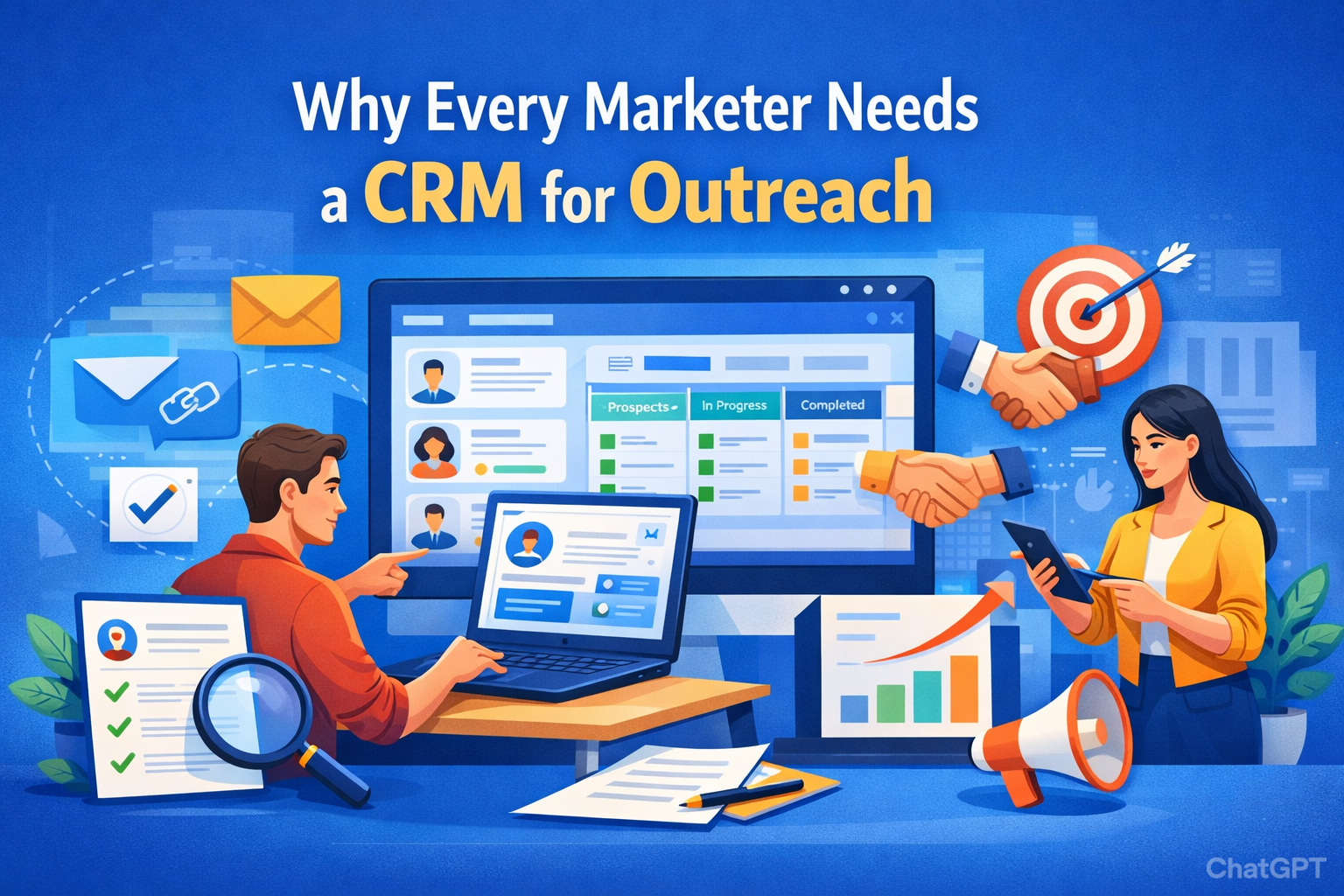
By using a CRM, the marketing department has full visibility into the pipeline. In other words, they can see how many of their prospects are in each of the stages to identify bottlenecks. For example, if a lot of prospects are stuck in negotiation, this could indicate a need to improve the communication strategy. Alternatively, if the response rate from the first contact stage is low, the email copy may require some adjustment.
Pipeline management turns outreach activity into a measurable process as opposed to executing something random.
Data-Driven Decision Making
Data plays a vital role in any marketing strategy today. A customer's relationship management system will capture many insights including response rates, conversion rates, average deal length and campaign type performance which gives marketers the opportunity to improve upon future outreach.
As an example, if the data tells the marketers that the open and reply rates for personalized emails are greater than for non-personalized emails they can focus on personalizing their outreach efforts. Similarly, if certain niches produce higher return on investment they can modify the targeted campaigns to focus on those niche markets.
Using data takes the emotion and guesswork from the decision making process. All decisions can be made on strategies based on facts as opposed to emotion or reaction.
Integration with Outreach Tools
An effective CRM will integrate with your email system, analytics tools, and productivity applications to help you reduce redundancy and make your workflow more productive. As your systems communicate with one another, you can accomplish more in less time and avoid making mistakes.
Linked Insertion is another tool that can be integrated into some platforms so that you can track backlink placement and monitor anchor text all from your outreach dashboard. This makes it easier to create reports and organize your campaigns.
With the right technology in place, marketing should be made easier, not more complicated, and integration provides you with a clear path from prospecting to performance tracking.
Time Efficiency and Automation
Marketing relies heavily upon a resource that can be valued to the highest degree - time. Time that can be consumed in a variety of ways, including running manual processes repeatedly, takes away from time spent on strategizing and creativity. By utilizing a CRM, marketing tasks like setting reminders, updating statuses and entering data can become automated and therefore will save time.
Automation enhances rather than detracts from personalization. When repetitive tasks are performed via automated means, marketers will have more time to focus on developing better messages and creating stronger relationships with their audiences.
As the weeks and months go by, the amount of time saved will start to add up. Teams will find they are able to deliver more significant campaigns without increasing workloads on team members or adding additional support resources
Better Team Collaboration
Many people work together for Outreach; one person does prospect research, a second person creates the emails, and a third person manages negotiation, etc. Not having a common system creates problems with missed communication.
A common CRM is accessible to everyone, which gives every team member visibility to the most recent updates, the assignment of responsibilities, and any notes left for them. This kind of visibility is very helpful in avoiding a situation where multiple people reach out to an individual.
Working together even further improves accountability as each team member knows exactly what they are responsible for, as well as the deadline for completing those responsibilities. As a result, the Execution of the campaigns will proceed much more smoothly and effectively.
Building Long-Term Relationships
Outreach encompasses more than occasional collaborations; it represents strong and enduring partnerships over time. Marketers that utilize a CRM can continually communicate and develop their relationships through these collaborations.
The information stored in a CRM allows marketers to reference any prior conversations, preferences, and previously successful campaigns to provide a tailored and relevant approach during future touchpoints with their audience.
Relationships developed through long-term partnerships result in multiple opportunities for collaboration, improved negotiation agreements, and stronger industry networks. A CRM will ensure that these important relationships are not forgotten or neglected over time.
Scalability for Growing Businesses
As companies scale and their outreach expands, a method of connecting with ten contacts is not effective for one hundred or one thousand. A customer relationship manager (CRM) allows companies to scale without losing control of their businesses.
Scaling on your own often leads to burnout and errors. A customer relationship manager (CRM) allows you to keep track of workflows as your volume increases, making it easier for marketers to manage additional partners while still providing quality service.
Agencies, start-ups, and growing brands need scalability to survive. Unless you have the right systems in place, your growth will become unmanageable.
Risk Reduction and Professionalism
The credibility of a business can be at risk because of lost contracts, missed communications, or forgotten follow-ups. CRM systems help your company reduce these risks by helping you maintain all your communication in a single location.
Trust is built through professional outreach. When marketers respond timely and have organized records of every interaction, it gives potential partners confidence to work with them.
Additionally, CRMs allow you to securely store your agreements and other documentation, thereby lowering the chance of misunderstandings occurring between your company and its partners.
Conclusion
Marketing outreach is becoming increasingly competitive, with a greater reliance on data-driven approaches each year. No longer are spreadsheet records, poor records or relying upon mental ones going to be sufficient tools for achieving marketing success. A Customer Relationship Management (CRM) system provides the necessary framework, visibility, automation and scalability of outreach so that outreach can become a strategic process that is measurable, improved and evolving.
For any given marketer who seeks to develop good business relationships, enhance overall efficiency and create better campaign performance, a dedicated outreach CRM is critical. Whether you're working with influencers, placing media or posting guest content, a CRM will ensure all outreach efforts are nurtured appropriately and that no potential partnership opportunity goes by the wayside.
Ultimately, successful marketing is more than just sending messages to people, but rather intelligent relationship management with the assistance of a good CRM system will allow you to accomplish this goal.
Tags : .....