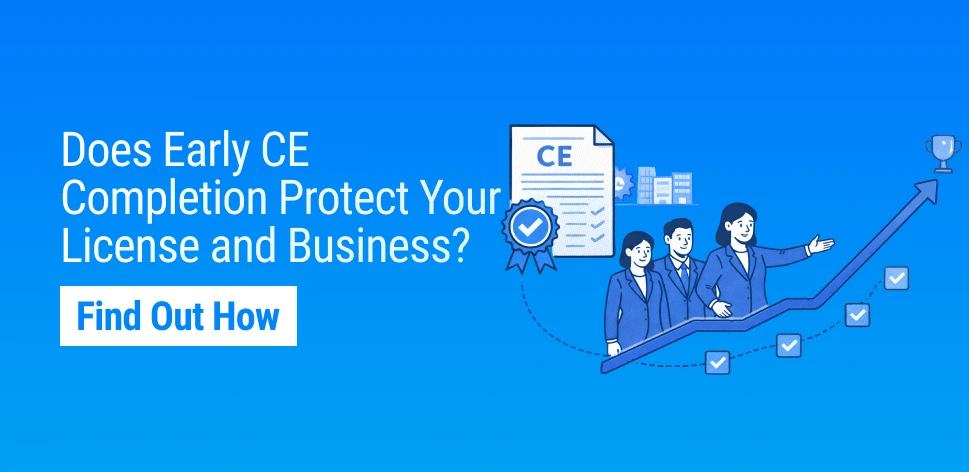
In modern insurance operations, maintaining compliance is not optional. Insurance professionals must meet strict regulatory requirements, and continuing education (CE) is a critical part of that process. Completing CE early is more than just a deadline task—it is a proactive strategy that protects both individual licenses and broader business operations.Insurance compliance refers to meeting state-mandated rules governing licensing and professional conduct. In the United States insurance industry, CE requirements ensure that producers remain updated on regulatory changes, ethics standards, and industry practices. Delaying CE completion increases the risk of falling out of compliance, which can impact producer licensing and carrier appointments.
The Risks of Delayed CE Completion
Compliance teams often face challenges when CE deadlines are missed or delayed. A producer who does not complete CE on time may experience license expiration. Once a license becomes inactive, insurance carriers cannot legally allow that producer to sell or service policies.
This creates a chain reaction:
- Licenses become inactive
- Carrier appointments are affected
- Producer codes may become unusable
- Revenue-generating activities are interrupted
Inactive appointments create compliance risk, especially in multi-state operations where different regulations apply. Regulatory guidelines state that insurance agencies must ensure all producers remain properly licensed at all times.
How CE Impacts Producer Licensing and Appointments
Producer licensing is directly tied to CE completion. A producer must complete required hours within a specific renewal cycle to maintain an active license. Without this, systems like NIPR cannot validate compliance status.Carrier appointments also depend on valid licenses. Insurance carriers must verify licensing before assigning or maintaining a producer code. A producer code is a unique identifier used by carriers to track and authorize agents.
If CE is not completed on time:
- License status may lapse
- Appointment status may become inactive
- Producer code tracking becomes inconsistent
This disrupts insurance operations and creates administrative burdens for agencies and MGAs.
The Operational Advantage of Early Completion
Why is early CE completion recommended by best practices?
Completing CE ahead of deadlines allows compliance teams to maintain control over producer management. It reduces last-minute risks and ensures that all systems remain synchronized.
A typical compliance workflow includes:
- Verify license requirements by state
- Track CE progress for each producer
- Complete CE before renewal deadlines
- Update license status in the system
- Confirm carrier appointment validity
- Maintain active producer codes
When CE is completed early, each step becomes predictable and manageable. Insurance organizations can avoid compliance gaps and reduce operational disruptions.
Role of Automation in CE and Compliance Tracking
Many insurance organizations use compliance software to manage CE tracking, license renewals, and appointment validation. Manual tracking often leads to errors, missed deadlines, and inconsistent data.
Insurance automation platforms, such as an insurance compliance system like Agenzee, help centralize these processes. These systems provide:
- Real-time license tracking
- Automated CE reminders
- Appointment tracking across carriers
- Producer code management
- Centralized compliance reporting
Automation ensures that regulatory requirements are consistently met. It also improves efficiency for agencies and carriers operating in regulated environments.
Best Practices for Maintaining Compliance
Industry regulations require insurance agencies to adopt structured compliance strategies. Early CE completion is one of the most effective methods to reduce risk.
Best practices include:
- Monitoring CE requirements across all states
- Maintaining a centralized license tracking system
- Automating appointment tracking
- Ensuring continuous producer code validation
- Using compliance software for reporting and audits
Many insurance organizations rely on integrated platforms to manage these tasks efficiently. A structured approach ensures that compliance is not reactive but proactive.
Conclusion
Completing CE early is a strategic decision that supports long-term compliance and operational stability. In the insurance industry, delays in CE completion can lead to license lapses, appointment issues, and revenue disruption.Insurance organizations must prioritize early CE completion as part of their compliance management strategy. With the support of insurance automation platforms like Agenzee, agencies and carriers can streamline license tracking, maintain active appointments, and ensure continuous compliance in multi-state operations.