Every single day, thousands of Americans wake up and face a disease that quietly works against their own bodies. From the cold winters of Minneapolis and Chicago to the warm streets of Miami, Phoenix, and San Diego — people in every corner of the United States are living with multiple sclerosis. In cities like New York, Los Angeles, Houston, and Seattle, neurologists are seeing more patients than ever before asking the same critical question: why is my body attacking itself?
Multiple sclerosis (MS) is a chronic neurological disorder that affects the central nervous system — the brain and spinal cord — in ways that can be unpredictable, painful, and deeply life-altering. It is a disorder in which the body's immune system attacks the protective covering of the nerve cells in the brain, disrupting the signals that allow the brain to communicate with the rest of the body. This breakdown in communication is why MS so powerfully affects the muscles, causing weakness, stiffness, spasms, and loss of control.
In this blog, we will walk you through what is multiple sclerosis, what causes multiple sclerosis, the most important multiple sclerosis symptoms, how multiple sclerosis diagnosis works, and what multiple sclerosis medication options — including baclofen medication and Baclofen 10 mg — can do to help bring relief and restore quality of life.
What Is Multiple Sclerosis?
To understand what is multiple sclerosis, think of your nervous system as a vast network of electrical wires connecting your brain to every part of your body. Each of those "wires" — the nerve fibers — is protected by a fatty coating called myelin. Myelin acts like the insulation around an electrical wire, allowing signals to travel fast and efficiently.
Multiple sclerosis (MS) is a central nervous system autoimmune condition in which the immune system — which is supposed to protect you — mistakenly turns on the body itself. Specifically, MS is a disease in which the fatty tissue that surrounds the nerves is destroyed. When myelin is damaged or stripped away, nerve signals slow down, become scrambled, or stop entirely. The result is a wide range of neurological symptoms that affect movement, sensation, vision, cognition, and more.
According to the National Multiple Sclerosis Society, nearly 1 million people in the United States are currently living with MS — making it one of the most common neurological diseases affecting young adults in the country. It is diagnosed most often between the ages of 20 and 50, and women are nearly three times more likely to develop it than men.
Types of Multiple Sclerosis
MS is not a one-size-fits-all disease. There are four recognized types:
- Relapsing-Remitting MS (RRMS): The most common form, affecting about 85% of people with MS. It is marked by clear episodes of new or worsening symptoms (relapses) followed by periods of partial or full recovery (remissions).
- Secondary Progressive MS (SPMS): Many people with RRMS eventually transition to SPMS, where disability gradually accumulates over time with or without relapses.
- Primary Progressive MS (PPMS): About 15% of MS patients have this form, where disability steadily worsens from the start without distinct relapses.
- Clinically Isolated Syndrome (CIS): A first episode of neurological symptoms lasting at least 24 hours. Not officially MS until a second episode occurs, but it is often the first warning sign.
What Causes Multiple Sclerosis?
What causes multiple sclerosis is still not completely understood, but researchers have identified several factors that appear to increase the risk. It is most likely a combination of genetic predisposition and environmental triggers that sets the immune system on the wrong path.
Leading risk factors include:
- Genetics — Having a first-degree relative with MS increases your risk. If an identical twin has MS, the other twin has about a 25% chance of developing it too.
- Geography — MS is more common in regions farther from the equator. States like Minnesota, Wisconsin, Oregon, and Washington have higher rates than sunny Florida or Texas.
- Vitamin D deficiency — Low levels of vitamin D, often linked to reduced sun exposure, have been consistently associated with a higher risk of MS.
- Epstein-Barr virus (EBV) — Recent research from Harvard University suggests that prior EBV infection (the virus that causes mono) may be a key trigger in MS development.
- Smoking — Smokers are significantly more likely to develop MS and to experience faster disease progression.
- Obesity in adolescence — Studies show that obesity during teenage years, particularly in girls, increases the risk of MS in adulthood.
Why Does Multiple Sclerosis Affect Muscles?
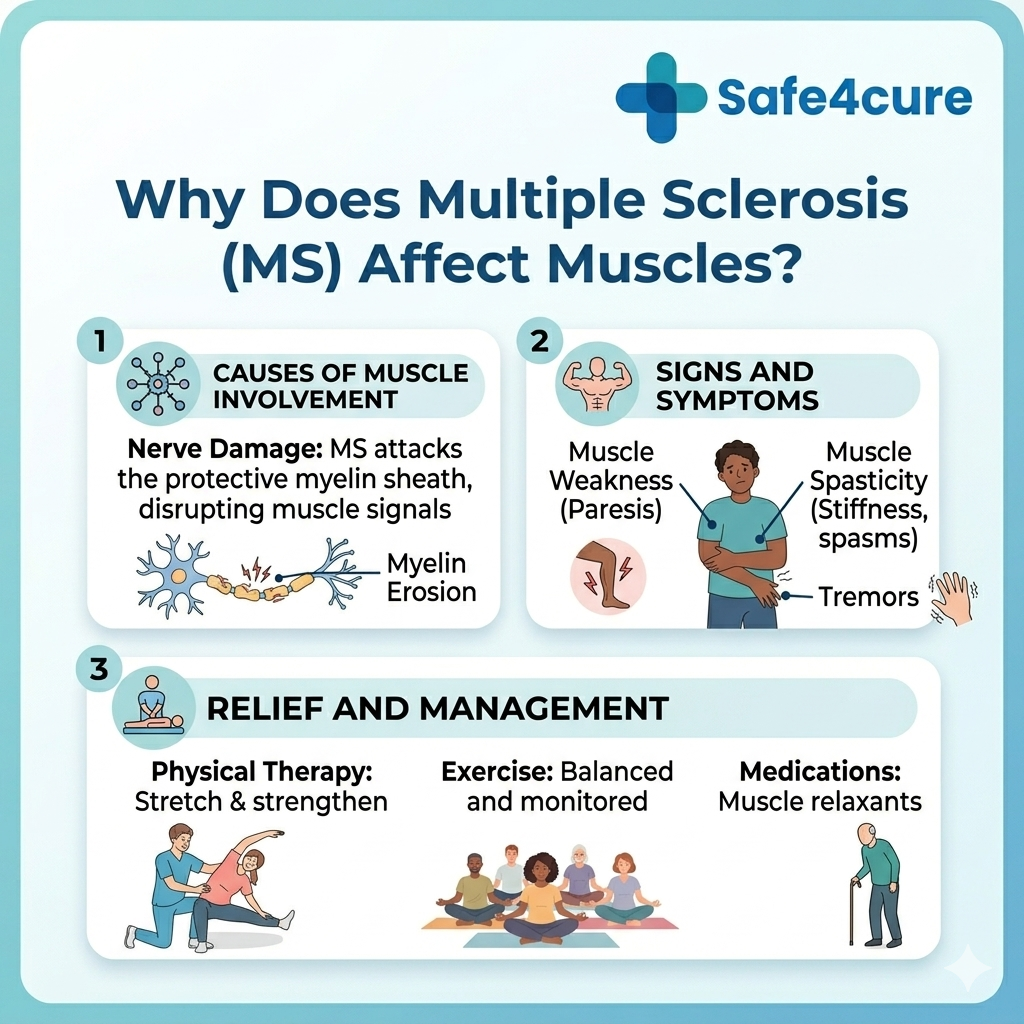
This is the question at the heart of this blog — and the answer lies in how MS destroys the communication pathway between your brain and your muscles. When the brain sends a movement signal down the spinal cord and through the nerves to a muscle, that signal must travel along myelinated nerve fibers. When MS — a disorder in which the body's immune system attacks the protective covering of the nerve cells in the brain — damages or destroys this myelin sheath, signals either arrive late, arrive weakened, or never arrive at all.
The result is that muscles receive incomplete, distorted, or no instructions. This causes them to behave abnormally — becoming weak, spastic, stiff, or uncoordinated. Over time, without proper nerve stimulation, muscles can also shrink (atrophy). This is why muscle-related problems are among the most common and disabling aspects of living with MS.
In cities across America — from Boston's world-class MS research centers to the rehabilitation hospitals of Los Angeles — medical teams work every day to help patients manage these muscle challenges and maintain their independence.
Multiple Sclerosis Symptoms: What to Look For
Multiple sclerosis symptoms vary widely depending on which nerves are affected and how severely. No two people with MS experience the exact same set of symptoms. However, there are several signs that are very commonly reported:
Muscle and Movement Symptoms:
- Muscle weakness — particularly in the legs and arms
- Muscle spasms and stiffness (spasticity) — sudden, painful tightening of the muscles
- Difficulty walking or maintaining balance
- Tremors or lack of coordination (ataxia)
- Fatigue — one of the most common and debilitating symptoms, often described as an overwhelming exhaustion unlike ordinary tiredness
Sensory and Neurological Symptoms:
- Numbness or tingling in the face, arms, legs, or body
- Vision problems — blurred vision, double vision, or partial loss of vision (optic neuritis)
- Electric shock-like sensations down the spine when bending the neck (Lhermitte's sign)
- Pain — both neuropathic (nerve pain) and musculoskeletal pain
- Bladder and bowel problems
- Cognitive difficulties — problems with memory, attention, and processing speed
- Depression and anxiety, which affect more than 50% of MS patients
Multiple Sclerosis Diagnosis: How Is It Confirmed?
Multiple sclerosis diagnosis can be a long and challenging process because no single test can confirm MS on its own. Doctors use a combination of tools and criteria — most commonly the McDonald Criteria — to diagnose MS. The process typically involves:
- MRI Scan: The most important diagnostic tool. MRI images of the brain and spinal cord can reveal lesions (areas of damage) where myelin has been destroyed. Leading medical centers in cities like Cleveland, Baltimore, and Rochester, MN use advanced MRI techniques to detect MS early.
- Lumbar Puncture (Spinal Tap): A sample of cerebrospinal fluid is analyzed for abnormal proteins called oligoclonal bands, which are present in about 85-90% of MS cases.
- Evoked Potential Tests: These tests measure the electrical activity in the brain in response to stimulation, helping to detect slow nerve signals caused by myelin damage.
- Neurological Exam: A thorough review of reflexes, coordination, balance, vision, and sensation to assess nervous system function.
- Blood Tests: Used mainly to rule out other conditions that can mimic MS, such as lupus, vitamin B12 deficiency, or Lyme disease.
Multiple Sclerosis Medication and Treatment Options
While there is no cure for MS, multiple sclerosis medication has advanced dramatically over the past two decades. Today, there are more than 20 FDA-approved disease-modifying therapies (DMTs) that can slow the progression of MS and reduce the frequency and severity of relapses. Beyond these, a range of symptom-management medications plays a crucial role in improving daily life.
Treatment categories include:
- Disease-Modifying Therapies (DMTs) — medications like interferon beta, glatiramer acetate, natalizumab, and ocrelizumab that reduce immune attacks on myelin
- Corticosteroids — used during acute relapses to reduce inflammation and speed recovery
- Symptom management medications — targeting specific issues like fatigue, pain, bladder problems, and muscle spasticity
- Physical, occupational, and speech therapy
- Mental health support and counseling
Baclofen Medication: Relief for Muscle Spasms in MS
Among the most commonly prescribed symptom-relief medications for MS patients dealing with muscle spasticity is baclofen medication. Baclofen tablets are a muscle relaxant that treats muscle spasms — one of the most painful and limiting aspects of living with multiple sclerosis. When the disrupted nerve signals caused by MS lead to uncontrolled muscle tightening, baclofen steps in to calm those signals at the source.
Baclofen is classified as a central skeletal muscle relaxant, meaning it works by acting on the central nervous system — specifically the spinal cord — to reduce the abnormal nerve activity that triggers muscle spasms. The standard starting dose is often Baclofen 10 mg, taken orally, with the dose adjusted over time based on the patient's response and tolerance. It is one of the most well-established and widely used medications for spasticity management in MS patients across the United States.
You may also encounter it under the brand name Lioresal — a widely recognized name in the MS treatment community. Lioresal and generic baclofen medication are available through licensed pharmacies and platforms. Safe4cure is one trusted online resource where patients can learn about baclofen medication and other treatment options, always under the guidance of their prescribing physician.
Important: Never start, stop, or adjust baclofen medication without consulting your neurologist. Abrupt discontinuation of baclofen can cause serious withdrawal effects including hallucinations and seizures.
Multiple Sclerosis in the USA: Recent Developments
The United States is home to some of the world's most advanced MS research and treatment programs. Here are some key developments and resources that American patients should be aware of:
- The National MS Society funds over $50 million in research annually and offers chapters in every major U.S. city, from Denver to Philadelphia.
- A landmark 2022 study from Harvard found near-universal EBV infection preceding MS, potentially opening the door to a preventive vaccine — a major breakthrough being followed closely by researchers in San Francisco and Bethesda.
- The FDA has approved several high-efficacy DMTs in recent years, giving patients in states like Illinois, Ohio, and North Carolina access to cutting-edge therapies.
- Telehealth expansion since 2020 means MS patients in rural areas of states like Montana, Wyoming, and Arkansas can now access neurologists remotely.
- Physical and occupational therapy reimbursement under Medicare and Medicaid has improved, helping millions of MS patients afford ongoing rehabilitation.
- Intrathecal baclofen pumps — implanted devices that deliver baclofen medication directly to the spinal fluid — are now offered at major medical centers in cities like Pittsburgh, Nashville, and San Antonio for patients with severe spasticity.
Conclusion
Multiple sclerosis (MS) is a chronic neurological disorder that strikes without warning, reshaping the lives of nearly one million Americans. It is a central nervous system autoimmune condition — a disorder in which the body's immune system attacks the protective covering of the nerve cells in the brain — and because of that, it strikes directly at the muscles, movement, and independence that we often take for granted.
Understanding what causes multiple sclerosis, recognizing multiple sclerosis symptoms early, getting a proper multiple sclerosis diagnosis, and finding the right multiple sclerosis medication — including baclofen medication and Baclofen 10 mg as a powerful central skeletal muscle relaxant, available under the brand name Lioresal and through resources like Safe4cure — can make all the difference in the world.
Across every city and state in America — from the research hospitals of Baltimore to the rehabilitation centers of Denver, from the MS clinics of Chicago to the patient communities of Atlanta — people are living proof that MS does not have to define you. Stay informed, work closely with your neurologist, and know that you are never alone in this fight.
Tags : Health Lifestyle Multiple Sclerosis