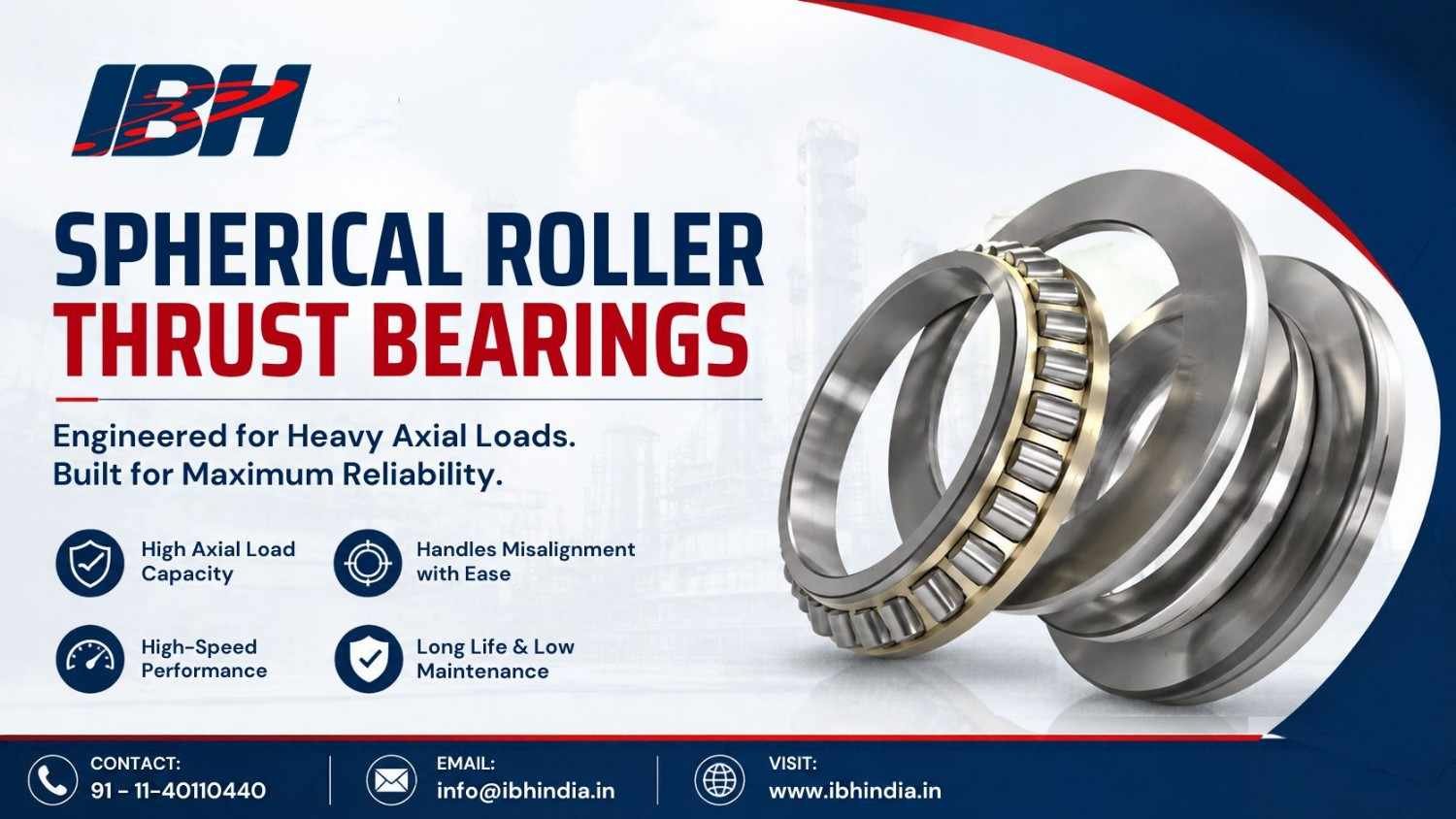
A gearbox misaligned by even half a degree during installation isn't a rare event on a factory floor — it's closer to the norm than most buyers admit. Spherical roller thrust bearings exist specifically because perfect shaft alignment is a theoretical ideal, not a manufacturing reality, and their self-aligning geometry absorbs that misalignment without transmitting it into premature wear the way a rigid bearing would. If your current bearing keeps failing on equipment that "should" be aligned correctly, the misalignment tolerance of the bearing itself, not the installation crew's competence, is usually where the real problem sits.
What Makes the Geometry Different
The spherical roller thrust bearing employs a spherical raceway on the housing washer. This allows the bearing to support heavy combined axial and radial loads, while accommodating for the angular misalignment of the shaft and housing.
The ability to accommodate its load in dual-directions, as well as cope with the application being at an angle, differentiates a spherical roller thrust bearing from another bearing; the thrust ball bearing.
Misalignment Tolerance and Why It's Measured, Not Assumed
Most catalogs list a misalignment tolerance figure — typically a couple of degrees — but that number assumes correct initial installation, not ongoing compensation for a housing that shifts under thermal load. Buyers who treat that tolerance figure as a permanent safety margin rather than a starting allowance are setting themselves up for the exact failure the bearing was supposed to prevent.
The Detail Buyers Skip: Cage Design Under Heavy Radial Combined Load
Cage material and design determine how well a spherical roller thrust bearing holds up under combined radial and axial load at speed, and it's the spec buyers check last, if at all. A steel cage handles higher speed and temperature; a machined brass cage handles heavier shock load more gracefully. Picking based on bore size alone, without checking cage suitability for the actual duty cycle, is a mistake we see on repeat orders more often than first-time ones — which tells you it's not obvious even to buyers with experience.
What the Right Bearing Protects
Spherical roller thrust bearings cost more upfront than a standard thrust ball bearing, and that price difference only makes sense if it's actually protecting something measurable.
- Reduced misalignment-driven failure. Absorbing angular error at the bearing prevents that stress from transmitting into the shaft, coupling, and gearbox housing, which protects far more expensive components than the bearing itself.
- Lower vibration on heavy rotating equipment. Self-aligning geometry reduces the vibration signature that comes from forcing a misaligned shaft through a rigid bearing, extending service life across the whole assembly.
- Combined load capacity in one component. Handling both radial and axial load in a single bearing simplifies design and reduces the number of failure points compared to using separate bearings for each load type.
- Fewer alignment-related warranty disputes. A bearing engineered for misalignment tolerance reduces the odds of a failure being blamed on installation quality when the real cause was bearing selection.
Why Sourcing Location Still Decides Your Downtime
A spherical roller thrust bearing failure on heavy processing equipment doesn't wait for a convenient delivery window, and the larger, less common sizes typically used in this category aren't something every regional distributor holds in depth.
Stocking a genuine range of Nachi Spherical Roller Thrust Bearings Distributors in India inventory across steel, cement, mining, and paper & pulp industrial clusters means a specialized size doesn't turn into a three-week wait when a machine is already down. That gap between "in the catalog" and "actually on the shelf" is where a lot of suppliers quietly fall short.
What We've Learned Supplying This Category Specifically
We're an authorized supplier of premium bearings in India, and spherical roller thrust bearings are one of the categories where we hold deeper stock than our general catalog suggests, because the mining and cement customers we work with can't afford a multi-week wait when a processing line goes down. We started splitting our cage-type inventory in 2022 after a cement customer's steel-cage bearing failed under a heavier shock load than the application description had suggested — we should have asked more questions at quoting stage, and we changed our intake process because of it.
As Nachi Spherical Roller Thrust Bearings Suppliers, we ask about duty cycle and shock load before we ask about bore size, because bore size alone tells us almost nothing about whether a bearing will actually hold up in the application it's going into.
The Bottom Line on Spherical Roller Thrust Bearings
Spherical roller thrust bearings solve a problem that rigid bearings simply can't — real-world misalignment combined with heavy combined load — and treating them as an interchangeable upgrade to a standard thrust bearing misses why they exist in the first place. Buyers who match cage design and misalignment tolerance to their actual duty cycle get a component that quietly does its job for years. That's a better outcome than discovering the mismatch after a shutdown.
FAQs
What's the difference between spherical roller thrust bearings and standard thrust ball bearings?
Spherical roller thrust bearings tolerate angular misalignment and carry heavier combined radial and axial loads; standard thrust ball bearings handle axial load well at higher speed but have very limited misalignment tolerance. The right choice depends on whether your application has meaningful alignment variation, not just load magnitude.
Are you Nachi Spherical Roller Thrust Bearings dealers for both standard and heavy-duty cage types?
We are, though heavy-duty cage variants sometimes require a longer manufacturer lead time than standard steel-cage stock — we'll confirm actual availability rather than assume the size you need is sitting on our shelf.
How much misalignment can a spherical roller thrust bearing actually tolerate in continuous operation?
Catalog figures typically list a couple of degrees, but that's a starting allowance, not a permanent buffer once thermal expansion and wear are factored in over time. We'd rather walk through your specific installation than quote a number that may not hold up in practice.
Do Nachi Spherical Roller Thrust Bearings Suppliers in India typically stock large or uncommon bore sizes?
Not universally — many distributors stock common sizes only and special-order the rest. We hold deeper stock in this category specifically because our mining and cement customers can't wait weeks for a processing-line replacement.
Can spherical roller thrust bearings handle combined axial and radial load at high speed?
Within limits, yes, but speed capacity drops as combined load increases, and cage material becomes the deciding factor at higher speeds. Assuming one spec works across your full operating range without checking is a common and avoidable mistake.