Why Bronze Products Are Widely Used in Engineering and Manufacturing Industries
By Ganga Metals 12-10-2026 7
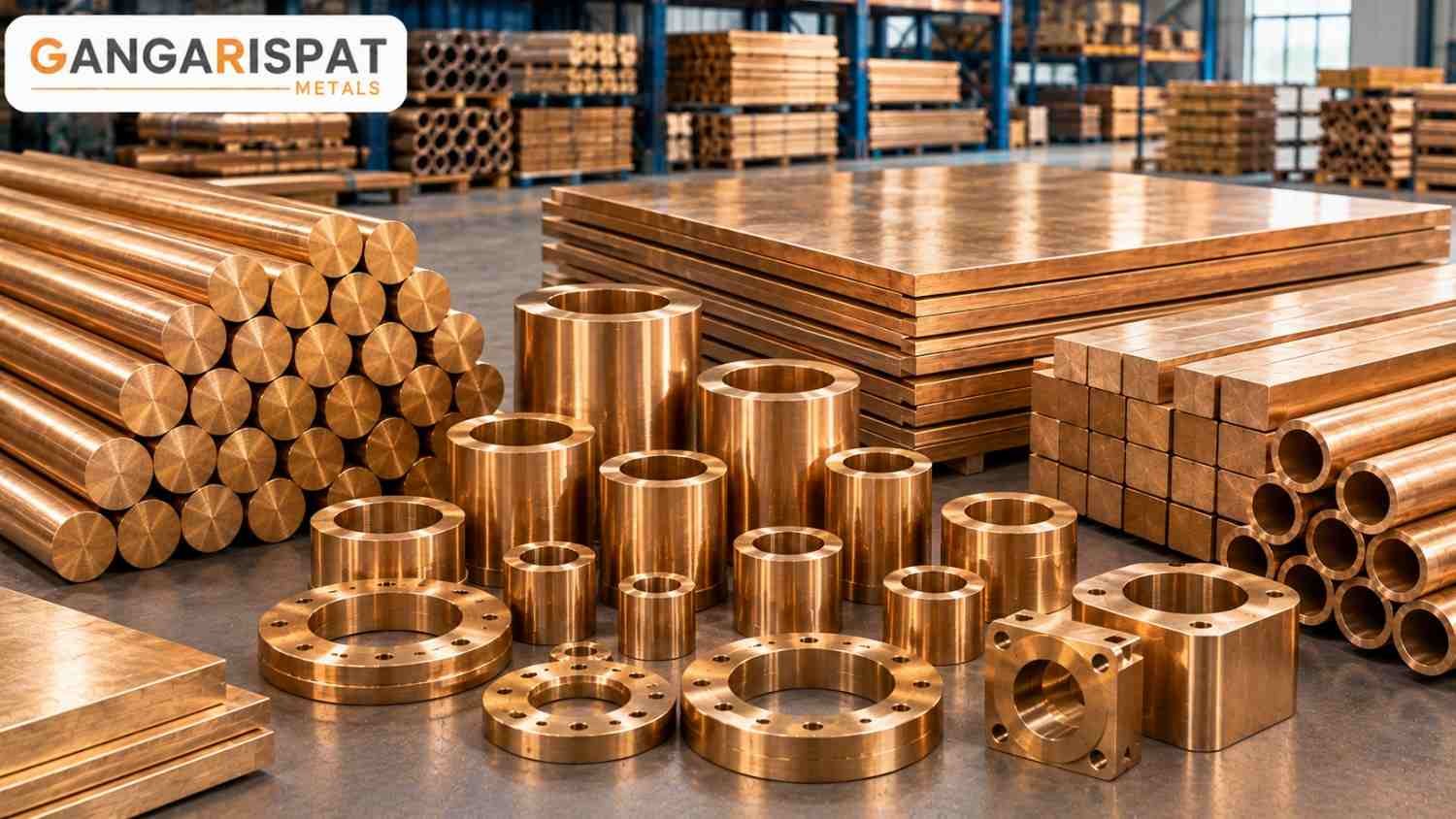
A gearbox bushing fails at month eight, and the argument starts. The buyer blames the supplier. The supplier blames the operator's lubrication. Nobody opens the mill certificate until the dispute is two emails deep.
That's the usual story with Bronze products in Indian industry. The metal is rarely the problem. The grade mismatch is. Bronze earns its place in bearings, valves, pump parts and marine fittings because it holds up under friction, load and corrosion, but only when the alloy you ordered is the alloy that lands at your dock.
Bronze Products Grades: The Spec Detail Most Buyers Skip
Bronze is copper alloyed mainly with tin, though aluminium, silicon and phosphorus define other families. Density sits around 8.8 g/cm³. Three families cover most engineering orders.
Tin and Leaded Tin Bronze
Typically copper with roughly 10–12% tin, with lead added in bearing grades (IS 318 covers leaded tin bronze castings). Lead helps the bush survive a brief loss of lubrication and makes machining faster. Bushes, sleeves, gears and pump components live here.
Phosphor Bronze
Tin content runs up to about 11%, with 0.01–0.35% phosphorus as a deoxidiser. You get fatigue resistance and good wear behaviour, which is why worm wheels, springs and thrust washers are made from it.
Aluminium Bronze
Aluminium at roughly 5–12% gives high strength (some grades reach around 600 MPa) and strong seawater resistance. Propellers, valve seats and ship fittings. It is also harder to work than buyers expect: it dulls tooling quickly, and welding needs a qualified procedure.
Here's the detail most buyers skip. The certificate shows ladle chemistry for the heat, not the rod on your pallet.
Ask for a spectrometer reading from the dispatched lot, with the heat number marked on the material itself. Without that, you are trusting a document, not a product.
Five Questions That Expose a Weak Bronze Supplier
Ask these before you issue a PO. Each has both a strong answer and a weak one.
- Can you show a mill test certificate with a heat number for this exact lot? Good: a dated certificate that matches the stamp on the material. Bad: a generic certificate with no heat number, or one from last year's batch.
- Which standard is this grade made to? Good: IS, ASTM or EN named, with the grade code. Bad: "equivalent to" and nothing else. Equivalent to what?
- What happens when a lot fails inspection? Good: a written replacement or credit policy with a timeline. Bad: "we'll sort it out case by case." That isn't a policy. You’d be losing this deal the moment the package hits the ground.
- Why is your price what it is? Good: a quote that tracks copper and tin plus a visible conversion margin. Bad: a number below the metal value. Nobody has a miracle process. They are blending scrap, and the lead, zinc and iron contamination shows up in your wear parts.
- Can I verify your certifications independently? Good: an ISO certificate you can check on the issuing body's portal. Bad: a PDF with no accreditation mark and a lapsed date.
Where Bronze Protects Your Margin
Longer wear life. A longer replacement interval means fewer line stoppages, and a stopped line costs far more than the bush.
Corrosion resistance in wet and marine service. Less coating, fewer warranty claims from coastal buyers.
Low galling against steel. The bush wears before the shaft does, and the shaft is the expensive part.
Faster machining in leaded grades. Shorter cycle times and lower tooling cost per part, which adds up across a 5,000-piece order.
Low sparking behaviour. Useful in fuel, chemical and grain-handling plants where a spark is a safety event, not a quality issue. Check the specific grade, though, rather than assuming.
Scrap value you can recover. Bronze is fully recyclable and holds resale value, so a rejected lot is a loss you can partly claw back.
Bronze Products Suppliers in India: Why Location Is a Supply Chain Decision
Demand clusters tell you a lot. Pump makers in Coimbatore, machine-parts shops in Ludhiana and Jalandhar, engineering foundries around Rajkot, auto suppliers in Pune and Chennai. Each pulls bronze from a different corridor.
The port you ship from often decides your lead time more than the factory does. Nhava Sheva and Mundra handle most containerised exports, and a supplier inland by three days of trucking adds that to every order.
Know what you're buying from whom. Bronze Products Manufacturers can pour a custom casting, but a new pattern takes weeks. Distributors win on stock: standard rod diameters and bush sizes dispatched in days. When you compare bronze products for sale, check which one you are actually talking to.
About Us
We are Ganga R Ispat Metals. We've supplied bronze and allied metal products to engineering and manufacturing buyers across India and export markets for [X years / since YEAR].
[Replace with your real operational fact, for example: We re-test every outgoing rod lot on our own spectrometer. In [YEAR], we pulled [N] lots back from the dispatch bay because tin sat 0.4% below spec. The buyer never knew. That's the point.]
We hold [ISO certification, body and number] and export to [N countries]. Our documents are built for customs and for your quality team, not just for our own files.
Send us the grade and standard, dimensions or drawing, quantity, and destination port. We reply with a priced quote within [24 working hours]. Our minimum order is [500 kg per grade]. If you don't have a grade yet, send us the application and operating conditions, and we'll tell you what we'd specify.
Contact Ganga R Ispat Metals at the website.
Conclusion
Bronze products keep showing up in engineering plants because they fail slowly and predictably, and buyers pay for that predictability. The grade, the certificate and the supplier's willingness to be audited matter more than the price per kilo. As more buyers demand lot-level traceability, suppliers who can't provide it will lose the order before the quote is opened.
FAQs
1. Which bronze products do engineering buyers order most? Bushes and sleeves, followed by rods, plates and gears. Leaded tin bronze is the volume grade for bearings. Aluminium bronze comes up for marine and high-load work.
2. How do I tell Bronze Products Manufacturers from traders? Ask for the foundry address, a video walk-through of the furnace and the in-house spectrometer. A real manufacturer answers in an hour. One caveat: some legitimate manufacturers outsource final machining, which is fine as long as they own the casting and the testing.
3. Do Bronze Products Distributors carry standard sizes in stock? Usually for common diameters in popular grades. Odd sizes and specialty grades often aren't stocked, so confirm before assuming a one-week dispatch. Distributors also quote against the day's copper and tin prices, so quotes expire fast.
4. Where do I find bronze products for sale in bulk? Start with manufacturers and large distributors in the industrial corridors close to your plant or port, then verify certificates before you compare price. A cheap lot with no heat number is more expensive than it looks.
5. Bronze or brass for a bearing application? Bronze, almost every time. Brass wears faster under sliding load and handles seawater worse. Brass is the cheaper choice for fittings and decorative parts where load is light.
6. What is the typical MOQ and lead time for export orders? For standard grades, [500 kg per grade] and [2–3 weeks] from confirmed order. Custom castings take longer because of pattern making, and I won't give you a date until I've seen the drawing.
7. Can I lock the price for a repeat order? Not beyond the quote validity, because bronze follows copper and tin markets daily. What we can do is agree a pricing formula tied to a published metal rate plus a fixed conversion charge, so there are no surprises.


















