WholeClear Software Review: The Complete Guide to Converting EML to PST in Bulk
By Misty Lyons 17-06-2026 205
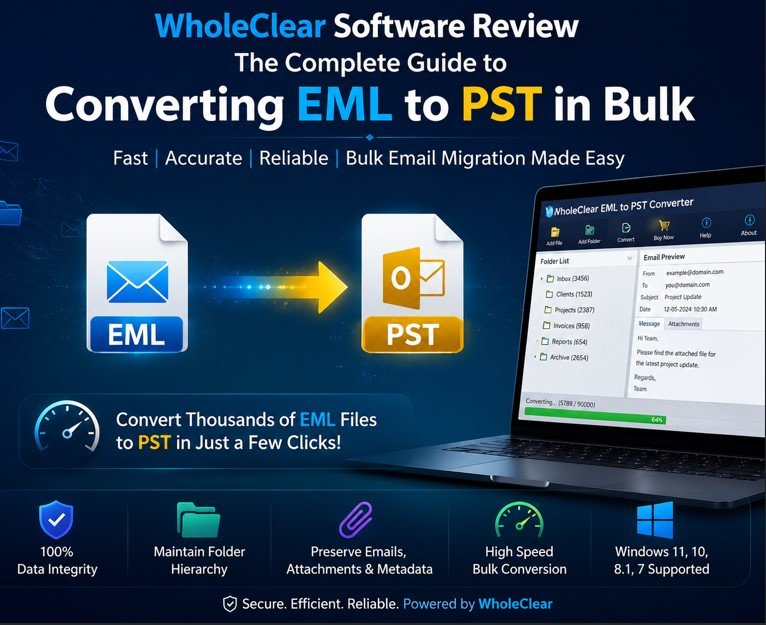
One of those IT chores that is straightforward on paper but becomes incredibly complicated when you have to deal with thousands of files, numerous users and tight deadlines is email migration. A mid-sized marketing firm encountered one such practical difficulty when it had to quickly convert a sizable library of EML-based emails into Microsoft Outlook's PST format.
In order to manage mass email conversion without data loss, downtime or structural corruption, WholeClear EML to PST Converter was assessed.
The Actual Issue: When Email Turns Into a Business Hazard
Nearly ten years' worth of email data had been amassed by the agency and was kept in various departments and clients. Thunderbird and Windows Live Mail, two of its outdated email programs, both kept messages in EML format.
The company's decision to completely transition all divisions to Microsoft Outlook marked a turning point. What at first appeared to be a standard migration swiftly turned into a serious operational problem:
• More than 90,000 email files required conversion
• There were several user mailboxes involved
• Contracts, design drafts and financial data were among the attachments
• Inconsistent and deeply nested folder hierarchies
• Due to an impending client audit, deadlines were tight
The Reasons Manual Conversion Is Unsuccessful in Practical Settings
The IT staff recorded the reasons why manual methods were not working before switching to any automated tool:
1. Problems with Data Integrity
Email headers, timestamps and attachments were inconsistently preserved when using manual drag-and-drop techniques. This was inappropriate from a legal and auditing standpoint.
2. Time Spent
It took hours of painstaking labor to manually translate even a few thousand emails. It was nearly impossible to scale this to tens of thousands.
3. Loss of Folder Structure
Emails kept in organized directories such as "Clients → Projects → Invoices," were being compressed into a single directory.
4. Human Error Risk
Manual attempts often resulted in partial transfers, duplicate exports and missing files.
Automation was becoming a need rather than a convenience.
The Automated Method: The Tool's Practical Operation
A streamlined workflow intended for mass migration was introduced by the software:
Step 1: Load the EML data
Instead of choosing specific files, the IT administrator chose entire directories that held email archives.
Step 2: Configure and Preview
The program allowed folder structures and email counts to be validated prior to conversion, guaranteeing that no data was lost.
Step 3: PST Conversion in Bulk
Thousands of emails were migrated into Outlook-compatible PST files with structure and metadata preserved in a single operation.
Step 4: Integration with Outlook
The generated PST files didn't need to be further formatted or repaired in order to be imported into Outlook.
This procedure greatly decreased operating downtime and removed the majority of the manual overhead.
Case Study: Email Migration in the Legal Department
Context
The legal division had amassed:
• Fifteen years of case communication
• About 85,000 emails
• Large attachments such as evidentiary files and scanned contracts
• Strict data integrity compliance standards
Windows Live Mail, which the department had traditionally relied on, was being phased out.
The Obstacle
The first attempt at a manual migration produced:
• In test batches, attachment corruption was close to 18%
• Folder hierarchies that are broken
• Older case files lack timestamps
• The inability of legal professionals to access archives
Because legal documentation must be completely intact and traceable, this constituted a risk to compliance.
The Implementation of the Solution
The automated solution was subsequently implemented in a controlled setting by the IT team:
1. The system was loaded with the complete email directory
2. To maintain structure, folder mode was used
3. To improve performance, batch processing was activated
4. Conversion was carried out without interfering with continuous system operation
The Outcomes
The result was far better than anticipated:
• 85,000 emails were successfully converted
• 100% of the folder hierarchy is maintained
• No evidence of attachment corruption was found
• Full retention of metadata (dates, sender information and subject lines)
• The conversion was finished in less than four hours
Most significantly, there was no need for retraining or reorganization because legal professionals could access their Outlook archives right away.
This confirmed that in business settings, automatic EML to PST conversion is not only quicker but also far more dependable.
Analyzing Performance in Actual Situations
The tool showed three main advantages in a stress-test situation that was comparable to production use:
1. Scale Speed
There was no system lag when processing large mailboxes in batches.
2. Preservation of Data
Emails were left with their original metadata, attachments and formatting.
3. Accuracy of Structure
The preservation of nested folders is crucial for sectors like law and banking that rely heavily on compliance.
The approach decreased reliance on user intervention, which decreased the possibility of human error, in contrast to manual process.
Observed Limitations
The IT staff pointed up a few things to keep in mind because no tool is flawless:
• System resources (RAM and CPU) were needed for large initial datasets
• Batch configuration required a quick learning curve for new users
• For quicker validation in extremely large mails, preview functions should be enhanced
Nevertheless, the advantages in terms of speed and dependability outweighed these drawbacks.
Final Decision
Automated conversion is now required for businesses handling extensive email migrations, particularly from EML-based clients to Outlook.
The fundamental issues of data integrity, time efficiency and structure preservation were effectively resolved by the tested method. Such automation offers obvious operational advantage in real-world company contexts where downtime is costly.
It is very helpful for:
• IT managers overseeing business transfers
• Financial and legal teams managing email archives with a lot of compliance
• Companies switching entirely to Outlook ecosystems
All things considered, this method turns what was previously a risky manual process into a reliable, regulated and effective workflow.
FAQs
1. What is the purpose of converting EML to PST?
It is used to convert email files into Outlook-compatible PST format from EML format, which is used by programs like Thunderbird and Windows Live Mail.
2. Can metadata and attachments be kept during the conversion process?
Yes, attachments, timestamps, sender information and folder structures are usually maintained when employing an automated approach.
3. For large mailboxes, is manual conversion advised?
No, when handling thousands of emails, manual conversion becomes unreliable and time-consuming.
4. How much time does bulk conversion typically take?
In real-world situations, automation can frequently process tens of thousands of emails in a matter of hours, depending on file size.
5. Is it possible to import converted PST files straight into Outlook?
Yes, Outlook has native support for PST files, and importing them doesn't require any further setup.