Monel needle valves can offer an advantage over stainless steel valves in specific services involving seawater, hydrofluoric acid, and aggressive chloride environments where the selected stainless grade may have limited corrosion resistance. Get that choice wrong, and the consequences show up later as leaks, seized stems, or a shutdown nobody scheduled. Selecting Corrosion Resistant Instrumentation Valves at the design stage directly affects equipment reliability, maintenance costs, and service life. A Monel Needle Valve has a nickel-copper alloy construction built specifically for demanding marine, offshore, and chemical processing applications. Stainless steel remains a solid, popular choice across general industrial service, but Monel pulls ahead in certain aggressive environments where stainless simply doesn't hold up as well.
What Is a Monel Needle Valve?
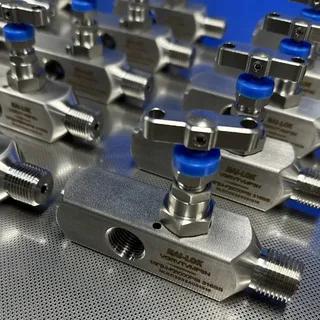
Monel is a nickel-copper alloy containing roughly two-thirds nickel and one-third copper. It is valued for its strong corrosion resistance in several marine and chemical environments where conventional stainless steels may be less suitable. Monel needle valves are valves made of that alloy for precision flow control. They feature a tapered, needle-shaped plug seating into a corresponding orifice for accurate metering and tight shutdown. This construction works particularly well in instrumentation applications where precise flow control and material durability are both important.
What Is a Stainless Steel Valve?
Stainless steel valves include chromium, which forms a protective oxide layer that resists corrosion in many general industrial applications. Molybdenum is added to grades such as 316 to increase chloride resistance, hence extending the applicability of stainless steel to moderately harsh environments. In most common process and instrumentation applications, stainless steel is the material of choice because it offers reliable performance at a more affordable material cost than Monel. That’s why it continues to rule the roost in so many industrial piping and valve specs.
When Are Monel Needle Valves Better Than Stainless Steel Valves?
The honest answer is: it depends on what the valve actually has to survive. Certain environments push standard stainless steel past its comfort zone quickly, and that's where Monel earns its higher price tag.
Marine and Offshore Applications
Continuous seawater exposure can create pitting and crevice-corrosion risks for some stainless steel grades, particularly in stagnant or shielded areas. Monel can offer better resistance in selected marine services where chloride exposure is severe.
Chemical Processing Plants
Hydrofluoric acid service is where Monel genuinely shines, since few materials handle that specific chemistry as well. Alkali handling systems, chemical reactors, and acid transfer lines all benefit from the same resistance, holding up where stainless steel would degrade within a much shorter window.
Oil and Gas Industry
Offshore production facilities combine saltwater exposure with high-corrosion process media, exactly the dual threat Monel was built to handle. Instrumentation tubing systems, pressure gauges, and analyzers all depend on a valve material that won't compromise accuracy as it slowly corrodes.
Desalination and Water Treatment
Brine handling systems and reverse osmosis plants push concentrated saltwater through piping continuously, and saltwater pipelines need a material built for sustained chloride exposure. Monel handles that duty without the pitting concerns that eventually catch up to stainless steel.
Critical Instrumentation Systems
High-accuracy flow control and pressure monitoring systems can't tolerate a valve that degrades unpredictably. Analyzer panels depend on consistent performance, and Monel's durability supports longer maintenance intervals along with the reliable shutoff these systems require to stay trustworthy over time.
Monel Needle Valves vs Stainless Steel Valves: Complete Comparison
Factors to Consider Before Choosing
Process fluid compatibility should drive the decision before anything else, since a valve material that's wrong for the actual chemistry negates every other consideration. Corrosion severity, operating pressure, and operating temperature narrow the field further, while applicable industry standards confirm the chosen material meets project requirements. Maintenance requirements matter too, since a valve needing frequent servicing in a hard-to-access location costs more over time than its purchase price suggests. Lifecycle cost versus initial investment ties this together: Monel costs more upfront, but in the right environment, that premium pays for itself through fewer replacements and less unplanned downtime.
Conclusion
Monel Needle Valve is the ideal choice for marine, offshore, desalination, and aggressive chemical applications because to its corrosion resistance, durability, and long service life, far better than stainless steel. For many general-purpose industrial applications that don’t get into these harsh conditions, stainless steel is still quite enough. The choice between the two comes down to matching material to the actual operating environment, and a Monel Needle Valve from an experienced manufacturer such as Virgin Engineers is worth the cost whenever seawater, hydrofluoric acid, or persistent chloride exposure is part of the job.
FAQs
Is a Monel needle valve better than stainless steel?
Yes. In highly corrosive environments involving seawater, chlorides, or hydrofluoric acid, yes. For general-purpose service, stainless steel usually performs just as well at a lower cost.
Can Monel valves be used in seawater applications?
Yes, Monel's resistance to pitting and crevice corrosion makes it one of the most reliable materials available for continuous seawater exposure.
Why is Monel preferred for hydrofluoric acid service?
Monel is far more resistant to assault by hydrofluoric acid than is stainless steel, which degrades rapidly in that particular chemistry.
Are Monel needle valves worth the higher cost?
Yes. In hostile environments. Yes. The higher initial cost of the material is often mitigated over time by its longer service life and lower maintenance.
Which industries commonly use Monel needle valves?
Monel needle valves are used in the marine engineering, offshore oil and gas, chemical processing, and desalination industries where high corrosion resistance is required.