What Makes AI Companion App Development Technically Challenging Today?
By Agata Peatik 20-02-2026 80
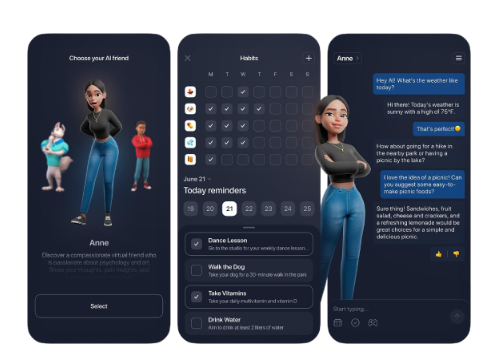
The companion apps developed using AI technology have advanced significantly beyond the scripted chatbots and novelty interactions. The users today demand systems that can support conversations with context, adapt to emotional cues, and provide continuity over time. As the bar is raised, AI Companion App Development has become a highly technical field that is influenced by developments in machine learning, system architecture, and human-AI interaction design. The challenge does not lie in a single system but in the interaction of multiple systems in real time without disrupting immersion and trust.
Context Preservation in Long-Form Interaction
Among the most challenging tasks of contemporary companion platforms is the management of conversational context. While task-oriented AI applications require the ability to recall previous conversations, companion applications are expected to recall previous conversations, preferences, and even nuances of tone. This is more than a short-term memory task. Companion platform developers are expected to implement complex memory structures that can separate transient context from persistent user information.
The challenge is in determining what to remember, for how long, and when to apply it in a subsequent response. Too much memory can result in inappropriate and repetitive responses, while too little memory can cause a disruption in the flow of conversation. In an AI companion platform like candy ai, this is a critical technical issue rather than an enhancement.
Stateful Systems at Scale
However, the more users there are, the more complex it becomes to maintain the state of a conversation. A conversation can be based on individual data, but it should still be scalable. This is where traditional web applications’ stateless architecture fails, and a combination of stateful and scalable solutions is required.
Emotional Modeling and Response Coherence
The AI companion apps are also assessed for emotional consistency as opposed to factual correctness. This is because the user will be able to detect the sudden change in tone or the lack of connection with the emotional context of a conversation. From a technical perspective, this involves integrating language models with emotional analysis, intent detection, and response modulation layers.
The models have to work in conjunction without causing latency. Emotional modeling cannot be treated as a post-processing task; it has to be integrated into the response generation process.
Real-Time Performance Expectations
Compared to asynchronous AI applications, companion apps are expected to respond immediately. Any delay, no matter how small, can break immersion. The problem of providing low-latency responses with complex AI models is an ongoing engineering problem.
To overcome this problem, developers use optimized inference paths, model caching techniques, and adaptive response generation. The problem becomes more complex when the platforms support rich media, voice conversations, or real-time personalization. A skilled ai development company usually pays as much attention to infrastructure optimization as it does to model optimization to fulfill such requirements.
Moderation and Safety Logic Integration
Platforms for AI companions are involved in socially complex domains. The conversations can range from emotional vulnerability to personal discussions or creative role-playing. Moderation platforms need to work in conjunction with conversational AI without making the user feel like they are being watched or mechanized.
Technically speaking, this implies the need to integrate filtering, intent analysis, and policy enforcement directly into the conversation loop. These platforms need to analyze content constantly while still enabling natural conversation flow. The engineering challenge of making moderation both effective and invisible is complex.
Continuous Learning Without Drift
However, users also demand that their AI companions exhibit dynamic feelings, but uncontrolled learning may cause inconsistency or deterioration in behavior. Most production-level systems refrain from self-training in real-time and prefer to update based on collective learnings.
There arises a conflict between adaptability and stability. Developers have to create feedback mechanisms that will help in future updates without changing the behavior erratically. This is particularly important in the initial validation stages, which are also associated with AI MVP app development.
Integration of Development Approaches
AI companion apps are frequently developed by teams of people with varied skill sets. Some aspects of the app may require highly specialized knowledge in machine learning, while other parts can be constructed with rapid application development tools. The emergence of no code developers as support staff further introduces complexity, as graphical development software and bespoke AI services need to work well together.
To maintain consistency in development approaches can be a challenge in itself.
Conclusion
What makes AI Companion App Development technically challenging in the current state is not one problem but the presence of many challenging requirements that need to work together in perfect harmony. The ability to preserve context, maintain emotional consistency, perform in real-time, execute moderation logic, and scale architecture are all requirements that need to work together in perfect harmony. With the increasing influence of platforms such as an ai companion platform like Candy AI, app developers are faced with the challenge of building AI that is not only intelligent but also stable, responsive, and context-aware.
Tags : .....