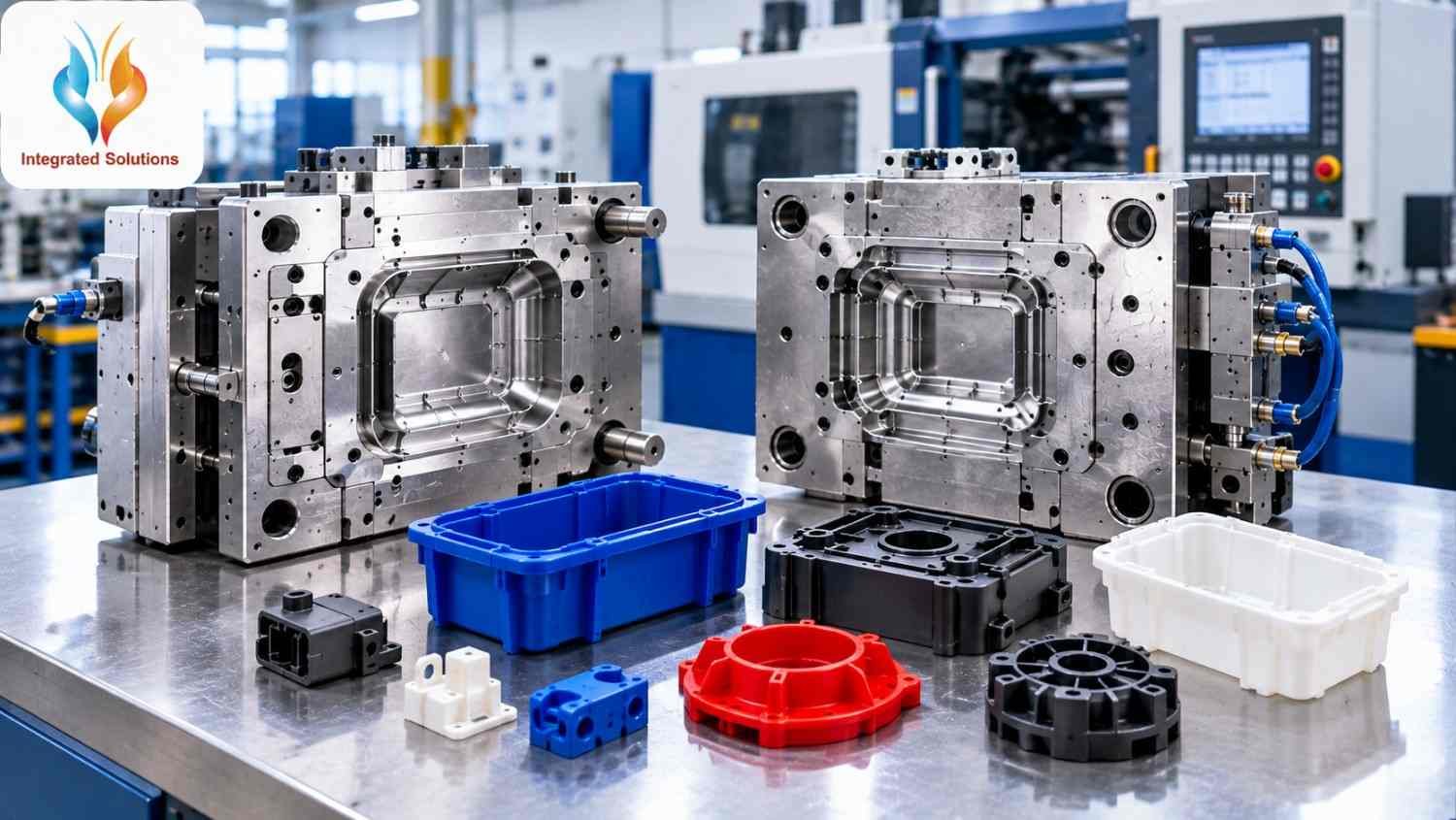
The CAD model looks fine. Then the first parts arrive with sink marks, sticking, or drifting dimensions. That is when buyers learn that a Plastic Mould is not simply a shaped block of steel; it must control filling, pressure, cooling and ejection. Autodesk describes four main stages—clamping, injection, cooling and ejection—with typical cycles ranging from about 2 seconds to 2 minutes. A weak mould repeats its mistakes every cycle.
Plastic Mould Specifications Buyers Should Understand
A mould uses matched halves to form the cavity, with gates or runners for flow, cooling channels and an ejection system. Plastic is melted, injected under pressure, cooled, then released. Integrated Solutions states that it builds single-cavity and multi-cavity moulds using CAD/CAM, CNC and EDM.
Cavity Count, Draft and Cooling Are Not Minor Details
Most buyers focus on shape and price. That is a mistake. Protolabs notes that multi-cavity tools may produce two, four or eight parts per cycle, while flow and thermal balance become harder as cavity count rises. A common draft guideline is roughly 1° per inch of cavity depth. Cooling is harder than buyers expect; Autodesk says it can consume up to 80% of the cycle.
Five Supplier Checks Before You Approve the Tool
- Design review: Ask how gate position, draft, shrinkage and ejection are checked. Bad answer: “We will adjust it during trial.”
- Machining route: Confirm CNC and EDM capability. Bad answer: vague claims about “precision machines.”
- Cavity strategy: Ask why the tool needs one cavity or several. Bad answer: more cavities are recommended only because output sounds better.
- Trial procedure: Ask what is measured during testing. Bad answer: “If the sample looks okay, production can start.”
- Production fit: Match mould, resin, machine and volume. Bad answer: a quotation issued before the supplier reviews the part file and material.
Integrated Solutions publicly lists two cavity approaches—single and multi-cavity—plus mould testing and trial runs.
Nobody tells you how expensive a cheap mould becomes after repeated fitting, welding and re-machining.
How Better Tooling Protects Cost and Output
A well-engineered tool protects margin in practical ways. Repeatable cavity conditions reduce rejection risk. Balanced filling lowers short-shot and sink-mark risk. Planned cooling protects machine time; if cooling can take up to 80% of a cycle, poor channel design becomes a cost problem. Correct draft reduces drag during ejection. Multi-cavity tooling can raise pieces per shot where flow permits. Trial runs expose defects before serial production.
And yet, buying on mould price alone is still common. It is a weak purchasing method because scrap, downtime, repairs and missed dispatches do not appear in the tooling quote.
Plastic Mould Manufacturers in India: Why Location Still Matters
For Indian buyers, location affects design discussions, trials, corrections and dispatch—not just freight. Integrated Solutions lists its base in Gurugram, Haryana, and states plastic mould manufacturing experience since 2004.
Most buyers should care less about pin code than about how quickly drawings, samples and trial feedback move between teams.
That is why comparing mould suppliers in India should include technical response, trial access and service after delivery. A nearby shop that changes dimensions without revision control is not automatically safer.
About Integrated Solutions
We have worked in Plastic mould manufacturers since 2004. Our published capability covers custom mould design, single- and multi-cavity tools, CNC and EDM machining, testing and trial runs. We also list four plastics for injection-moulding work: ABS, PP, nylon and polycarbonate.
Here is the operational point that matters: we do not stop at the CAD model; we machine the tool, run trials and check the mould before release.
We state a response time of within 24 hours on our enquiry pages. Send us your 2D/3D drawing, plastic grade, critical dimensions, expected quantity, finish requirement and machine details if the tool must run on your equipment.
We do not publish one fixed MOQ for custom mould projects, so we will not invent one here. We confirm MOQ, cavity approach and trial needs after reviewing the requirement. Send the project data to Integrated Solutions before issuing a purchase order.
Conclusion
A Plastic Mould works by controlling four linked stages: clamping, injection, cooling and ejection. The hard part is making a tool that repeats the required result in production. Buyers who review draft, gating, cooling, cavity strategy and trials early reduce expensive corrections later. The next step is turning the part drawing into a production-ready mould plan.
FAQs
1. What is a Plastic Mould used for?
It shapes molten plastic into a defined component. Injection-moulding cycles can range from roughly 2 seconds to 2 minutes, depending on part, resin, mould and machine.
2. How do mould manufacturers decide cavity count?
Plastic Mould manufacturers usually consider geometry, resin flow, machine capacity, volume and cost. Two, four or eight cavities may raise output, but balancing becomes harder as cavity count rises.
3. What should I send before requesting a mould quote?
Send a 2D/3D file, resin grade, quantity, critical dimensions, finish and machine constraints. Without that data, a serious tool price is mostly guesswork.
4. Are Plastic Mould manufacturers in India suitable for custom tooling?
Many are, but capability differs. Integrated Solutions lists custom design, CNC/EDM machining, single- and multi-cavity moulds, testing and trials; verify the exact process required for your part.
5. Is a multi-cavity mould always better?
No. It can produce several parts per cycle, but balancing is harder. For difficult geometry, validation before committing to more cavities may be safer.
6. How much draft should a moulded part have?
A common starting point is about 1° per inch of cavity depth. That is not universal; resin, texture, depth and ejection conditions can require more.
7. How fast does Integrated Solutions respond to a mould enquiry?
Its enquiry pages state within 24 hours. Tooling lead time is separate and depends on complexity, cavity count, machining, trials and corrections.