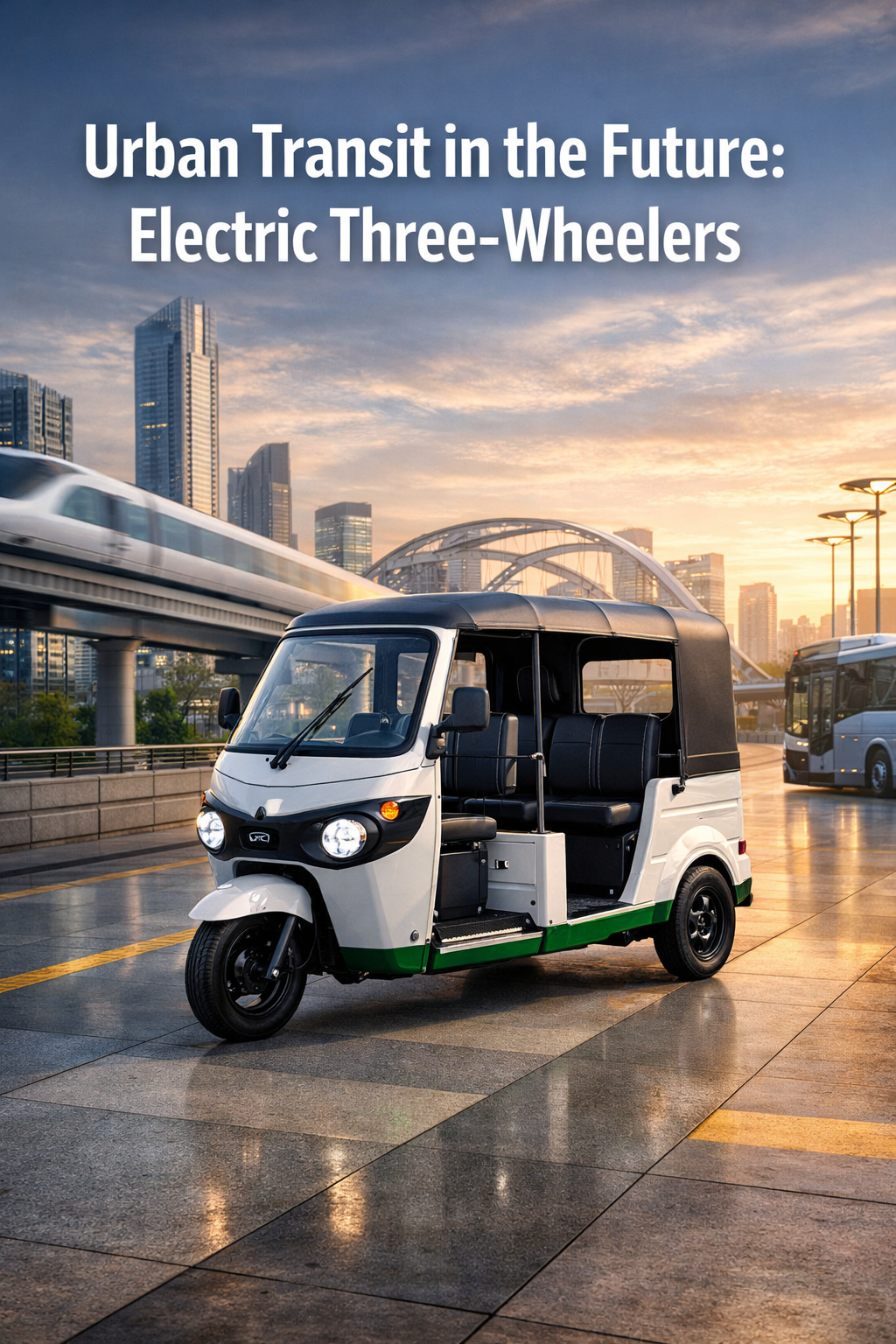
The city transport is in a frenzy of change as cities all over the world struggle to find affordable, efficient and environmentally friendly modes of transport. Three-wheeler vehicles, particularly e-sourced ones have become a very convenient solution to these issues as they are now considered as vehicles that provide last-mile connectivity, passengers, and light cargo transportation. This is their miniature size, affordability, and flexibility, which make them the foundation of sustainable urban transit in both the developing and the developed economies.
The Rising Significance of three-wheeler as Mobility in the city.
Three-wheelers have been an essential component of transportation in the urban and semi-urban areas and especially in Asia, Africa and Latin America. They have been made indispensable through the way they are able to navigate small roads, low cost of operation, and reliability of travelling over short distances. No longer considered as a luxury, these cars are now a necessity to the millions of daily commuters and small businesses.
As urban populations are growing and the demand on the transport infrastructure grows, city planners and policymakers are considering three-wheelers as a viable strategy to reduce congestion and enhance accessibility. The transition to the electric powertrains can also increase their applicability because it reduces emissions and operational costs.
Market Expansion Supported by Healthy Data.
The industry analysis by MarkNtel Advisors revealed that in 2024, the Global Three Wheeler Market is estimated to have reached USD 11.6 billion and is expected to grow to close to USD 19.5 billion in 2030. This growth indicates a high compound annual growth rate (CAGR) of approximately 9.04 percent over the 2025 2030 period.
Such a constant increase can be explained by several factors, such as unstable urbanization, the growing need in transport with low prices, and the efforts of the government which encourages the use of electric mobility. Significantly, this information underscores the fact that three-wheelers are transformed into non-informal solutions of transport to a structured and technology-intensive mobility resource.
The Electric Three-Wheeler -The Rise.
The electrification of the three-wheeler is changing the segment at an accelerated rate compared to other types of vehicles. There are a number of benefits on the electric three-wheelers: the cost of fuel is less, it requires less maintenance, it is quiet and has no tailpipe emissions. These advantages are especially useful in the overpopulated cities where noise and pollution are becoming a problem.
The transition is being facilitated by governments in key markets by way of subsidies, tax incentives, and investments in charging infrastructure. To the fleet operators and individual drivers, the electric models offer a strong economic appeal as the cumulative cost of ownership is much less than that of the vehicle throughout its existence.
Position in Last-Mile Connections and E-Commerce.
The number of last-mile delivery services is considered to be one of the strongest growth drivers of the Global Three Wheeler Market. The fast-growing e-commerce, food delivery market, and local logistics have generated a need to have agile and low-cost vehicles that can make frequent stops and short routes.
Three-wheelers and particularly electric cargo versions are best positioned to do this. They allow companies to shorten the delivery times, minimize fuel costs and meet the new environmental regulations. Due to the aggressive growth of urban zones of delivery, where larger vehicles are limited, three-wheelers are the new choice of sustainable logistics.
The players that contribute to the innovation in the industry.
The industry has a combination of both developed automotive and domestic experts. The major firms like TVS Motor Company, Bajaj Auto Limited, and Mahindra and Mahindra Limited have always invested on product innovation, safety, and electric mobility solutions. The large distribution networks and brand loyalty they have is very important in the growth of the market.
Other interesting players at play will be Scooters India Limited, Piaggio and C. S.p.A, and ChongQing Zongshen Tricycle Manufacturing Co. with their different strengths in terms of design, engineering and local knowledge. Through these companies, the competitive environment is becoming one that is based on performance, affordability, and sustainability.
Growth and New Opportunities in the Region.
Asia-Pacific is the leading region owing to the great level of concentration in population density, the use of three-wheelers, and the favorable government policies. The adoption of electric models is also very high in countries like India and Southeast Asian countries because of the fluctuation of fuel prices and emission standards are becoming stricter.
In the meantime, there are emerging opportunities in Africa and some parts of Latin America, which are fuelled by informal transport demand and the enhanced infrastructure. Three-wheelers can be the keystone to daily mobility in these areas, so electrification has good long-term prospects.
Evolution of Technology, Safety and Regulation.
The three-wheelers of today are not meant as simple utility vehicles. Improved suspension systems, better braking technologies, digital meters, and better battery control system are some of the capabilities being added by manufacturers. These updates enhance comfort to the driver, safety of the passengers and the reliability of the vehicle.
Regulations are also changing in nature and the regulatory bodies are tightening their safety measures and the emission regulations are forcing manufacturers to come up with more safe and efficient designs. The fact that technology and policy coincide enhances the credibility and sustainability of the Global Three Wheeler Market.
A Sustainable Path Forward
With cities facing the challenge of supporting mobility demands without undoing environmental sustainability, three-wheelers (and, specifically, the electric ones) emerge as one of the viable and scalable solutions. They are affordable, and they are efficient thus achieving the sustainability objective.
The Global Three Wheeler Market has strong market statistics, long-time, well-established manufacturers, and an increasing policy-support to grow steadily over the next ten years. Three-wheelers have ceased being an option to stakeholders in the transportation, logistics, and urban planning sectors and have become a crucial element of the future of urban transport.
Tags : Three Wheeler Market Size