Learning to drive is an citing milestone. It represents freedom, independence, and responsibility. However, with that freedom comes the need for awareness—especially of hazards that aren’t immediately visible. One of the most underestimated dangers for new drivers is the blind spot.
Blind spots are responsible for thousands of preventable collisions every year. For inperienced drivers, failing to properly check blind spots can quickly turn a routine lane change into a dangerous situation. Understanding what blind spots are, why they matter, and how to manage them effectively is a crucial part of modern driver education.
What Is a Blind Spot?
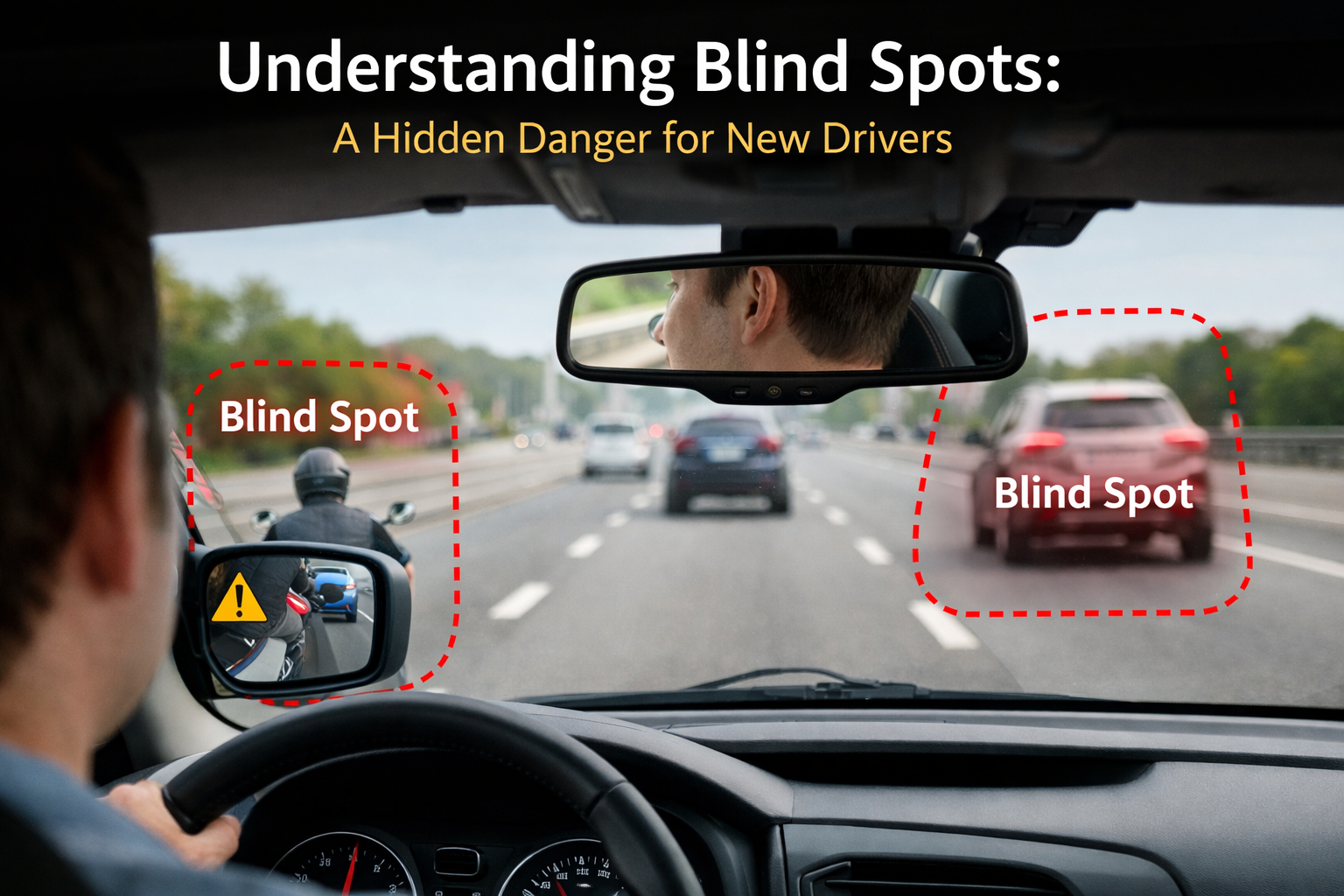
A blind spot is any area around your vehicle that cannot be seen using your rearview or side mirrors alone. Even with properly adjusted mirrors, there are still areas—especially along the sides and slightly behind your vehicle—where another car, motorcycle, cyclist, or pedestrian can remain hidden.
Most blind spots ist:
- Directly behind the vehicle
- Along the rear sides of the vehicle
- Near the rear passenger doors
- In front of large vehicles like trucks or buses
For new drivers, understanding the physical limitations of mirrors is the first step toward safer driving habits.
Why Blind Spots Are Especially Dangerous for New Drivers
perienced drivers develop habits over time. They instinctively check mirrors, scan surroundings, and perform shoulder checks before changing lanes. New drivers, however, are still building these refles.
Here’s why blind spots pose a greater risk to beginners:
1. Over-Reliance on Mirrors
Many new drivers assume mirrors show everything. They signal and change lanes without turning their head to physically check. Unfortunately, mirrors do not eliminate blind spots entirely.
2. Slower Hazard Recognition
New drivers often focus intensely on the road ahead. Because they are still mastering steering, speed control, and traffic awareness, they may not consistently scan side areas.
3. Panic Under Pressure
If a new driver suddenly notices a vehicle in their blind spot mid-lane-change, they may panic—leading to overcorrection or abrupt braking, which can cause secondary collisions.
Common Situations Where Blind Spots Cause Accidents
Blind spot-related incidents most commonly happen during:
- Lane changes on highways
- Merging onto busy roads
- Passing slower vehicles
- Turning at intersections
- Backing out of parking spaces
Highways are particularly risky because vehicles travel at higher speeds. A car hidden in a blind spot can appear instantly when you begin merging, leaving very little reaction time.
Motorcycles are especially vulnerable because their smaller size makes them harder to detect in blind zones.
The Proper Way to Check Blind Spots
Professional driving instructors emphasize one simple but powerful habit: the shoulder check.
Here’s the correct method:
- Check your rearview mirror.
- Check your side mirror in the direction you plan to move.
- Signal your intention.
- Quickly turn your head over your shoulder to visually confirm the lane is clear.
- Proceed smoothly if safe.
The shoulder check should be quick—about a one-second glance—just enough to confirm there is no vehicle in the blind zone. The key is maintaining forward control of the vehicle while briefly checking.
Practicing this consistently during driving lessons helps build muscle memory so it becomes automatic.
Mirror Adjustment: Reducing Blind Spots
While blind spots cannot be completely eliminated, proper mirror positioning can significantly reduce them.
Many drivers incorrectly angle their side mirrors inward, showing part of their own vehicle. Instead:
- Lean slightly toward the driver’s window and adjust the left mirror outward until you barely see the side of your car.
- Lean toward the center of the car and adjust the right mirror similarly.
This wider angle reduces overlap between mirrors and spands your side visibility.
However, even perfectly adjusted mirrors do not replace a shoulder check.
The Role of Technology
Modern vehicles often include Blind Spot Monitoring (BSM) systems. These systems use sensors to detect vehicles in adjacent lanes and alert the driver with a warning light or sound.
While helpful, technology should never replace proper driving habits. Sensors can fail in bad weather, heavy traffic, or compl road conditions. New drivers must treat these systems as assistance tools—not substitutes for awareness.
Learning the fundamentals first ensures drivers remain safe even in vehicles without advanced technology.
Teaching Blind Spot Awareness in Driving Schools
Professional driving schools place heavy emphasis on blind spot checks from the very first lesson. Students are trained to perform shoulder checks during:
- Every lane change
- Every merge
- Every turn
- Every parallel parking attempt
- Every three-point turn
Repetition builds safe habits.
Instructors also simulate real-life scenarios, such as hidden vehicles approaching from behind, to demonstrate why blind spot checks are essential. When students see how easily a car can disappear from mirror view, the lesson becomes unforgettable.
Driving schools also teach defensive driving techniques, encouraging students to anticipate the blind spots of other drivers. For example:
- Avoid lingering beside large trucks.
- Assume other drivers may not see you.
- Position your vehicle where you are clearly visible.
Defensive Driving and Blind Spots
Defensive driving goes beyond checking your own blind spots—it includes understanding that other drivers have blind spots too.
Smart drivers:
- Avoid driving in another vehicle’s blind zone.
- Pass large vehicles quickly and safely.
- Increase following distance in heavy traffic.
- Stay visible to others at all times.
By thinking ahead, new drivers can prevent collisions before they happen.
Parking Lot Blind Spots
Blind spots are not just a highway issue. Parking lots are full of hidden hazards—children running, shopping carts rolling, pedestrians walking behind vehicles.
When reversing:
- Turn fully to look behind you.
- Check both side mirrors.
- Reverse slowly.
Backup cameras help, but they have limited angles and may not detect fast-moving pedestrians.
Building Safe Habits Early
Driving habits formed during the first year behind the wheel often last a lifetime. If blind spot checks become automatic early on, they dramatically reduce the likelihood of future accidents.
Parents and instructors should reinforce these behaviors consistently. Encouragement, correction, and repetition are key.
For new drivers, safety is not about perfection—it’s about awareness and consistency.
Final Thoughts
Blind spots may be invisible, but their risks are very real. For new drivers, understanding and managing blind spots is one of the most critical skills to master.
Mirrors alone are not enough. Technology alone is not enough. Safe driving requires active awareness, proper training, and consistent shoulder checks.
By building strong habits from the beginning, new drivers not only protect themselves—they protect passengers, pedestrians, cyclists, and everyone sharing the road.
Driving is a responsibility. and Sometimes, the greatest dangers are the ones you cannot see—until you learn how to look for them.
Tags : driver education