Turnstile Gate: A Practical Solution for Organized Pedestrian Movement
By Global Outreach 06-10-2026 22
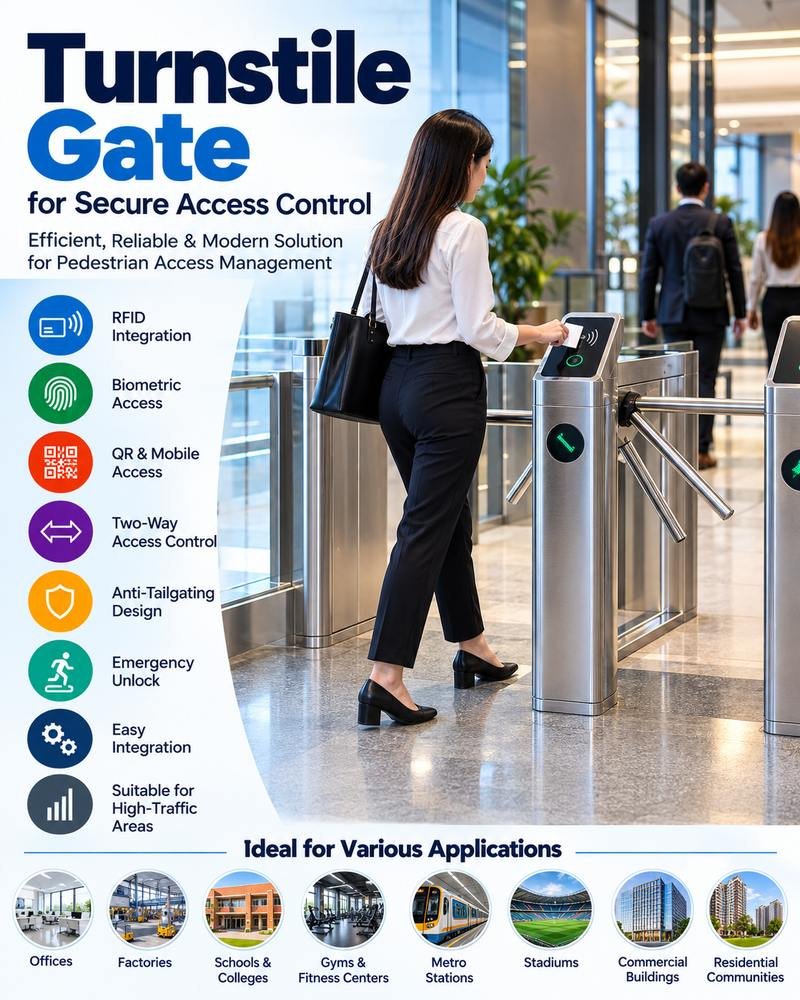
Managing people at busy entrances can become difficult when hundreds of users arrive at the same time. Offices, factories, schools, gyms, metro stations, stadiums, and commercial properties need a simple way to maintain an orderly flow.
A turnstile gate is designed for this purpose. It creates a dedicated passage where people can be checked before moving into a building or restricted area.
Modern systems can work with RFID cards, QR codes, biometric readers, and electronic controllers, making them suitable for different types of properties.
Understanding Turnstile Gates
A turnstile gate is a mechanical and electronic pedestrian passage system.
It generally consists of a body, rotating or moving barrier, control unit, reader, and safety mechanism. When an approved credential is presented, the control unit allows the barrier to operate.
After the person passes through, the mechanism returns to its normal position.
This arrangement creates a clear and orderly route for people entering a property.
Why Are Turnstile Gates Becoming Popular?
Traditional entrances may require security staff to manually check every person. This can become difficult during busy hours.
A turnstile system can automate much of this process.
It can help organizations manage:
- Employee movement
- Visitor movement
- Member entry
- Student movement
- Staff attendance
- Building entry
- Restricted-area movement
The system can also be connected to software used for attendance and visitor records.
RFID-Based Turnstile Gate
RFID is one of the commonly used technologies for turnstile systems.
Each registered user can receive an RFID card or credential. The reader identifies the card when it is presented near the turnstile.
If the credential is approved, the controller releases the barrier and the user can pass.
RFID turnstiles are useful for:
- Corporate offices
- Factories
- Educational institutions
- Fitness centers
- Residential properties
- Industrial buildings
Biometric Turnstile Gate
Some locations require identity verification through biometric technology.
A turnstile can be paired with a fingerprint or facial recognition device. The biometric device verifies the user and communicates with the controller.
This type of setup can be useful where organizations want to connect pedestrian movement with employee or member records.
QR Code Entry
QR technology provides another convenient option.
A temporary QR code can be issued to visitors, event participants, contractors, or other approved users. The code can be scanned at the entrance and the turnstile can respond according to the configured permission.
This can reduce paperwork and simplify temporary entry management.
Where Can Turnstile Gates Be Used?
Turnstile gates can be installed in many environments.
Corporate Offices
Companies can use turnstiles at reception areas to manage employee and visitor movement.
Manufacturing Plants
Factories can create dedicated pedestrian lanes for employees and contractors.
Schools and Colleges
Educational institutions can use turnstiles to manage student and staff movement at selected entrances.
Gyms
Fitness centers can connect turnstiles with membership systems to simplify daily entry.
Metro Stations
Transit locations can use pedestrian gates to manage large numbers of passengers.
Stadiums
Sports venues can use turnstile lanes at entrances to organize crowd movement.
Residential Properties
Apartment communities can use electronic turnstiles for controlled pedestrian movement.
Main Advantages
A well-planned turnstile installation can provide several advantages.
Organized Movement
Dedicated lanes help create a predictable route for people.
Faster Processing
Electronic verification can reduce manual checking at busy entrances.
User Records
When connected with suitable software, the system can help maintain movement records.
Multiple Verification Options
RFID, QR codes, biometric readers, and other technologies can be used according to project requirements.
Better Entrance Management
Turnstiles provide a clearly defined pedestrian passage and can support the overall security plan of a property.
Choosing a Turnstile Gate
Before purchasing a turnstile system, buyers should review the requirements of the location.
Important points include:
Daily User Volume
Estimate how many people will use the entrance each day and during peak periods.
Installation Location
Determine whether the equipment will be installed indoors or outdoors.
Passage Requirements
Check the available space and required lane width before selecting a model.
Reader Technology
Choose RFID, QR, biometric, or another reader according to the planned user verification method.
Emergency Operation
Review how the system behaves during power failure or an emergency.
Software Connection
Check whether the turnstile can communicate with attendance, visitor, membership, or building management software.
Service Support
Warranty, installation assistance, spare parts, and maintenance are important for long-term operation.
Turnstile Gate Manufacturer in India
When searching for a turnstile gate manufacturer in India, buyers should compare product construction, operating mechanism, reader compatibility, installation support, customization options, warranty, and service availability.
Houston Systems offers pedestrian movement and security solutions for offices, factories, educational institutions, commercial properties, gyms, and other locations.
The appropriate model can be selected according to the number of users, installation environment, reader technology, lane requirements, software connection, and operational needs.
Conclusion
A turnstile gate can provide an organized and technology-driven way to manage pedestrian movement.
With options such as RFID, QR codes, biometric readers, and electronic controllers, turnstile systems can be adapted to different types of buildings and user requirements.
Before investing in a system, organizations should evaluate daily user volume, available space, reader technology, installation conditions, emergency operation, software connection, warranty, and service support.
A properly planned turnstile installation can improve the overall flow of people while creating a more structured entrance environment.