Tripod Turnstile Comparison: Features, Specifications & Buying Guide
By Houston System 26-09-2026 38
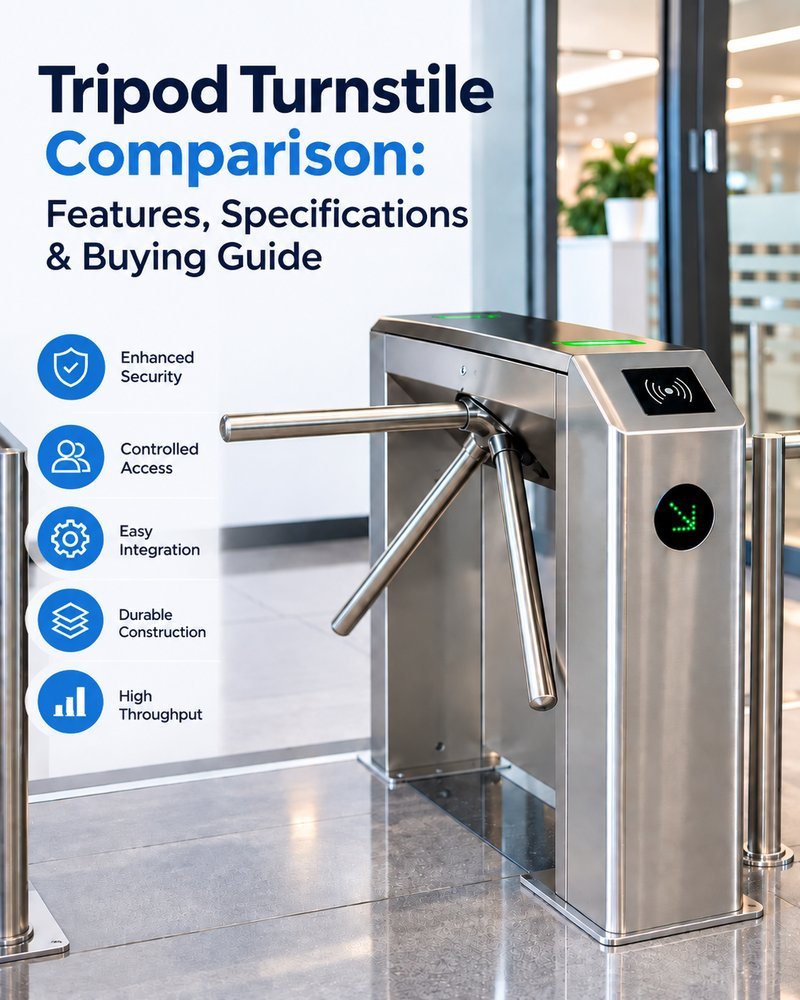
Managing pedestrian access is an important part of security and facility management. Offices, factories, educational institutions, gyms, stadiums, transit facilities, and commercial buildings often need controlled entry systems that can regulate movement without creating unnecessary delays.
A Tripod Turnstile provides a practical solution for controlled pedestrian access. It uses a three-arm mechanism to permit authorized users to pass through a designated entry point while helping organizations manage access more systematically.
However, choosing the right system involves more than comparing prices. Construction, access-control integration, passage requirements, emergency operation, durability, and after-sales support should all be considered.
What Is a Tripod Turnstile?
A tripod turnstile is a pedestrian access-control gate with three rotating arms. The mechanism allows one authorized person to pass through after successful authentication.
Depending on the configuration, a Tripod Turnstile Gate can work with RFID cards, QR codes, biometric readers, access cards, or other access-control technologies.
Organizations evaluating a Tripod Turnstile should consider construction quality, access-control compatibility, pedestrian traffic, emergency operation, and long-term maintenance requirements.
Key Features to Compare
Before selecting a tripod turnstile, buyers should compare important technical and operational parameters.
| Parameter | What to Consider |
|---|---|
| Product Type | Automatic or semi-automatic |
| Construction | Stainless steel and suitable material grade |
| Passage Direction | Single or bidirectional |
| Access Methods | RFID, QR, biometric, card, etc. |
| Passage Width | Based on site requirements |
| Emergency Operation | Emergency unlock/free passage |
| Anti-Tailgating | Available functionality |
| Reader Integration | Compatibility with access-control readers |
| Throughput | Expected pedestrian traffic |
| MCBF | Mechanical cycle rating |
| IP Rating | Suitability for the installation environment |
| Power Supply | Required electrical configuration |
| Communication | Supported interfaces/controllers |
| Operating Temperature | Environmental suitability |
| Installation | Indoor/outdoor suitability |
| Integration | Access-control and security systems |
| Warranty | Manufacturer warranty |
| AMC Support | Maintenance availability |
| Customization | Project-specific requirements |
| Technical Support | Installation and after-sales assistance |
Actual specifications can vary by model, so buyers should always verify the manufacturer's technical datasheet before making a purchase.
Automatic Tripod Turnstile: How Does It Work?
An Automatic Tripod Turnstile typically works by connecting the turnstile mechanism with an access-control system.
When an authorized user presents an RFID card, QR code, biometric credential, or another approved authentication method, the controller verifies the access request. If access is authorized, the turnstile releases the mechanism and allows the user to pass.
After passage, the mechanism returns to its controlled position.
This type of automation can help organizations manage pedestrian movement while maintaining an electronic record of access activity when integrated with suitable software.
RFID and Biometric Integration
Modern tripod turnstiles can support integration with different authentication technologies.
RFID Access
RFID cards or tags can be used to identify authorized employees, students, members, or visitors.
QR Code Access
QR-based access can be useful for temporary credentials, visitors, events, and ticket-based entry.
Biometric Access
Biometric authentication can be integrated where identity-based access is required.
The appropriate authentication method depends on the organization's security requirements and existing access-control infrastructure.
Tripod Turnstile vs. Other Turnstile Systems
Different facilities may require different types of pedestrian access-control systems.
A tripod turnstile is generally suited to controlled pedestrian access where a compact solution is required. Flap barriers can provide a wider and more visually open passage, while full-height turnstiles provide a substantially enclosed physical barrier for applications with different security requirements.
Before selecting a system, consider:
- Required security level
- Available installation space
- Expected pedestrian volume
- Passage width
- Indoor or outdoor environment
- Access-control technology
- Emergency requirements
- Integration requirements
- Maintenance needs
The right choice depends on the actual requirements of the facility.
Where Are Tripod Turnstiles Used?
A Pedestrian Turnstile Gate can be considered for a wide range of controlled-access environments, including:
- Corporate offices
- Factories
- Warehouses
- Educational institutions
- Gyms and fitness centers
- Metro and transit facilities
- Stadiums
- Government facilities
- Commercial buildings
- Residential communities
For demanding outdoor or higher-security applications, organizations may need to consider alternative configurations such as full-height turnstiles.
What Should You Check Before Buying?
1. Construction Quality
Check the material, finish, mechanical construction, and environmental suitability of the system.
2. Access-Control Compatibility
Confirm compatibility with the existing RFID, biometric, QR, card, or centralized access-control system.
3. Pedestrian Capacity
Consider the expected number of users during peak periods and select a system designed for the required traffic.
4. Emergency Operation
Understand how the turnstile behaves during power failures and emergencies. Confirm whether emergency unlock functionality can be integrated with the facility's safety systems.
5. Integration
For larger projects, check whether the turnstile can integrate with access-control, attendance, visitor-management, or other security systems.
6. Maintenance and Support
Warranty, spare-parts availability, installation support, technical assistance, and AMC options can be important for long-term operation.
Why Manufacturer Selection Matters
Selecting an experienced Tripod Turnstile Manufacturer can make it easier to evaluate the system according to the actual site requirements.
A suitable manufacturer or supplier should be able to provide technical documentation, integration guidance, installation assistance, warranty information, and after-sales support.
For projects involving multiple access points, buyers should also check whether the manufacturer can provide customization and future expansion support.
Tripod Turnstile Buying Checklist
Before finalizing a system, compare:
- Construction and material
- Passage width
- Access-control compatibility
- RFID/QR/biometric integration
- Emergency operation
- Anti-tailgating functionality
- Throughput
- MCBF
- Environmental/IP rating
- Power requirements
- Warranty
- AMC support
- Installation requirements
- System integration
- Scalability
- Technical support
A detailed comparison can help organizations avoid selecting a system based only on its initial purchase price.
Frequently Asked Questions
What is a tripod turnstile gate?
A tripod turnstile gate is a pedestrian access-control system that uses three rotating arms to regulate entry and exit through a controlled passage.
Can a tripod turnstile support RFID access?
Yes. Many tripod turnstile systems can be integrated with RFID readers and access-control systems, depending on the selected configuration.
Can tripod turnstiles be integrated with biometric systems?
Yes. Compatible biometric readers can be integrated with a tripod turnstile to provide identity-based access control.
What is the difference between a tripod turnstile and a full-height turnstile?
A tripod turnstile uses three rotating arms and provides a relatively compact pedestrian access solution. A full-height turnstile creates a taller physical barrier and is generally considered for applications requiring more restrictive pedestrian control.
What should I consider when choosing a tripod turnstile manufacturer in India?
Consider product specifications, construction quality, integration capabilities, customization, installation support, warranty, spare-parts availability, and after-sales service.
Final Thoughts :
Choosing a tripod turnstile should be based on the complete operational requirements of a facility rather than price alone.
Construction quality, authentication technology, pedestrian traffic, emergency functionality, integration capabilities, durability, and after-sales support can all influence the suitability of a system.
By comparing these factors before purchasing, organizations can select a Tripod Turnstile Gate that fits their access-control infrastructure and long-term operational requirements.