Top Software Development Trends 2026 Every Business Is Searching for Right Now
By Impero IT Services 16-12-2025 85
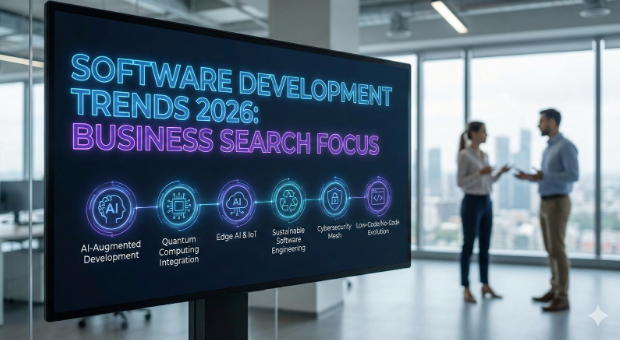
If you talk to enough engineering teams, you start hearing the same set of questions, such as, What’s actually changing in software development? Which trends matter? Which ones are just noise?
2026 has a different energy compared to the last few years, and it brings less hype and acts with more maturity. Technologies that felt experimental a few years earlier are finally stable enough to influence architecture decisions, hiring plans, and product strategy.
Most of these trends are shaping the future of software development. So, let’s walk through the trends engineering teams are actively preparing for, based on what teams across Canada, New York, and San Francisco are actively implementing right now.
1. AI Engineering Matures Into a Full SDLC Discipline
AI engineering is turning into a proper pillar in the SDLC with its own pipelines, testing strategies, and release processes. Teams are building:
- model versioning workflows (think MLflow + internal registries)
- automated drift detection
- embedding reuse services
- retrieval-layer abstractions instead of one-off RAG hacks
- The real friction is integrating AI systems with existing observability stacks. Telemetry for model behavior
- looks nothing like application metrics, and most orgs are still plugging that gap manually.
2. Code Automation Gets Practical and Sometimes Invisible
We are not talking about AI “writing” production services. The actual impact is showing up in automation layers around the codebase. 2026 dev environments are moving toward:
- AI-assisted unit test generation
- automated API contract verification
- self-healing CI pipelines
- code review suggestions tuned to org-specific patterns
Most of this happens quietly. You will see PRs shrinking and deployment windows tightening. A quick observation from real projects like automation almost never reduces headcount; it reallocates developers toward deeper architectural work.
3. E-Commerce Tech Stacks Turn Into Real-Time Decision Systems
E-commerce used to be CRUD with caching, but not anymore. In 2026, the stack is shifting toward:
- low-latency personalization via edge inference
- streaming-based recommendation systems
- dynamic storefront rendering driven by user-intent vectors
- per-session pricing/offer logic
The tricky part is orchestration models run in multiple places, edge, browser, and region-level nodes, and keeping behavior consistent takes careful design.
4. Composable Architectures Replace the “One Big Platform” Mentality
The future of software development in New York is modular and not a chaotic microservices rush. Teams are standardizing around:
- headless services
- domain-native packaged business capabilities
- event-first architectures
- poly-repo structures with strict contract enforcement
The hardest part is observability. Every time you decompose something, your logs scatter. Engineers underestimate this far more than they should.
5. Multi-Cloud Is a Resilience Requirement
By 2026, business teams care less about vendor flexibility and more about availability zones not taking them down. The engineering consequences:
- multi-cloud identity fabric
- consistent networking layers, service meshes are back in style.
- workload portability using WASM runtimes and container-optimized images
- region-aware data-sync flows
Multi-cloud sounds simple, but now it is seen as a practical strategy. The engineering reality of identity management, networking, and observability, but none of those behave nicely when you spread workloads across providers.
6. Edge Development Goes From Niche to Normal
The push to run AI inference closer to the user is shaping architectures in a big way. Edge patterns that are becoming standard are
- hybrid inference pipelines (client → edge → cloud)
- distributed feature stores
- device-side caching and state reconciliation
- latency-aware A/B routing
One unexpected engineering challenge is that debugging logs from hundreds of edge nodes feels like sorting through confetti. But once teams nail the deployment strategy, user-facing latency improvements are massive.
7. Privacy Engineering Becomes a Core Design Constraint
Between regulatory changes and increasing AI adoption, privacy cannot be bolted on later. In 2026, engineers are adopting:
- differential privacy for analytics
- client-side vectorization to avoid sending raw data
- federated training for region-limited data
- zero-trust data pipelines with per-hop encryption
A lot of AI architectures now have a privacy layer before the actual inference layer.
8. Low-Code/No-Code Integrates into DevOps Instead of Competing with It
Nobody will be replacing developers with LCNC tools, but San Francisco engineers are embedding low-code automation into internal systems. Its typical uses include:
- workflow orchestration
- admin dashboards
- internal data tooling
- ops automation
The danger here is the “shadow systems” created by business users. Most dev teams now set guardrails early, so they do not inherit a monster later.
9. Software Supply Chain Security Becomes a Build-Breaker
Security teams are getting stricter, and CI/CD is enforcing rules that used to be “recommended.” By 2026, expect these to become compulsory:
- mandatory SBOMs
- signed container images
- automated dependency health scoring
- isolated build environments
- reproducible builds
We are seeing more companies treat supply chain issues as critical incidents, not post-release fixes. Teams resist these rules until a compliance audit forces the upgrade, then nobody argues again.
Why These Trends Matter for Engineering Teams
Software development in 2026 is about building smarter, faster, and safer, without overcomplicating the tech stack. This year, development gets more distributed, more automated, and more AI-first.
Most teams do not require the use of every trend. But they do need enough awareness to choose what actually moves their product forward.
If you already operate in tech-heavy regions like Canada, San Francisco, or New York, you will see these changes hitting even faster. And if you are planning your 2026 strategy, focusing on AI engineering, automation, and composable systems is a solid place to start.