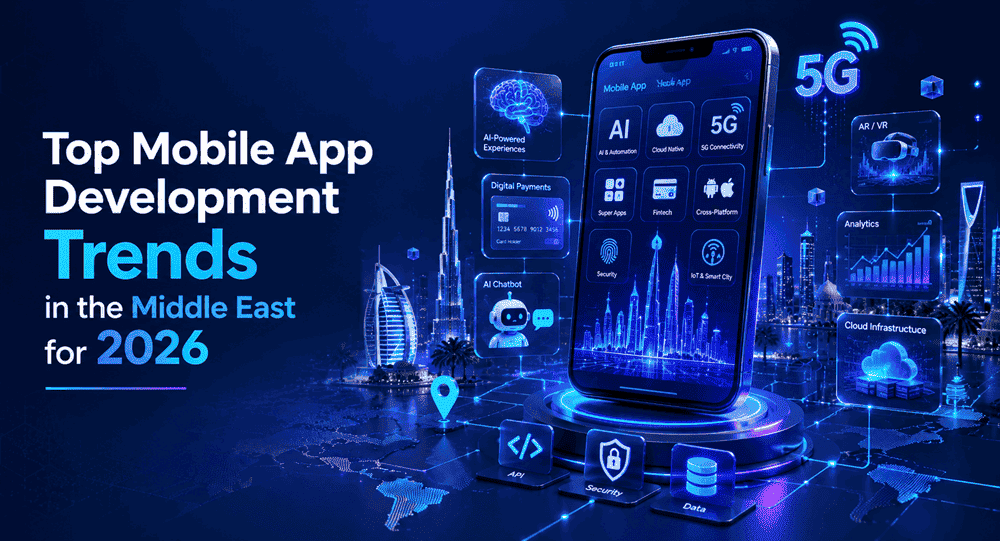
The mobile app ecosystem in the Middle East is entering a completely new growth phase in 2026. What was once a region rapidly adopting digital transformation has now become a global innovation hub for AI-driven experiences, fintech ecosystems, smart city infrastructure, and enterprise mobility solutions.
Countries like the United Arab Emirates, Saudi Arabia, Qatar, and Bahrain are investing in artificial intelligence, cloud infrastructure, smart governance, digital banking, and connected ecosystems. These investments are directly influencing how businesses approach mobile app development across industries such as healthcare, logistics, fintech, eCommerce, transportation, tourism, and real estate.
In 2026, mobile apps are no longer just customer-facing tools. They are becoming intelligent business platforms powered by AI, automation, predictive analytics, cloud-native architecture, and immersive technologies.
The next generation of mobile applications in the Middle East will focus on:
- Hyper-personalized user experiences
- AI-powered automation
- Real-time connectivity through 5G
- Secure digital payments and fintech ecosystems
- Super apps with multi-service capabilities
- Cloud-native and cross-platform development
- Privacy-first app architecture
- Smart city integrations
The region’s growing digital economy, combined with government-backed innovation programs, is creating massive opportunities for businesses investing in scalable mobile applications. Industry analysts and recent technology reports indicate that AI integration, super apps, IoT connectivity, biometric security, and cross-platform frameworks are among the strongest app development trends shaping 2026.
Let’s explore the biggest mobile app development trends transforming the Middle East in 2026.
AI-Native Mobile Applications Are Becoming the Standard
Artificial intelligence is no longer an optional feature in mobile apps. In 2026, AI will become the foundation of modern app experiences across the Middle East.
Businesses are integrating AI directly into their mobile platforms to automate workflows, improve personalization, enhance customer support, and analyze user behavior in real time. AI-powered mobile applications are helping businesses:
- Deliver personalized recommendations
- Automate customer service using chatbots
- Enable predictive search functionality
- Improve fraud detection in fintech apps
- Optimize logistics and fleet management
- Enhance healthcare diagnostics
- Automate enterprise operations
Generative AI is also playing a major role in mobile app innovation. Businesses are integrating AI assistants, voice-based interactions, AI-generated content, and intelligent automation directly into mobile ecosystems.
The rapid growth of AI-focused infrastructure in the Middle East is accelerating this shift. Governments and enterprises are heavily investing in enterprise AI adoption, smart automation, and sovereign AI ecosystems.
According to recent industry reports, AI-driven personalization and automation are among the most influential mobile app development trends shaping 2026.
Super Apps Are Dominating the Middle Eastern Market
The rise of super apps is one of the biggest mobile app trends transforming the Middle East. It is inspired by platforms like Grab and WeChat. The businesses in the region are now building multi-service ecosystems that combine:
- Payments
- Food delivery
- Ride-hailing
- Banking
- eCommerce
- Insurance
- Messaging
- Travel booking
- Utility services
Instead of downloading multiple apps, users increasingly prefer one centralized ecosystem that manages all daily digital activities. This trend is especially strong in the GCC region, where digital adoption rates are among the highest globally.
Super apps offer several business advantages:
- Higher customer retention
- Increased cross-selling opportunities
- Unified customer data
- Improved engagement
- Reduced acquisition costs
- Better scalability
Mobile banking and fintech sectors are aggressively moving toward super app ecosystems in 2026. Financial institutions are integrating investments, insurance, payments, lending, and digital wallets into unified mobile experiences.
5G-Powered Mobile Experiences Are Expanding Rapidly
The expansion of 5G infrastructure across the Middle East is transforming how mobile applications are designed and deployed. With ultra-fast connectivity and low latency, developers can now build highly immersive and data-intensive applications that were previously impossible.
5G is enabling:
- Real-time video communication
- Cloud gaming
- AR/VR experiences
- Smart city applications
- IoT-powered ecosystems
- Autonomous mobility solutions
- Remote healthcare monitoring
- Live analytics platforms
The impact of 5G is particularly significant in sectors like healthcare, logistics, manufacturing, and transportation.
Modern app architectures are increasingly optimized for 5G-first experiences. Developers are focusing on real-time synchronization, edge computing, and cloud-native deployment models to maximize performance.
Technology reports continue to identify 5G integration as a core mobile app development trend for 2026.
Fintech and Digital Banking Apps Continue to Surge
The Middle East has become one of the world’s fastest-growing fintech markets. Digital banking, mobile wallets, contactless payments, and AI-powered financial ecosystems are rapidly replacing traditional banking experiences.
In 2026, fintech app development is heavily focused on:
- Embedded finance
- Open banking APIs
- Digital wallets
- AI-powered wealth management
- Cross-border payments
- Blockchain integration
- Buy Now Pay Later (BNPL) systems
- Biometric authentication
Consumers across the region increasingly expect secure, mobile-first financial experiences. Banks and fintech startups are investing heavily in mobile banking applications capable of delivering seamless user journeys with advanced security infrastructure.
Cross-Platform Development Is Becoming the Preferred Approach
Businesses in the Middle East are increasingly prioritizing faster deployment and reduced development costs.
As a result, cross-platform app development frameworks such as Flutter, React Native, and Kotlin Multiplatform are becoming the preferred development approach in 2026.
Cross-platform development allows businesses to:
- Launch apps faster
- Reduce maintenance costs
- Reach Android and iOS users simultaneously
- Accelerate MVP development
- Maintain consistent UI/UX experiences
- Simplify updates and feature rollouts
Modern cross-platform frameworks now offer near-native performance, making them ideal for enterprise-grade applications.
This trend is especially beneficial for startups and growing enterprises seeking scalable digital transformation without excessive development expenses.
Industry reports identify cross-platform frameworks as one of the dominant trends in mobile app development heading into 2026.
IoT-Integrated Mobile Apps Are Reshaping Smart Ecosystems
The Middle East’s investment in smart cities and connected infrastructure is accelerating IoT app development. Mobile applications are increasingly connected with:
- Smart homes & buildings
- Connected vehicles
- Industrial automation systems
- Healthcare devices
- Wearables
- Smart retail ecosystems
- Energy management systems
IoT-enabled mobile apps are becoming critical for industries like logistics, healthcare, manufacturing, and transportation.
For example:
- Smart healthcare apps can monitor patients remotely
- Logistics apps can track fleet performance in real time
- Retail apps can enable automated inventory systems
- Smart city apps can manage utilities and transportation networks
As IoT adoption grows, developers are focusing on scalable cloud infrastructure, real-time analytics, and edge computing integration. IoT connectivity remains one of the most influential trends shaping mobile applications in 2026.
Privacy-First and Zero-Trust Security Models Are Essential
Cybersecurity is becoming one of the most important priorities for mobile app development in the Middle East. As digital ecosystems expand, businesses are increasingly investing in:
- Zero-trust security architecture
- End-to-end encryption
- Multi-factor authentication
- Biometric login systems
- AI-powered threat detection
- Blockchain-based identity systems
- Secure cloud infrastructure
Users now expect strong privacy protection and secure digital experiences. Fintech, healthcare, and enterprise applications require advanced compliance-focused architectures capable of protecting sensitive user data.
Biometric authentication is rapidly replacing traditional passwords across mobile ecosystems. Security-focused app development is expected to become a baseline requirement for enterprise mobility solutions in 2026.
AR and VR Mobile Experiences Are Expanding Beyond Gaming
Augmented reality and virtual reality are moving beyond entertainment and gaming applications. In 2026, businesses across the Middle East are adopting immersive mobile technologies for:
- Real estate visualization
- Virtual tourism
- Retail try-on experiences
- Healthcare training
- Industrial simulations
- Education platforms
- Smart retail experiences
Retail and eCommerce brands are especially leveraging AR to improve customer engagement and increase conversion rates. Real estate companies are integrating virtual property tours directly into mobile apps, allowing users to explore properties remotely.
The growth of smart tourism initiatives across the Middle East is also accelerating AR-powered travel experiences. Industry reports continue to identify AR and VR as major growth areas in future mobile applications.
Voice Technology and Conversational Interfaces Are Growing
Voice-enabled mobile experiences are becoming more sophisticated with advancements in AI and natural language processing. Businesses are integrating voice functionality into mobile apps for:
- Smart customer support
- AI assistants
- Voice commerce
- Smart home controls
- Enterprise workflow automation
- Healthcare support systems
Arabic-language AI assistants are also gaining momentum in the Middle East, creating more localized and culturally relevant mobile experiences.
Conversational UI design is expected to become common across fintech, retail, healthcare, and enterprise applications.
AI-powered conversational interfaces are now viewed as a major differentiator for user engagement and accessibility.
Cloud-Native Mobile Applications Are Becoming the Backbone of Scalability
Cloud-native app development is becoming essential for businesses building scalable digital ecosystems in 2026. Modern mobile applications increasingly rely on:
- Kubernetes infrastructure
- Microservices architecture
- Serverless computing
- API-first development
- Cloud-based databases
- Real-time synchronization
Cloud-native architecture helps businesses:
- Scale applications faster
- Reduce downtime
- Improve performance
- Accelerate feature deployment
- Enhance app reliability
- Optimize operational costs
As mobile applications become more complex, businesses in the Middle East are prioritizing flexible cloud infrastructure capable of supporting rapid growth. Cloud-native ecosystems are particularly important for fintech, healthcare, logistics, and enterprise mobility solutions.
Low-Code and No-Code Development Are Accelerating Innovation
The demand for faster digital transformation is driving the adoption of low-code and no-code development platforms across the Middle East. Businesses are increasingly using these platforms to:
- Build internal enterprise tools
- Launch MVPs quickly
- Automate workflows
- Reduce development timelines
- Improve operational agility
While enterprise-grade applications still require advanced engineering, low-code platforms are helping businesses enhance experimentation and innovation. This trend is especially useful for startups and SMEs seeking faster market entry without extensive development cycles.
The Future of Mobile App Development in the Middle East
The Middle East is rapidly evolving into one of the world’s most advanced digital economies. Government-led digital transformation initiatives, rising smartphone penetration, strong cloud adoption, and AI investments are reshaping how businesses approach mobile innovation.
Successful mobile applications will not simply offer functionality in 2026. They will deliver intelligent, connected, scalable, and highly personalized digital ecosystems.
Businesses that invest early in AI-native architecture, super apps, cloud-native infrastructure, fintech innovation, and immersive user experiences will be better positioned to compete in the region’s rapidly expanding digital marketplace.
The future of mobile app development in the Middle East will be driven by:
- AI-powered automation
- Intelligent personalization
- Hyper-connectivity through 5G
- Smart city ecosystems
- Cloud-native scalability
- Secure fintech infrastructure
- Immersive AR/VR experiences
- Cross-platform agility
As user expectations continue to evolve, businesses must prioritize innovation, scalability, security, and user-centric design to remain competitive in 2026 and beyond.