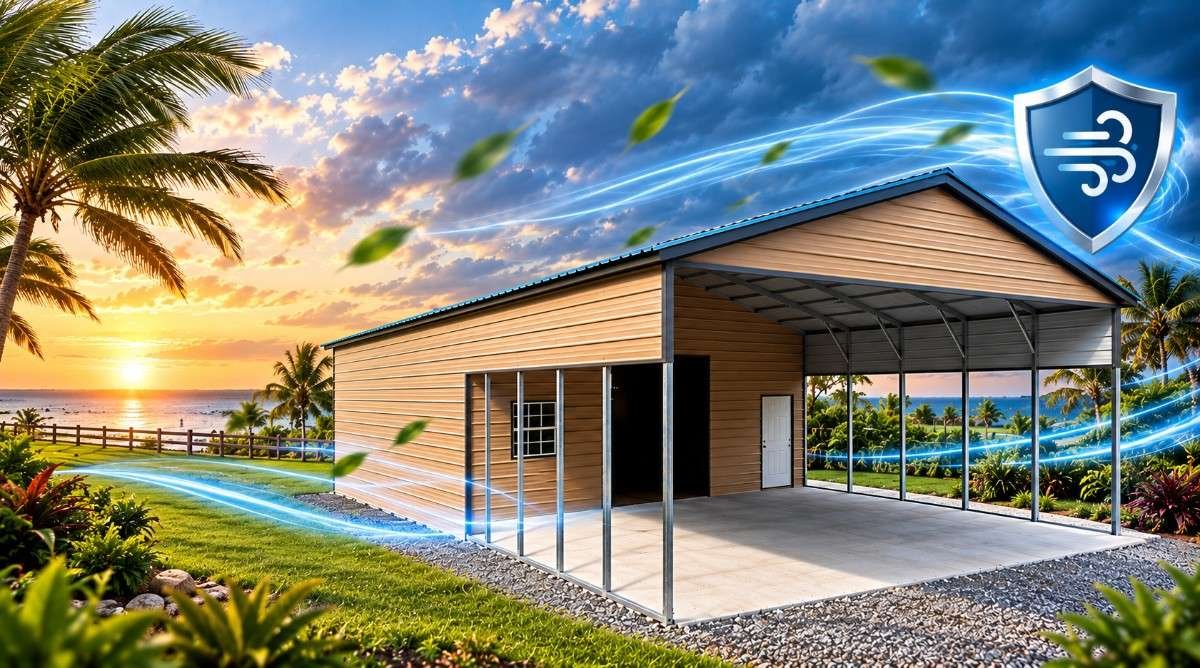
Wind ratings might be mere numbers for some people, but they are crucial for people who are planning to install metal carports. They have to check the metal carport wind load carefully so the structure can bear the pressure and weight and protect everything stored inside it.
This checking is crucial because wind pushes on the sides and lifts the roof. It generally happens in many states in the USA. That wind pressure mainly travels through the frame and anchors into the ground and becomes the main reason frames are uprooted in many cases. That's why building owners have to focus on wind-rated metal carports when buying them.
But what metal carport wind rating is best for your carport so it can bear the wind speed. Well, wind ratings are not universal grades. U.S. building standards use location-specific data. Today, we will talk about five wind ratings: 90, 120, 130, 150, and 170 mph because they are useful reference points. But these ratings are not fixed for all types of wind pressure, carports, and regions; many other factors, like local codes and site conditions, are considered to decide on the right wind rating for metal carports.
What Is a Metal Carport Wind Rating?
Wind rating refers to the wind speed, and carports with wind ratings are called wind-rated metal buildings. Engineers working on prefabricated buildings consider how much pressure the building can withstand while designing it. Well, it does not promise the carport will come through a storm untouched at that speed, but it ensures that it can stand firm against enough pressure.
The International Building Code requires wind loads to be set using ASCE 7. FEMA adds that wind speed, exposure, building height, shape, enclosure, terrain, and risk category all shape the final number. This is why, before you buy a metal carport, always read a rating alongside your site conditions.
Here Are the Top 5 Wind Ratings Worth Knowing
There are various other types of ratings as well. But these are widely accepted ones, and most installers consider them for a metal carport wind rating.
1. 90 MPH: It's the Lower Benchmark
90 MPH is a starting point for metal carport wind speed. This is mostly used for properties and areas away from coastal areas. But you still have to discuss with your local authorities whether they allow you to install a structure with this metal carport wind load or not. Moreover, consider local codes and terrain, because they play a major role in installation.
2. 120 MPH: A Common Storm Benchmark
At 120 mph, the forces are far heavier than at 90mph. You need to ensure that your prefab carport can handle 120mph if you live in an area where wind speed is higher than normal. This rating is effective if you want a metal carport for areas with strong storms. This is why you should not only focus on thicker panels, but also wind-rated structures.
3. 130 MPH: A Code-Level Benchmark
130 MPH speed appears directly in the 2021 IRC. This rating treats 130 to under 140 mph as Wind Zone 1 in one provision. At this level, you need to focus on metal carport wind load, not just the mph label. For example, your installers say that it is a wind-rated metal carport, but don’t just go by the sticker; you need proof. Always ask for engineering documents that have proof. You can also check the design basis, the foundation, and anchoring.
4. 150 MPH: High-Wind and Hurricane Regions
If you live in hurricane-prone areas, this rating is going to be super important for your structure. In parts of Florida, the Atlantic and Gulf coasts, wind blows with speed; often it uproots structures. But that does not mean every property in those states needs 150 mph; in most cases, local jurisdiction, coastal distance, exposure, and risk category set the real rating for a structure.
5. 170 MPH: Extreme Hurricane Design
The 2021 IRC places 150 through 170 mph in Wind Zone 3 and anything above 170 mph in Wind Zone 4. In this case, you should install a steel carport with only stronger framing or the right gauge as per need. Ensure you buy from a trusted metal carport dealer who designs connections and enhances anchoring carefully. In this case, picture two carports with identical dimensions.
Why Location Changes Your Metal Carport Wind Load
Because different locations face different weather conditions. Local authorities decide on the structure installation as per different situations in their areas. You can check the ASCE Hazard Tool to know about the location-specific wind data. For this, just enter an address and pick the applicable standard edition to know how much wind-rated metal building you need.
Here are some steps you can take to decide:
First, finalize your steel carport size, features, and other things
Talk to local authorities about the structure and building codes applicable to your area
Discuss specifically whether they allow the particular wind-rated metal carport.
Once they approve your structure, find a trustworthy steel building manufacturer
Ensure the dealer provides the carport with a wind-rating certificate.
Final Thoughts
By this time, you must have understood that wind-rating is more than just a number on the product listing. Analyze these ratings 90, 120, 130, 150, and 170 mph carefully, and you can analyze other ratings as well, as per the area you live in. The ratings discussed above are benchmarks used in U.S. design, but your location decides which one applies. Look at your needs, structure, roof type, steel gauge, anchors, trims, and many other factors and features. And then match those to your site location. This way, you can select the right metal building for your needs.