Top 10 Mobile App Development Technologies to Watch—and Invest In—in 2026
By Peter Parker 26-08-2026 221
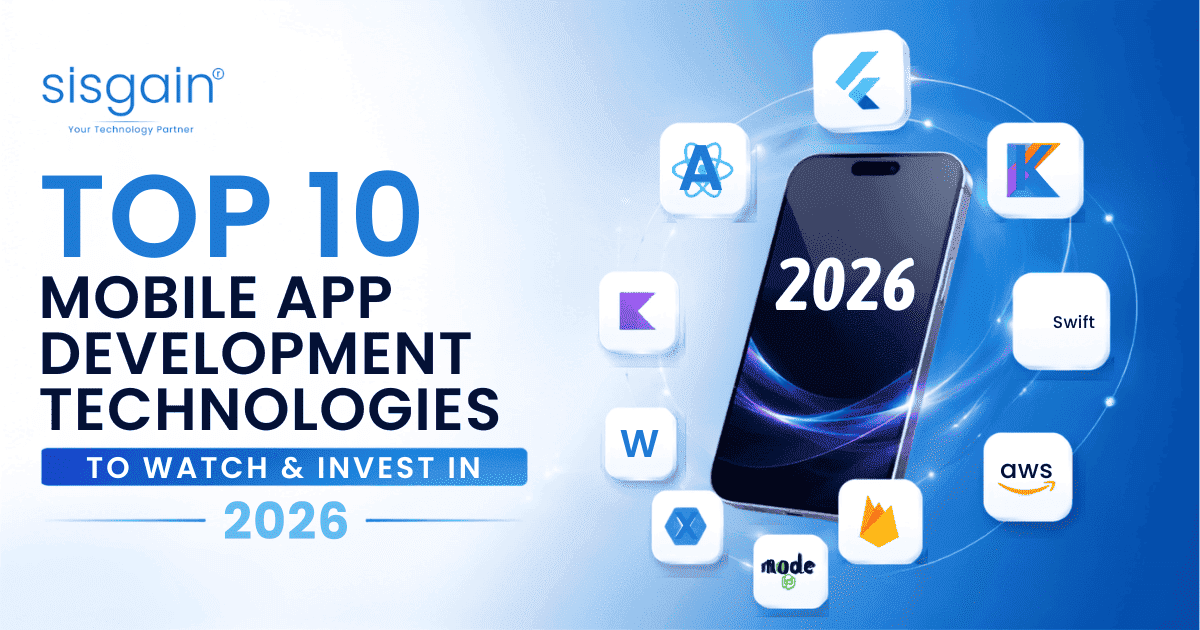
If you're a CEO or founder weighing where to put your technology budget next year, here's the uncomfortable truth: most of that budget is still going toward apps built on 2022 assumptions. That's a problem, because the mobile app development technologies shaping 2026 aren't incremental upgrades — they're changing who wins the customer, who ships faster, and who gets left explaining a stalled roadmap to the board.
This isn't a trend roundup written by people who've never shipped a product. It's a practical guide for decision-makers who need to know which technologies actually move revenue, retention, and speed to market — and which ones are just noise dressed up as innovation. As a mobile app development company Dubai businesses already trust for exactly these calls, we've built this list around what's working right now, not what sounds good in a keynote.
Key Takeaways
- Global mobile app revenue hit roughly $330 billion in 2025 and is projected to cross $1 trillion within the next decade — the market isn't slowing down, it's compounding.
- AI is no longer a bolt-on feature. Roughly 6 in 10 mobile development teams now build AI into the core app architecture, not around it.
- Cross-platform frameworks (Flutter, React Native, Kotlin Multiplatform) have become the default choice for enterprise mobile builds, not the budget option.
- Low-code platforms are projected to power 75% of new application development by 2026, up from 40% in 2021.
- Generative AI tools can cut development timelines by up to 50%, while AI-driven personalization lifts engagement by 40-60%.
- The UAE holds an estimated 60% share of the Middle East's mobile app market, making Dubai one of the most competitive — and lucrative — regions to launch in.
- 90% of apps are opened once and abandoned. Choosing the right technology stack from day one is the difference between a sunk cost and a growth engine.
Why Mobile Technology Decisions Matter More in 2026
Founders don't need another lecture on "digital transformation." What you need is a clear-eyed view of where the money is actually going.
Global mobile app revenue reached approximately $330.61 billion in 2025 and is on a trajectory that puts it past the $1 trillion mark within the next decade, growing at roughly a 14% compound annual rate. That growth isn't coming from more people downloading more apps — smartphone adoption has largely plateaued in mature markets. It's coming from depth of use: how sophisticated the monetization is, how personalized the experience feels, and how well the underlying technology performs under pressure.
Dubai and the wider UAE sit right in the middle of this shift. The country already accounts for an estimated 60% of the Middle East's mobile app market, and mobile retail sales alone were projected to grow at a 15.6% CAGR between 2022 and 2026 to reach $4.6 billion. Put simply: the audience is here, the spending power is here, and the competition is only going to get sharper. A generic app with outdated architecture won't survive that environment for long.
Here's the part that should actually keep you up at night: 90% of mobile apps are opened once and never used again. That statistic has nothing to do with marketing budgets and everything to do with whether the app was built on technology that could deliver a fast, relevant, trustworthy experience from the first tap. Below are the ten technologies deciding which side of that statistic your next app lands on.
| Trend | Business Impact | Adoption Urgency |
| Agentic AI in development | Faster releases, lower QA cost | Act now |
| Generative AI personalization | +40-60% engagement | Act now |
| Cross-platform frameworks | Lower build cost, one team, two platforms | Act now |
| Low-code/no-code | Faster MVPs, less engineering dependency | Pilot |
| 5G & edge computing | Lower latency for real-time apps | Pilot |
| Super apps & mini-apps | Higher customer lifetime value | Pilot |
| AR/VR & spatial computing | Differentiation in retail, real estate, healthcare | Evaluate |
| Voice & touchless UI | Accessibility, hands-free commerce | Evaluate |
| Privacy-first engineering | Regulatory compliance, trust | Act now |
| On-demand & IoT ecosystems | New revenue streams | Pilot |
1. Agentic AI in the Development Pipeline
AI has moved from a feature you add to your app to a participant in building it. Agentic tools now read entire codebases, resolve dependencies, write test cases, and flag security issues before a human ever reviews the pull request. For a founder, this isn't a developer convenience — it's a direct line to lower cost per release and shorter time-to-market.
Teams using AI-assisted pipelines are shipping features in days that used to take weeks. But here's the catch: agentic AI amplifies whatever process you already have. A disciplined engineering team gets faster. A disorganized one just accumulates technical debt more quickly. Before you invest in agentic tooling, invest in the pipeline it plugs into.
What this means for your ROI: Faster releases mean faster feedback from real users, which means fewer expensive pivots six months post-launch.
2. Generative AI-Powered Personalization
Generic app experiences are becoming a competitive liability. Mobile apps in 2026 are expected to anticipate user behavior, adjust content dynamically, and deliver predictive interactions rather than static menus. This isn't a nice-to-have UX layer anymore — AI-driven personalization has been shown to increase app engagement by 40-60%, and generative AI tools can cut overall development time by up to half.
For enterprises exploring artificial intelligence apps, this is where the real commercial upside lives: smarter recommendation engines, predictive churn detection, and support chatbots that actually resolve issues instead of routing customers in circles. If your current app still treats every user identically, you're leaving revenue on the table that a well-built recommendation layer would otherwise capture.
What this means for your ROI: Every point of engagement lift compounds into retention, and retention is cheaper than acquisition.
3. Cross-Platform Frameworks as the Default Architecture
"One codebase for iOS and Android" used to be a compromise. In 2026, it's the smart default. Frameworks like Flutter, React Native, and Kotlin Multiplatform now handle business logic, API calls, state management, and even native-feeling UI across both platforms from a single shared module. Development sentiment, community adoption, and job market demand have all matured to the point where cross-platform is no longer the "budget" choice — it's often the technically superior one for most business use cases.
| Framework | Best For | Trade-off |
| Flutter | Custom UI, consistent design across platforms | Larger app size |
| React Native | Teams with existing JavaScript/web expertise | Native module gaps for edge cases |
Kotlin Multiplatform | Sharing logic while keeping fully native UI | Steeper learning curve |
Businesses looking into cross platform app development services Dubai are typically trying to solve one problem: build once, launch everywhere, without doubling the engineering headcount. Done right, this cuts both initial build cost and long-term maintenance overhead, since bug fixes and feature updates only need to happen once.
What this means for your ROI: Lower total cost of ownership over the app's lifecycle, not just a cheaper first release.
4. Low-Code and No-Code Enterprise Platforms
Gartner projects that low-code development tools will account for 75% of new application development by 2026, up from 40% in 2021, and 87% of enterprise developers already use low-code platforms in some capacity. This shift matters for a specific reason: it changes who gets to validate an idea before committing serious engineering budget.
Low-code isn't a replacement for custom mobile app development on your flagship product — but it's an increasingly smart way to test an MVP, launch an internal tool, or validate a new market before greenlighting full custom builds. Founders who understand where low-code ends and where genuine custom mobile app development needs to begin will move faster than competitors who pick one approach and force every project through it.
What this means for your ROI: Faster, cheaper validation before your biggest bets, so engineering time goes toward ideas that have already proven demand.
5. 5G-Optimized and Edge Computing Apps
5G rollout across the UAE has been among the fastest globally, and apps that fail to take advantage of it are leaving performance — and user patience — on the table. Edge computing pushes processing closer to the device instead of routing everything through a distant server, which matters enormously for anything real-time: live video, AR overlays, IoT dashboards, or high-frequency financial apps.
For enterprises in logistics, healthcare, or fintech, edge-optimized architecture isn't a future consideration — it's already the difference between an app that feels instant and one that feels like it's stuck in a waiting room. Latency-sensitive use cases in particular reward early investment here, since retrofitting an app for edge performance later is considerably more expensive than building for it from day one.
What this means for your ROI: Reduced churn from performance frustration, especially in latency-sensitive industries.
6. Super Apps and Mini-App Ecosystems
The super app model — one app hosting multiple mini-apps for payments, bookings, delivery, and messaging — has proven itself decisively across Asia and is now gaining serious traction in the Gulf. For enterprises with multiple service lines, a super app strategy consolidates customer relationships into a single interface instead of fragmenting them across five separate downloads.
This matters commercially because customer acquisition cost keeps climbing across every channel. A super app doesn't need to win a new download for every new service — it just needs to activate a mini-app inside an app the customer already has installed and trusts. That's a materially cheaper path to cross-selling than building and marketing five standalone products.
What this means for your ROI: Higher customer lifetime value from a single acquisition event, not five.
7. AR/VR and Spatial Computing for Enterprise Workflows
Augmented and virtual reality have moved well past gaming. Cloud XR technology now lets AR/VR experiences run without requiring high-end hardware on the user's end, which has opened the door to enterprise applications in retail (virtual try-ons), real estate (remote property walkthroughs), and healthcare (surgical training and remote diagnostics).
User penetration for AR/VR is projected to climb from 54.1% in 2025 to 56.5% by 2029 — steady, not explosive, growth. That makes this a pilot-stage investment for most businesses rather than an "act now" one, unless your industry has an obvious, high-value use case like property showcasing or product visualization, where a well-built AR feature can directly shorten the sales cycle.
What this means for your ROI: A differentiation lever in visually driven industries, best piloted on one flagship feature rather than a full rebuild.
8. Voice, Touchless, and Conversational Interfaces
Voice search and touchless interaction are steadily becoming standard expectations, particularly in retail, automotive, and hospitality apps — all sectors where Dubai's economy has outsized weight. Conversational interfaces powered by natural language processing now handle everything from order tracking to appointment booking without a single tap.
Building these well requires more than bolting a chatbot onto an existing app — it requires an underlying AI layer trained on your actual customer data and use cases. That's the kind of work best handled by a specialized AI development company Dubai enterprises turn to when they want conversational features that actually resolve customer needs instead of frustrating them with scripted dead ends.
What this means for your ROI: Lower support costs and higher accessibility, particularly for hands-free or on-the-go usage contexts.
9. Privacy-First Engineering and Advanced Security
Data protection regulation has tightened across the region, and users have grown noticeably less tolerant of apps that mishandle their information. Privacy-first engineering means building consent management, encryption, and data minimization into the app's architecture from the start, not patching it in after a compliance review flags a problem.
This is one of the few technology investments on this list that isn't optional. Security failures don't just cost money in fines — they cost trust, and trust is the hardest thing to rebuild once a customer base has lost it. For any business handling payments, health data, or personal identifiers, this belongs at the top of the 2026 technology checklist, not the bottom.
What this means for your ROI: Avoided regulatory penalties and preserved brand trust, both of which are far more expensive to recover than to build in upfront.
10. On-Demand and IoT-Connected App Ecosystems
Connected devices are reshaping what "mobile app" even means. On-demand platforms — delivery, home services, logistics, mobility — increasingly rely on real-time IoT data feeds to route drivers, track inventory, and predict demand before it spikes. This is one of the fastest-growing categories in the region, driven directly by consumer appetite for instant fulfillment.
Businesses building in this space are increasingly turning to specialized on-demand app development solutions in Dubai that combine real-time tracking, dynamic pricing, and IoT integration into a single connected experience, rather than stitching together disconnected tools after launch.
What this means for your ROI: New, recurring revenue streams built on real-time data rather than one-off transactions.
How to Choose the Right Mobile App Development Partner in Dubai
None of these ten technologies matter if the team executing them doesn't understand your market. Dubai's mobile economy moves fast, and a generic, offshore build process often can't keep pace with local compliance requirements, payment infrastructure, or user expectations shaped by one of the most digitally competitive consumer bases in the world.
When you're evaluating a mobile application development company in Dubai, look past the portfolio screenshots and ask three questions: Have they shipped apps in your specific industry? Can they show measurable outcomes — retention, conversion, load times — not just "we built it"? And do they treat security and scalability as defaults, not add-ons you have to request?
That's the standard SISGAIN holds itself to as a premium mobile app development company — one that pairs technical depth with a genuine understanding of what CEOs and founders are actually trying to achieve: lead generation, retention, and a product that doesn't need a rebuild eighteen months after launch. Whether you need custom mobile app development for a flagship product or ongoing mobile app development services to scale an existing one, the technology choices above only pay off with the right execution partner behind them.
Conclusion
The technologies shaping mobile app development in 2026 all point toward the same conclusion: apps that anticipate, personalize, and protect will win, and apps that merely function will get uninstalled. For CEOs and founders in Dubai's fast-moving market, the question isn't whether to invest in these technologies — it's which ones deserve budget first, and which partner can actually deliver on them.
If you're planning your 2026 mobile roadmap and want a technology strategy built around your specific business goals — not a generic checklist — SISGAIN's team is ready to talk through what a modern, ROI-focused app build looks like for your company. Get in touch to start scoping your next mobile app development project today.