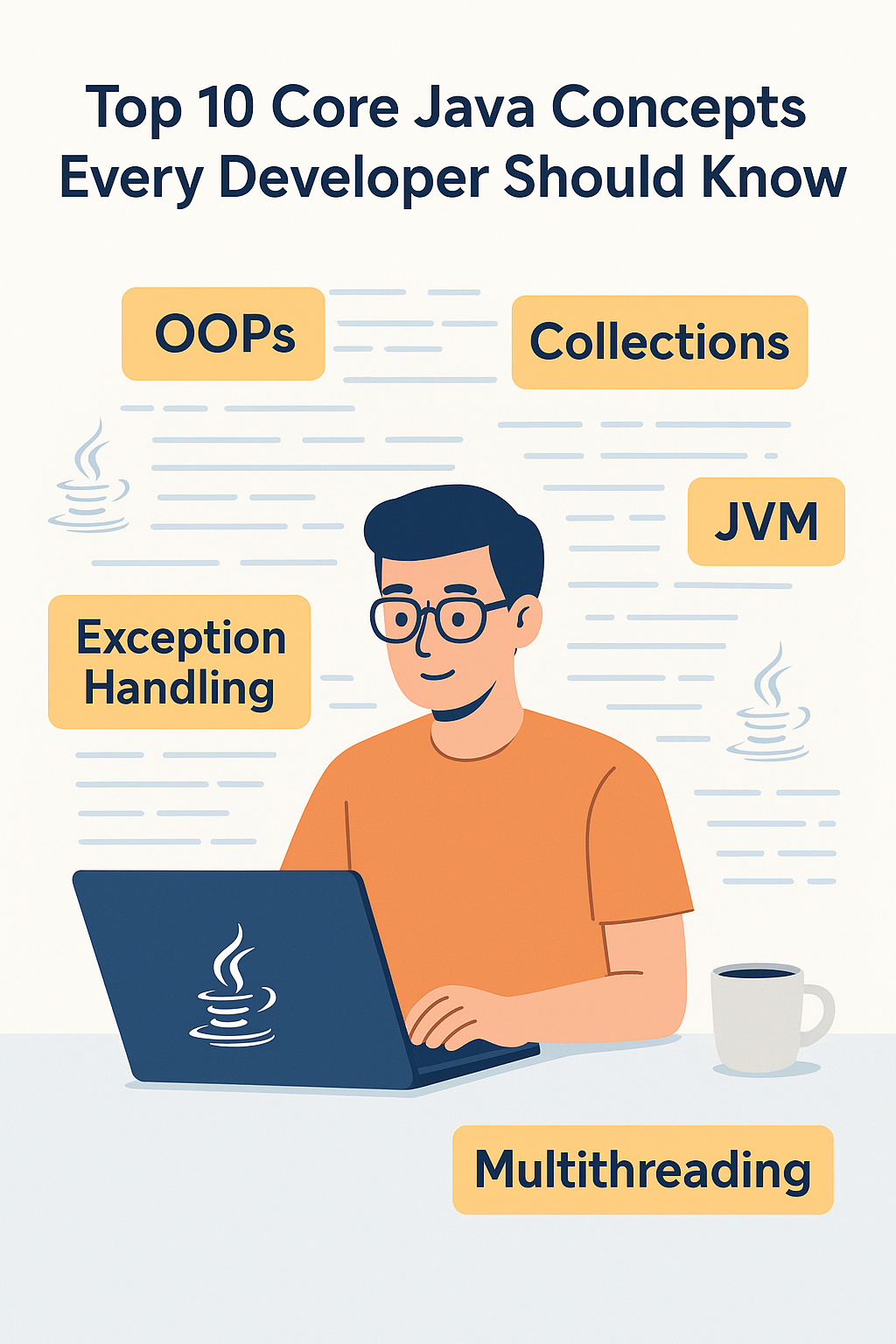
Core Java is considered the strongest foundation for anyone entering the world of Java development. Whether someone wants to build enterprise applications, mobile apps, desktop software, or cloud-based microservices, Core Java lays the building blocks. Understanding the fundamentals not only improves development confidence but also opens doors to frameworks like Spring Boot, Hibernate, Microservices, and Angular-Java based integrations. Below are ten Core Java concepts every developer should learn thoroughly to become highly efficient in real-world development scenarios.
1. Object-Oriented Programming Principles
Core Java is built on OOP, and its four pillars—Encapsulation, Inheritance, Abstraction, and Polymorphism—help developers write structured and reusable code. Encapsulation protects data through private fields and getters/setters. Inheritance reduces duplication by reusing parent structures. Abstraction hides internal logic and only exposes functionality. Polymorphism enables dynamic execution of behavior. Any Core Java developer must know how these concepts solve complex problems using simple structures.
2. Classes, Objects, and Constructors
Most applications start with object creation. A class defines a blueprint while objects are runtime instances. Constructors define how object initialization works. Core Java offers default constructors, parameterized constructors, and constructor overloading. Developers must also understand object lifecycle, accessibility modifiers, and static vs. non-static context.
3. Data Types, Operators, and Control Statements
A Core Java developer should know primitive data types, wrapper classes (like Integer, Double, Boolean), arithmetic operators, logical operators, and advanced flow-control mechanisms. Writing optimal loops, decision-making statements, and conditions improves performance.
4. Collections Framework
The Collections Framework is one of the most practical parts of Core Java. Classes like ArrayList, LinkedList, HashMap, TreeSet, and LinkedHashMap improve data handling flexibility. A developer should know:
How lists store ordered data
How sets ensure uniqueness
How maps handle key-value structures
Understanding time complexity of add(), remove(), contains(), and get() operations allows developers to choose appropriate structures.
5. Exception Handling
Real-time applications fail if errors are not handled gracefully. Core Java offers try-catch blocks, finally execution, custom exceptions, and throwable hierarchy. Proper exception handling ensures stable execution, readable error messages, and secure handling of sensitive functions like file operations or API interactions.
6. Multithreading and Concurrency
Any high-performance application uses multiple threads. Core Java provides Thread class, Runnable interface, Thread pools, Executors, synchronized blocks, volatile keywords, and atomic operations. Developers must know:
How to improve parallel execution
How to avoid race conditions
When to apply thread-safe collections
In real-world projects, concurrency improves user experience and processing speed.
7. JVM Architecture and Memory Management
JVM is the powerhouse behind Java execution. A strong Core Java developer must understand:
Class Loader subsystem
Runtime Data Areas (Heap, Stack, Method Area)
Garbage Collection
Memory leaks occur when objects remain referenced unnecessarily. Understanding garbage collection algorithms helps reduce performance overhead and increase application stability.
8. String Handling and Immutable Objects
String is a special class in Core Java. It is immutable, meaning once created, you cannot change it directly. Developers must also know:
StringBuilder for mutable operations
StringBuffer for thread-safe operations
This knowledge improves performance during heavy concatenation operations such as log creation, file processing, and large-volume reports.
9. File Handling and I/O Streams
Reading and writing data is important for any application. Core Java offers:
FileInputStream and FileOutputStream
BufferedReader and BufferedWriter
Serialization for object storage
Understanding character vs. byte streams helps developers manage file-based applications, database exports, logs, and report generation.
10. Interfaces, Functional Programming, and Lambda Expressions
Modern Core Java supports functional programming through:
Lambda expressions
Functional interfaces
Stream API
Method references
These introduce shorter and readable logic, especially when working with data manipulation, list filters, sorting, and aggregation.
Why Core Java Matters in Real Projects
Many developers rush into frameworks without mastering Core Java. However, top companies prefer strong fundamentals because:
Debugging becomes easier
Performance improvements are faster
Writing clean code becomes natural
Working with large enterprise systems becomes manageable
Interviewers often test Core Java more than frameworks because it reflects logical thinking.
Final Thoughts
Learning Core Java is like learning the grammar of a language. Once mastered, advanced libraries and frameworks feel simpler. Make sure you practice coding rather than just reading theory. Build small projects like Student Management App, Employee Salary Calculator, Library Inventory System, or Task Scheduler. These will help you apply Core Java concepts effectively.
If you are looking to strengthen your foundation, start revising important modules regularly, explore interview questions, and build hands-on mini applications. With strong Core Java skills, you unlock long-term career growth in software development.
Tags : .....