Consent management is no longer just about adding a cookie banner and an Accept button.
Businesses collect personal data across websites, mobile apps, CRM systems, forms, analytics tools, advertising platforms, customer portals, call centres, and offline channels. Users may accept one purpose, reject another, change preferences, or withdraw consent later.
A modern Consent Management Platform (CMP) helps businesses collect, record, manage, update, and honour these choices.
The right CMP depends on your business needs. Some organizations may only need cookie controls and Google Consent Mode, while banks, healthcare companies, SaaS businesses, and large enterprises may require purpose-based consent, APIs, preference management, audit trails, and integration with internal systems.
What Is a Consent Management Platform?
A Consent Management Platform provides the technology required to collect and manage user choices about how personal data may be processed.
At a basic level, this may include cookie banners, preference controls, consent records, and tracker management.
More advanced platforms connect consent with CRM systems, applications, advertising platforms, customer profiles, mobile apps, backend systems, and privacy workflows.
This distinction matters.
A beautiful cookie popup that cannot tell your CRM that a customer withdrew marketing consent is a little like installing an expensive lock but leaving the window open.
Under Article 7 of the GDPR, organizations relying on consent must be able to demonstrate that consent was given, and withdrawing consent must be as easy as giving it.
India is also moving deeper into operational privacy compliance through the Digital Personal Data Protection Act and the DPDP Rules, 2025. The Government notification dated 13 November 2025 established a phased commencement schedule for different provisions of the Act.
That makes consent infrastructure increasingly relevant for businesses operating across India and international markets.
1. Digital Anumati
Digital Anumati is an India-focused Consent Management Platform designed to help businesses capture, manage, update, withdraw, and prove consent across multiple customer touchpoints.
Instead of limiting consent management to a website banner or a single checkbox, Digital Anumati connects consent across web forms, mobile apps, APIs, IVR, assisted journeys, and offline interactions. Each consent choice can be linked to a specific purpose, such as marketing communications, analytics, profiling, or third-party data sharing, allowing users to make granular choices instead of accepting everything at once.
A key capability is its immutable consent ledger. Every consent event—whether granted, updated, or withdrawn—is recorded as a timestamped entry rather than simply replacing the previous status. This creates a historical consent trail that organizations can query or export when they need proof of consent or supporting audit evidence.
Digital Anumati also provides a self-service preference centre, where Data Principals can review and change their consent choices. When consent for a particular purpose is withdrawn, the updated status can be made available to connected systems instead of remaining isolated within one application.
For enterprise integration, Digital Anumati provides REST APIs and web and mobile SDKs, allowing businesses to connect consent records with their existing CRM, applications, customer portals, marketing systems, and backend infrastructure.
The platform also supports multi-channel and Indian-language consent experiences and is designed around consent requirements relevant to India's DPDP ecosystem.
For organizations looking beyond a simple cookie banner and evaluating consent infrastructure that can connect consent capture, preference management, withdrawal, audit trails, and enterprise applications, Digital Anumati provides a particularly India-focused approach.
2. OneTrust
OneTrust offers a broad privacy technology ecosystem, with consent and preference management forming one part of the platform.
Its Consent Management Platform supports consent collection across websites, mobile applications, connected television environments, and other digital properties.
OneTrust also provides Universal Consent and Preference Management. This capability creates unified profiles that can connect customer preferences across different channels and systems.
Its documentation describes integrations with platforms such as Salesforce, Adobe, Snowflake, Databricks, Google, Meta, and other technologies. OneTrust states that its Consent and Preferences offering supports more than 200 prebuilt integrations.
The platform also provides consent receipts, change history, timestamps, compliance logs, preference centres, and support for privacy signals including GPC, GPP, IAB TCF, and Google Consent Mode.
For large companies that already operate complex marketing, advertising, data, and privacy environments, this breadth can be valuable.
3. Cookiebot
Cookiebot focuses strongly on website consent and cookie compliance.
Its scanner identifies cookies and trackers, categorizes them, and allows organizations to block nonessential technologies until the visitor provides the required consent.
Cookiebot also integrates with Google Consent Mode v2, Google Analytics, Google Ads, Google Tag Manager, and common content management platforms.
Its documentation states that Cookiebot can automatically scan websites, categorize cookies, generate cookie declarations, store consent records, and communicate consent signals to advertising platforms.
That makes Cookiebot especially relevant to organizations whose main privacy requirement centres on websites, advertising, analytics, and cookie management.
It offers considerably more than a colourful banner, which is important because a banner without proper tracker control is mostly decoration.
4. TrustArc
TrustArc combines consent management with broader privacy management capabilities.
Its Consent and Preference Manager provides configurable forms, preference experiences, consent history, reporting, audit trails, and geographic targeting.
TrustArc states that its platform supports more than 60 languages and can deliver consent experiences based on user location.
Users can access consent histories, while organizations can centrally monitor consent trends and export compliance records.
TrustArc can therefore suit multinational organizations that need consent management alongside a wider privacy governance program.
5. Osano
Osano provides a Consent Management Platform aimed at simplifying cookie and tracking compliance across different privacy regimes.
Its platform includes cookie discovery, AI assisted cookie classification, tag blocking, customizable consent banners, granular controls, language support, reporting, and preference management.
Osano says deployment can start with a single JavaScript tag. The platform can discover trackers, work with tag management systems, and adjust consent experiences according to applicable requirements.
This combination can appeal to organizations that want a relatively centralized approach to website consent without manually maintaining every tracker or banner configuration.
6. Didomi
Didomi provides enterprise consent management across websites, mobile applications, connected devices, and different geographic markets.
Its CMP supports centralized configuration and consent management across multiple properties.
Didomi also provides cross device consent synchronization. This can reduce the need to ask the same identified user for the same choice repeatedly across different screens or applications.
For mobile environments, Didomi provides SDKs for iOS, Android, and hybrid applications, together with APIs and analytics capabilities.
Companies operating many websites, applications, or digital properties may find this centralized approach useful, particularly where consent needs to remain consistent across channels.
7. Complianz
Complianz takes a somewhat different approach because it has a strong WordPress focus.
Its privacy suite includes cookie scanning, consent banners, script controls, consent records, proof of consent, region specific configurations, Consent Mode support, Tag Manager integration, and privacy document capabilities.
Complianz also supports more than 40 languages according to its product documentation.
For organizations heavily invested in WordPress, a native WordPress approach can make implementation easier than adopting a large enterprise privacy suite.
That said, businesses should still evaluate whether website level consent is enough or whether consent must also travel into CRM, mobile, customer service, and backend systems.
8. iubenda
iubenda combines consent management with legal and privacy documentation tools.
Its CMP can scan websites, categorize cookies, block scripts according to consent preferences, create configurable banners, manage consent records, and support multiple regulatory environments.
The wider iubenda ecosystem also includes consent history, offline consent evidence, legal documents, privacy policies, and synchronization with other business systems.
iubenda is also a Google certified CMP and supports standards including GPC and GPP.
It can therefore be useful for businesses that want cookie consent and legal document management within a related set of tools.
9. CookieScript
CookieScript provides cookie scanning, cookie categorization, consent banners, consent records, script controls, geolocation, and integration with common content management systems.
It also supports Google Consent Mode v2 and IAB TCF integrations. CookieScript identifies itself as a Google certified CMP.
The platform automatically scans and categorizes cookies and can block first party and third party cookies according to user preferences.
CookieScript can be particularly practical for website owners and agencies managing multiple domains from a single account.
10. Sourcepoint
Sourcepoint focuses heavily on enterprise consent, advertising privacy, publishers, and complex digital environments.
Its Consent Management Platform supports different regulations, geographic targeting, web, mobile, application, OTT, and connected television environments.
Sourcepoint also provides consent analytics, testing capabilities, vendor insights, consent history, custom user journeys, and authenticated consent profiles.
Its Universal Consent and Preferences product extends this further by connecting marketing preferences, legal document acceptance, privacy consent, and customer interactions into a more unified system.
For publishers, media organizations, and enterprises with sophisticated advertising ecosystems, those capabilities deserve consideration.
How to Choose the Right Consent Management Platform
There is no universal CMP that fits every organization.
Before selecting one, ask a few practical questions.
- Do you only need cookie consent, or do you need enterprise wide consent management?
- Can users withdraw consent as easily as they provide it?
- Can the platform store evidence showing when, where, why, and how consent was collected?
- Can consent status reach CRM, ERP, marketing, analytics, mobile, and backend applications?
- Does the platform support the regulations and countries where your organization operates?
- Can it manage preference changes across different channels?
- Does it provide APIs and SDKs for custom integrations?
- Can it support your deployment, security, data residency, and audit requirements?
The answers will quickly separate a simple cookie banner tool from an enterprise consent infrastructure platform.
Final Thoughts
Consent management has moved well beyond the Accept Cookies button.
Businesses now need to understand where consent originates, what purpose it covers, how long it remains valid, where the related data travels, and what happens when the individual changes their mind.
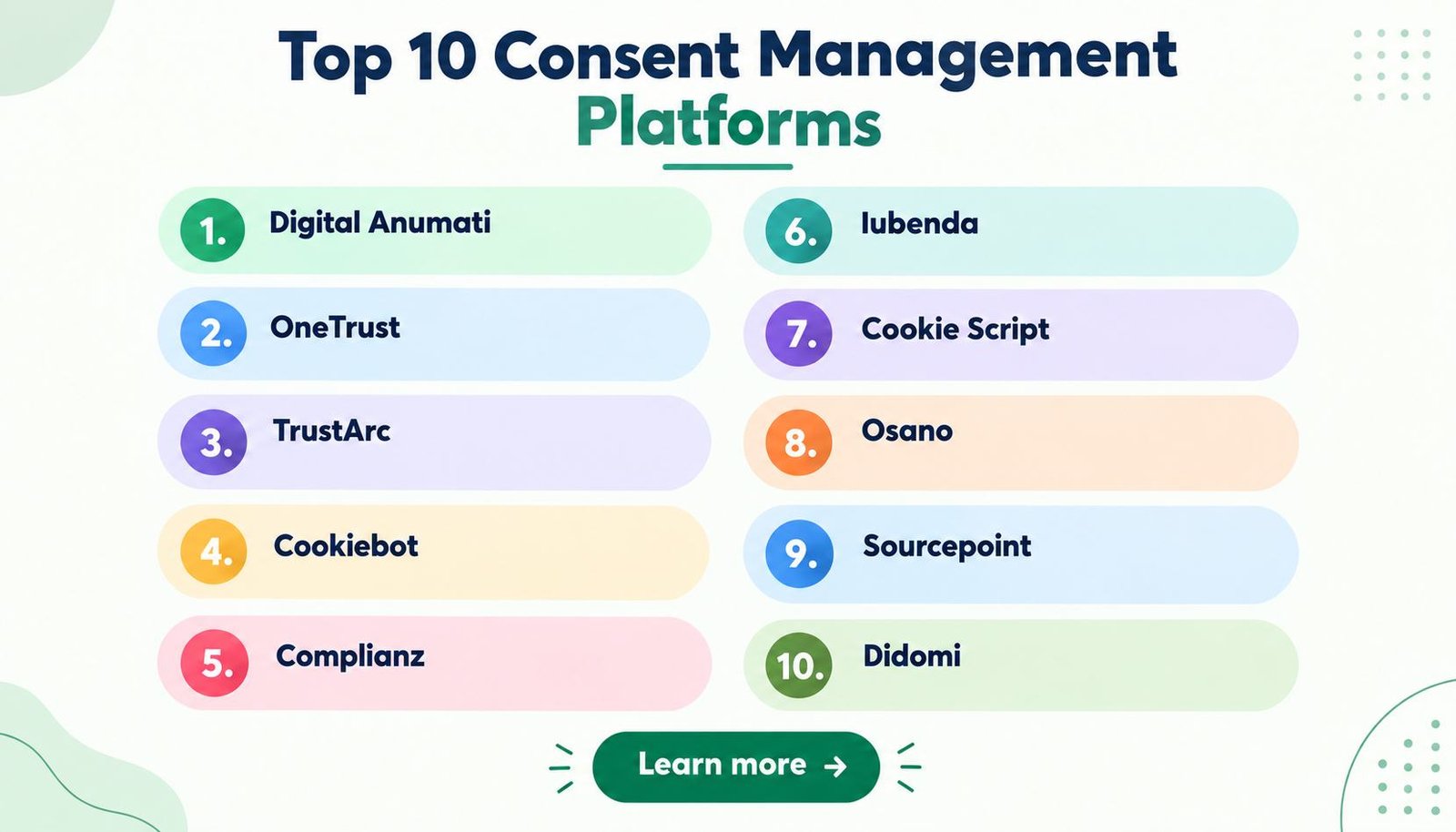
Digital Anumati, OneTrust, Cookiebot, TrustArc, Osano, Didomi, Complianz, iubenda, CookieScript, and Sourcepoint approach this problem from different angles.
Some focus strongly on website cookies. Others extend consent into identity, preferences, advertising, mobile applications, privacy workflows, or enterprise systems.
The right choice depends on your regulatory footprint, technology architecture, number of digital channels, integration requirements, and privacy maturity.
Start with your actual data flows and consent use cases. Then evaluate the technology.
Buying the tool first and discovering the requirements later is an impressively efficient way to buy the wrong tool.
Tags : Consent Management Platforms