Tool Design Services: A Complete Guide for Industrial Manufacturers
By Integrated Solutions 10-07-2026 210
Tool Design Services: A Complete Guide for Industrial Manufacturers
The Tooling Problem Appears After Production Starts
And then rejection rises. Parts stick, bends drift, operators add manual corrections, and procurement learns that an approved component drawing never became a workable tool. Tool Design Services prevent that gap between product geometry and repeatable production.
Integrated Solutions has operated since 2004 from a 4,456.8 sq. ft. Gurugram facility, covering design, reverse engineering, CNC/VMC machining and manufacturing support. Ignore machining access or maintenance clearance, and even impressive CAD can fail on the shop floor.
Correcting a design after steel cutting is harder than resolving it during concept review.
What Tool Design Services Must Define
Tool Type and Output
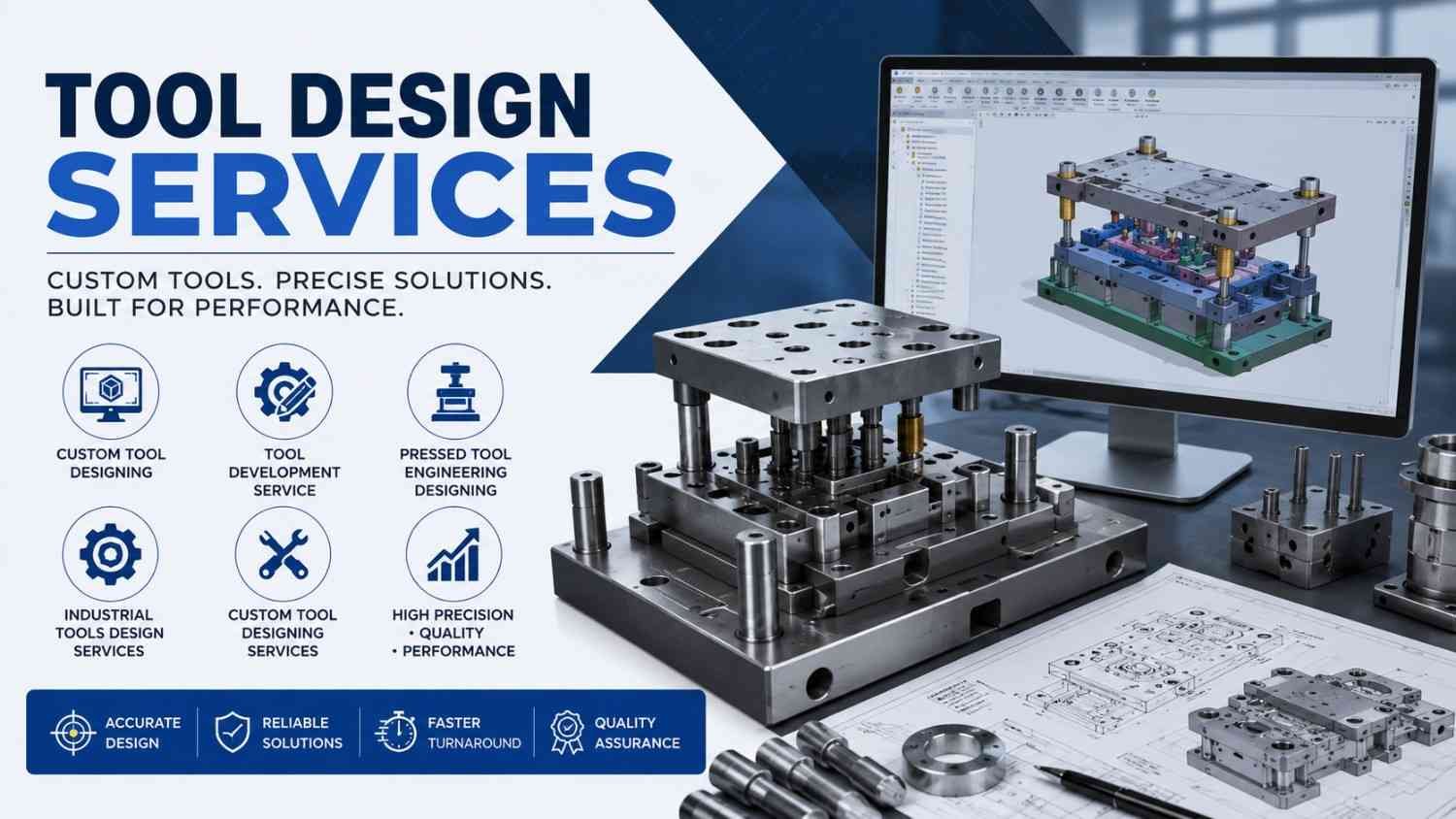
Start with process, material and volume. Integrated Solutions lists seven tooling categories: injection moulds, press tools, die-casting dies, blow moulds, jigs, fixtures and cutting tools. Outputs include 3D CAD, 2D drawings, assembly documents, STEP, IGES, Parasolid and native CAD files.
The Spec Detail Most Buyers Skip
Define machine capacity, material, annual quantity, shrinkage, draft, clearance, cooling, venting, ejection, wear inserts and datums. ISO 2768 provides four general tolerance classes, but critical fits and shut-off surfaces still need individual tolerances.
A buyer who sends one part PDF and asks for a final price has not issued an engineering RFQ.
Software and Review Stages
Integrated Solutions lists six CAD platforms—UG NX, CATIA, SolidWorks, Creo, AutoCAD and Inventor—and a six-stage route from requirement analysis to final delivery.
Five Checks Before Supplier Approval
A capable Tool Design Services provider should pass all five.
- Input checklist: It should request CAD, material, volume, machine data and acceptance criteria. Bad answer: “Send whatever you have.”
- Manufacturability review: Expect questions about undercuts, radii, springback, cooling or venting. Bad answer: automatic approval of every feature.
- Review gates: Require recorded concept and final-design approvals. Bad answer: an unnumbered WhatsApp screenshot.
- File ownership: Confirm editable and neutral formats before ordering. Bad answer: only locked PDFs after payment.
- Correction policy: Separate buyer changes from designer errors. Bad answer: “We will discuss defects later.”
These checks expose weak suppliers before launch pressure makes replacement expensive.
Six Ways Better Tooling Protects Margin
- Fewer trials: Simulation catches interference, flow and stress problems early.
- Lower rejection risk: Correct guiding, cooling, venting and datums improve consistency.
- Faster revisions: Parametric models reduce repeated drawing work.
- Longer tool life: Wear inserts can prevent replacement of the full assembly.
- Safer scaling: Pilot tooling tests the concept before high-volume investment.
- Clear accountability: 3D models, 2D drawings and assembly details create one reference.
And yet, buyers award work on the lowest design fee while ignoring one stopped production shift. Cheap design becomes expensive quickly. Integrated Solutions also lists pilot tooling and simulation-led optimisation before release.
Engineering Support Across India
Local Tool Design Services can simplify sample review and trial-part movement. Integrated Solutions is based near Dhankot Flyover, Basai, Gurugram 122006, and publishes a 4,456.8 sq. ft. facility area.
That proximity helps when worn samples or checking fixtures need inspection.
Its Custom Tool Designing Services in India support automotive, electrical, appliance, packaging, medical and general engineering applications. The Industrial Tools Design Services range includes moulds, dies, jigs and fixtures, while the Pressed Tool Engineering Designing Service addresses blanking, piercing, bending, forming and progressive stamping.
About Integrated Solutions: What We Bring to Review
We have worked in engineering and manufacturing since 2004. We combine custom tooling design with reverse engineering, CNC/VMC work, moulds and pressed-component support, so we review manufacturability beyond surface geometry.
We know one awkward truth: a 3D assembly can open perfectly on screen and still leave no sensible route for machining, polishing or replacing a worn insert.
Our process uses six defined stages and six listed CAD platforms.
Send us the component CAD or sample details, material grade, expected quantity, machine specifications, target tolerances, preferred tool type and trial acceptance criteria. We respond to enquiries within 24 hours.
We publish no fixed design MOQ; one mould, die or fixture can be a valid project, depending on complexity and deliverables. Share the requirement with Integrated Solutions, and we will return the technical questions needed for a workable quotation.
Conclusion
Good Tool Design Services convert product intent into tooling that can be manufactured, maintained and repeated under production pressure. Judge suppliers by input discipline, six-stage review control and editable deliverables—not the lowest CAD fee. The next generation of industrial tooling will be won before metal cutting begins.
FAQs
1. When Is Custom Tooling Necessary?
Choose Custom Tool Designing Services for unusual geometry, dedicated cycle targets or machine-specific constraints. The caveat: custom work needs better input data and more approval effort than standard tooling.
2. What Do Industrial Tools Design Services Cover?
Industrial Tools Design Services may cover seven listed categories, including moulds, press tools, dies, jigs, fixtures and cutting tools. Confirm whether simulation and detailing are included.
3. How Does a Pressed Tool Engineering Designing Service Reduce Defects?
A Pressed Tool Engineering Designing Service reviews clearance, strip layout, force distribution and springback across blanking, piercing, bending or forming operations.
4. Can Custom Tool Designing Services in India Support Distant Buyers?
Yes, CAD reviews can be digital. Physical trials and machine matching still require planning, so not every correction can be closed through video calls.
5. Which Files Should a Tooling Designer Provide?
Ask for the agreed native CAD file, STEP or Parasolid, 2D drawings, bill of materials and assembly documentation. Providers that supply only locked PDFs keep buyers dependent on them.