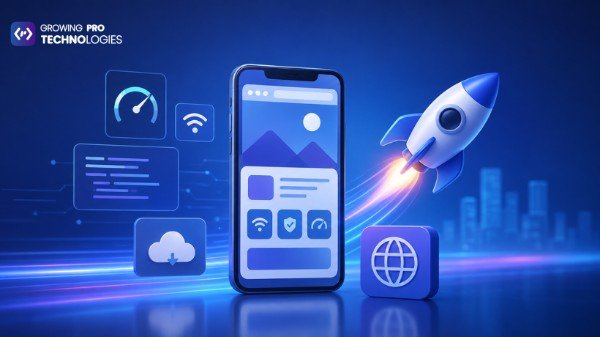
Mobile users expect websites to load quickly, respond instantly, and provide seamless experiences across devices. Businesses that fail to meet these expectations can lose visitors, engagement, and conversions. Progressive Web Apps (PWAs) offer a powerful solution by combining the accessibility of websites with many capabilities traditionally associated with mobile applications. With the right PWA development agency, businesses can create fast, reliable, and engaging digital experiences without requiring users to download a traditional app.
What Are Progressive Web Apps?
Progressive Web Apps are web applications built with modern web technologies to deliver an app-like experience through a browser. Unlike traditional websites, PWAs can provide features such as offline functionality, push notifications, home-screen installation, background processing, and improved performance.
PWAs use technologies such as service workers, web app manifests, HTTPS, responsive design, and modern JavaScript frameworks to create reliable experiences across smartphones, tablets, and desktops.
For businesses, this means users can access an application directly through a URL while still receiving many of the benefits associated with native mobile applications.
Why Mobile Performance Matters
Mobile performance has become a critical factor in digital success. Users are less likely to stay on a website that takes too long to load or responds slowly to interactions. Poor performance can increase bounce rates and negatively affect customer satisfaction.
High-performance mobile experiences should provide:
- Fast page loading
- Smooth navigation
- Responsive interactions
- Mobile-friendly layouts
- Reliable access under different network conditions
- Secure connections
- Consistent performance across devices
A well-designed PWA addresses many of these requirements by using efficient caching, responsive interfaces, optimized resources, and service-worker technology.
How PWAs Create High-Performance Mobile Experiences
1. Faster Loading and Improved Performance
One of the biggest advantages of PWAs is their ability to deliver fast experiences. Service workers can cache important files and resources, allowing frequently accessed content to load without repeatedly requesting everything from the server.
Developers can also optimize images, scripts, stylesheets, and other assets to reduce page weight. When combined with efficient caching strategies, these techniques can significantly improve perceived and actual performance.
A professional pwa development agency can evaluate application architecture and identify performance bottlenecks before implementing optimization strategies tailored to the business.
2. Reliable Experiences With Limited Connectivity
Mobile users do not always have stable internet connections. They may browse from areas with weak signals, switch between networks, or temporarily lose connectivity.
PWAs can use service workers to cache selected resources and deliver previously stored content when the network is unavailable. This creates a more reliable experience than a conventional website that depends entirely on a live connection.
For businesses serving users across different locations, offline and low-connectivity functionality can improve accessibility and engagement.
3. App-Like User Experience
PWAs can provide an interface that feels similar to a native application while remaining accessible through the web. Users can navigate between pages, interact with features, and in supported environments install the PWA directly on their device.
A web app manifest can define elements such as the application name, icons, display mode, and launch behavior. This allows businesses to create a more consistent branded experience.
The result is a convenient middle ground between traditional websites and native mobile applications.
4. Cross-Platform Accessibility
Developing separate applications for Android and iOS can require additional resources, maintenance, and development time. PWAs can reduce this complexity because a single web-based application can serve users across multiple platforms and screen sizes.
Responsive design allows the interface to adapt to smartphones, tablets, laptops, and desktops. This cross-platform approach can simplify maintenance while providing a consistent user experience.
Businesses working with a pwa development agency can also integrate APIs, databases, content management systems, payment solutions, and other business systems into their progressive web applications.
5. Better Engagement Through Push Notifications
Engagement does not end when users leave a website. In supported browsers and devices, PWAs can use push notifications to communicate with users.
Businesses can use notifications for:
- Promotional announcements
- Order updates
- Appointment reminders
- New product alerts
- Personalized offers
- Important account information
When implemented responsibly, push notifications can help businesses maintain communication with customers without requiring them to open a traditional mobile application.
6. Improved User Experience and Conversions
Performance and user experience are closely connected. When pages load quickly and interactions feel responsive, users can navigate through products, services, forms, and checkout processes more efficiently.
For eCommerce businesses, even small improvements in the purchasing experience can influence conversions. A fast PWA can make it easier for customers to browse products, access categories, review information, and complete transactions.
Similarly, service-based businesses can use PWAs to streamline lead-generation forms, appointment booking, customer portals, and other important interactions.
7. SEO-Friendly Web Accessibility
PWAs retain an important advantage over traditional mobile applications: they are web-based. Their content can potentially be discovered through search engines when properly implemented.
A PWA should still follow fundamental SEO practices, including:
- Crawlable URLs
- Descriptive page titles
- Optimized headings
- Unique and useful content
- Internal linking
- Mobile-friendly design
- Structured data where appropriate
- Proper canonicalization
- Fast performance
- Accessible rendering
PWA technology itself does not guarantee higher rankings. However, combining strong technical SEO with excellent performance can create a better foundation for organic visibility.
8. Enhanced Security
Security is another important consideration when developing modern web applications. PWAs require HTTPS, which helps protect data exchanged between users and the application.
Businesses should also implement secure authentication, authorization, API protection, input validation, secure data storage, and regular security testing where applicable.
Working with an experienced pwa development agency can help organizations incorporate security considerations into the application's architecture rather than treating them as an afterthought.
PWAs vs. Traditional Mobile Apps
Native applications can provide powerful device capabilities and deep platform integration. However, they usually require installation from an app store and may require separate development approaches for different platforms.
PWAs offer a different model. Users can access them through a browser, and supported environments may allow installation directly onto the device.
The right choice depends on business requirements. Companies that need advanced device-specific capabilities may benefit from native development, while organizations prioritizing accessibility, speed, cross-platform reach, and simplified deployment may find PWAs highly valuable.
Choosing the Right PWA Development Agency
Selecting the right development partner can significantly influence the performance and scalability of a PWA. Businesses should look for an agency with experience in responsive web development, progressive web technologies, API integrations, performance optimization, security, and scalable application architecture.
A capable development partner should also understand the business objective behind the application. Instead of simply converting an existing website into a PWA, developers should analyze user journeys, technical requirements, performance goals, and future scalability.
Growing Pro Technologies provides Progressive Web Development solutions designed to help businesses create responsive, scalable, and engaging web experiences. Learn more about its Progressive Web Development services to explore how a PWA can support your digital strategy.
The Future of High-Performance Mobile Experiences
As users increasingly expect fast and convenient digital experiences, businesses will continue looking for technologies that combine performance, accessibility, and functionality. PWAs are well positioned to meet these expectations by bringing together modern web capabilities and app-like experiences.
Emerging technologies such as AI-powered personalization, advanced browser APIs, improved web capabilities, and increasingly sophisticated performance optimization can further expand what PWAs can deliver.
For businesses, the key is not simply adopting the latest technology but creating an experience that solves real customer problems. A strategically planned PWA can help deliver faster interactions, broader accessibility, stronger engagement, and a more consistent digital experience.
Conclusion
Progressive Web Apps have changed the way businesses approach mobile experiences by combining the reach of the web with many capabilities associated with mobile applications. From faster loading and offline functionality to cross-platform accessibility and app-like interactions, PWAs can provide a strong foundation for modern digital products.
Partnering with an experienced pwa development agency can help businesses design, develop, optimize, and maintain a PWA that aligns with their performance and growth objectives. As mobile expectations continue to evolve, investing in high-performance progressive web technology can help businesses deliver digital experiences that are faster, more reliable, and easier for customers to use.
Tags : PWA development agency