The Rise of Autonomous AI: How Intelligent Agents Are Reshaping Modern Business
By Harris Anderson 17-07-2026 8
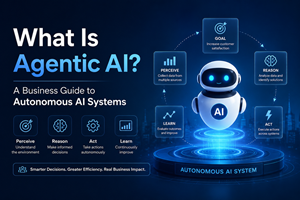
Artificial intelligence has evolved rapidly over the last few years. Businesses across industries have adopted chatbots, virtual assistants, and content-generation tools to improve productivity and streamline operations. These technologies have undoubtedly transformed how organizations communicate, analyze information, and support customers. However, most of these systems share one important limitation: they rely heavily on human input.
Traditional AI tools are reactive. They wait for a user to type a prompt, ask a question, or issue a command before producing a result. Once the interaction ends, the system stops working. While this model has created significant efficiency gains, companies are now looking for solutions that can operate more independently.
This demand has given rise to autonomous AI systems—often called agentic AI—which are designed not merely to generate responses but to make decisions, execute workflows, and achieve business objectives with minimal human intervention. As organizations seek new ways to improve efficiency and reduce operational bottlenecks, these intelligent agents are becoming an increasingly important part of enterprise technology strategies.
Moving Beyond Traditional AI
Earlier generations of artificial intelligence focused primarily on prediction and automation. Machine learning models analyzed historical data to identify patterns, while generative AI systems created text, images, and code. Despite their capabilities, these technologies still required constant guidance from users.
Autonomous AI introduces a different approach. Instead of waiting for instructions at every step, these systems can interpret high-level goals, break them into smaller tasks, select appropriate tools, and adapt their actions based on changing conditions.
Consider a customer support department handling thousands of service requests each day. A conventional chatbot might answer frequently asked questions, but an autonomous AI system could analyze incoming tickets, prioritize urgent cases, access internal databases, resolve routine issues, and escalate complex problems to human teams when necessary.
This ability to act independently is what separates autonomous AI from traditional software automation.
How Autonomous AI Systems Operate
At the heart of these systems lies an orchestration framework that coordinates reasoning, planning, and execution. Rather than responding to a single prompt, autonomous agents maintain context across multiple actions and continuously evaluate progress toward their objectives.
Several components work together to make this possible.
Intelligent Planning and Coordination
Autonomous AI systems begin by translating broad business goals into manageable tasks. Whether the objective is processing invoices, optimizing supply chains, or monitoring cloud infrastructure, the system creates a sequence of actions needed to achieve the desired outcome.
Unlike static workflows, these plans can change dynamically. If an obstacle arises—such as missing information or a failed software connection—the system can adjust its strategy and continue operating.
Memory and Context Retention
Human workers rely on memory to complete complex tasks, and intelligent agents require similar capabilities. Modern autonomous systems often combine multiple layers of memory to retain context.
Short-term memory keeps track of ongoing tasks, temporary variables, and active conversations. Long-term memory stores company policies, documentation, and operational procedures. Historical records allow the system to learn from previous actions and improve future performance.
Together, these capabilities enable AI agents to function effectively within complex business environments.
Tool Integration and Action
One of the most important characteristics of autonomous AI is its ability to interact with external systems. These agents can connect to databases, customer relationship management platforms, cloud infrastructure, and business applications through APIs.
For example, an operations agent could retrieve inventory data, update shipping schedules, generate reports, and notify relevant stakeholders—all without requiring human intervention.
This combination of reasoning and action transforms AI from a passive assistant into an active participant in business processes.
Business Benefits of Autonomous AI
Organizations are increasingly investing in autonomous AI because of the operational advantages it offers. The value extends far beyond cost savings and automation.
Accelerating Software Development
Development teams have already embraced AI-powered coding assistants, but many time-consuming tasks still require human attention. Testing applications, debugging errors, deploying updates, and monitoring systems continue to consume valuable engineering resources.
Autonomous coding agents are beginning to change this workflow. These systems can analyze bug reports, reproduce issues, write patches, execute tests, and prepare code changes for review. By automating repetitive tasks, companies allow developers to focus on innovation and product strategy.
Improving Legacy Operations
Many enterprises continue to rely on outdated software systems that require employees to manually transfer information between emails, spreadsheets, contracts, and databases. Traditional automation tools often struggle when interfaces or document formats change.
Autonomous AI systems are far more adaptable. They can interpret documents, extract relevant information, validate business rules, and update enterprise systems automatically. In industries such as finance, logistics, and procurement, this capability significantly reduces processing times and minimizes human error.
Enabling Predictive Operations
Most IT departments operate reactively, addressing problems only after systems fail. Autonomous AI enables a more proactive model by continuously monitoring infrastructure, analyzing performance metrics, and identifying risks before disruptions occur.
An intelligent operations agent might detect unusual server activity, allocate additional resources, optimize workloads, or trigger maintenance procedures automatically. This shift toward predictive management improves reliability while reducing operational costs.
The Importance of Governance and Security
Despite its potential, autonomous AI introduces new challenges. Systems that can execute transactions, modify databases, or communicate with customers must operate within clearly defined boundaries.
Successful deployments depend on strong governance frameworks that establish permissions, accountability, and oversight.
Organizations should follow the principle of least privilege, granting each AI agent access only to the systems required for its responsibilities. High-risk actions—such as approving payments or modifying sensitive records—should require human review.
Comprehensive audit logs are equally important. Every decision, action, and system interaction should be recorded to support compliance requirements and simplify troubleshooting.
The objective is not to eliminate human involvement but to redefine it. Employees move away from repetitive execution and toward supervision, strategy, and decision-making.
Looking Ahead
Autonomous AI represents the next major chapter in enterprise technology. Businesses are moving beyond tools that merely answer questions and toward systems capable of planning, reasoning, and acting independently.
Organizations that adopt these technologies thoughtfully will unlock new levels of efficiency, scalability, and innovation. Those that fail to adapt may struggle to keep pace with increasingly intelligent competitors.
The future of business technology will not be built solely on software that responds to human commands. It will be shaped by systems that can understand objectives, execute complex tasks, and actively contribute to organizational success.