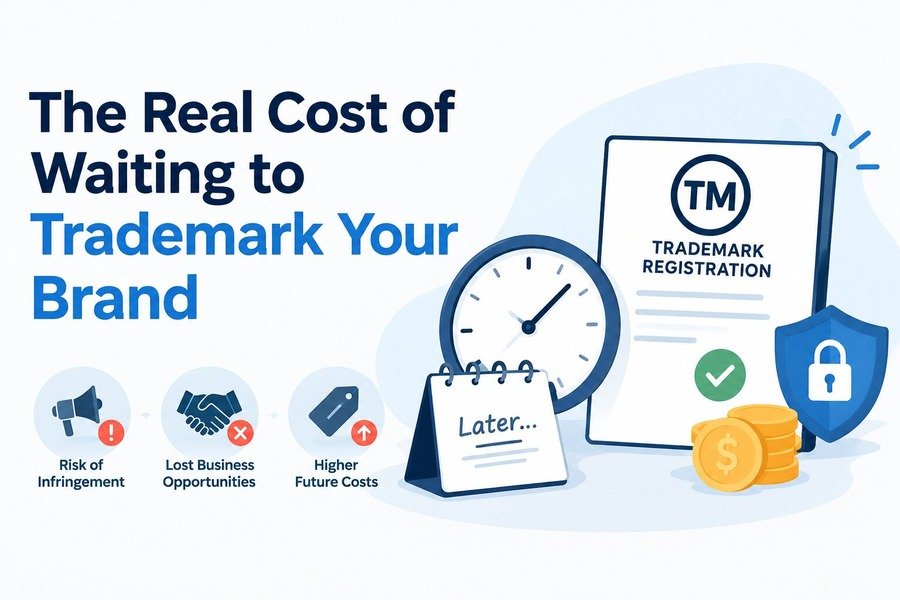
Every founder eventually asks the same question, usually after it's almost too late: "Do I actually own my brand name?" The honest answer, for most small and mid-sized businesses, is no — not legally. A name can be used on invoices, signage, packaging, and social media for years without ever becoming a protected asset. Until it's formally registered, it remains open territory, and open territory is exactly the kind of thing a faster-moving competitor eventually claims first.
This isn't a hypothetical risk. It's one of the most common regrets business owners run into once their brand starts gaining real traction — a rival in another city registers something confusingly similar, and suddenly the name that took years to build recognition around is legally contested, or worse, no longer usable at all.
Ownership Isn't Automatic — It's Filed
There's a persistent myth that using a name consistently, for long enough, creates some form of automatic ownership. In practice, that protection is thin and difficult to rely on. Unregistered use might support a narrow passing-off claim in extreme cases, but proving that in court requires demonstrating established reputation and active consumer confusion — an expensive, uncertain process compared to simply holding a registration certificate that already settles the question of ownership.
Formal registration flips that burden entirely. Once a mark is examined, published, and cleared through the opposition period, the registered owner holds nationwide exclusive rights — not a claim they have to argue for, but a legal fact they can point to.
What Actually Counts as a Trademark
People often assume trademarks only cover logos. In reality, the category is much broader. A protectable mark can be:
- A brand name or business name
- A logo, symbol, or design element
- A slogan or tagline used consistently in marketing
- A distinctive product shape or packaging design
- In some cases, a specific color scheme tied closely to a brand
What all of these share is a single function — helping a customer instantly identify who's behind a product or service, without needing to read a word of explanation. That instant recognition is the entire commercial value a trademark protects, and it's precisely what's left exposed when a business skips formal registration.
The Businesses Most at Risk of Losing Their Name
Some sectors face this risk more acutely than others. Retail, food and beverage, and e-commerce brands are particularly exposed, since visual identity and name recognition drive purchasing decisions directly — and counterfeit or copycat operations tend to cluster around exactly the categories where recognition already exists. A new restaurant chain, a packaged food brand, or an online store with a distinctive name are all realistic targets for a near-identical competitor entering the same market.
Startups face a related but different risk. Investors and acquirers routinely check whether a company's core brand assets are actually owned outright, not just used informally. An unregistered name can quietly undermine a valuation conversation, since a name without a certificate behind it isn't a transferable asset in the same way a registered one is.
Who's Actually Eligible to Apply
A common misconception holds people back from starting the process at all — the assumption that a business has to be formally incorporated first. That's not accurate. Individuals with a genuine intention to use a mark, sole proprietors, partnerships, and companies can all apply, and so can foreign businesses planning to enter the local market, generally by working through a locally appointed representative. The paperwork simply needs to match whoever is actually applying, whether that's an individual or an established company.
Picking a Name That Will Actually Survive Examination
Not every name is equally protectable, and this matters long before filing — ideally before a business even finalizes its branding. Names fall roughly into a spectrum:
- Invented or fanciful names offer the strongest protection, since there's nothing descriptive for an examiner to object to.
- Arbitrary names — ordinary words applied to unrelated products — are also strongly protectable.
- Suggestive names, which hint at a quality or benefit without describing it outright, are usually registrable with reasonable ease.
- Descriptive or geographic names face a genuinely harder path and often draw objections during examination.
- Purely generic terms typically cannot be registered under any circumstances.
Businesses that build their entire identity around a descriptive name — something that simply states what the product is — frequently discover this the hard way, months into a filing that stalls at the examination stage. A short clearance search before locking in a name is a fraction of the cost of rebranding packaging, signage, and marketing materials after the fact.
Understanding Classes — and Why the Wrong One Costs You
Trademark protection isn't universal across every kind of goods or service. Applications are filed under specific categories, and a certificate only protects the specific class it was filed under. A business that expands into a new product line without checking whether it falls under the original registration can end up operating, unprotected, in territory the certificate never actually covered.
This is one of the more overlooked risks in the entire process — a company can hold a perfectly valid registration and still have zero legal standing over the exact product causing them trouble, simply because it falls outside the class originally filed.
The Filing Journey, Realistically
The process itself follows a defined and fairly predictable sequence, even if the exact duration varies case by case:
- A clearance search against the existing register, checking for anything identical or confusingly similar
- Filing the application, specifying the applicant, the mark, and the correct class
- A formalities check, confirming the paperwork itself is complete
- Substantive examination, where distinctiveness and conflicts with prior marks are assessed
- Publication, opening a window for third parties to formally object
- Grant of the certificate, assuming no unresolved opposition remains
An unopposed, cleanly filed application generally moves through this sequence within roughly six months to a year. Anything that draws a formal objection or third-party opposition can extend well beyond that — sometimes close to two years in genuinely contested cases. The single biggest factor separating a fast filing from a stalled one is almost always the quality of the initial search and the accuracy of the class selected.
Registration Doesn't Travel With You Automatically
One assumption trips up more growing businesses than almost any other: that registering a trademark domestically somehow protects it everywhere a business happens to sell or ship. It doesn't. Trademark rights are territorial by design — protection secured in one country stops at that country's border. A business genuinely planning international expansion needs a deliberate strategy for each additional market it enters, sometimes supported by treaty-based priority claims, rather than an assumption that one filing covers everything.
The Difference Between ™ and ®, and Why It Matters
It's worth understanding these two symbols clearly, because using the wrong one can actually work against a business. The ™ symbol signals that someone is claiming rights to a mark, regardless of whether it's actually been examined or approved — it can be used the moment an application is filed, or even before. The ® symbol, by contrast, is legally reserved for marks that have completed the full registration process. Using ® prematurely isn't just inaccurate — it can weaken a business's credibility and legal position if the mark is ever challenged before registration is actually granted.
Renewal Is Part of Ownership, Not an Afterthought
A trademark isn't a one-time filing that lasts forever automatically. Registered marks typically remain valid for ten years and can be renewed indefinitely in further ten-year terms — but only if renewal is filed within the required window before expiration. A mark left unused for several consecutive years after registration can also become vulnerable to cancellation, which means active, ongoing use matters just as much as the initial paperwork. Businesses that treat registration as a "set it and forget it" task often discover the gap only when a dispute forces them to check their own records.
Where Most Applications Actually Go Wrong
The majority of delays and outright refusals trace back to a small, repeatable set of mistakes:
- Waiting too long to file, handing a faster competitor the opportunity to register first
- Choosing a name too generic or descriptive to clear examination
- Skipping the clearance search entirely and discovering a conflict only after filing
- Assuming that filing alone means the mark is protected, without tracking it through to grant
- Missing renewal deadlines and letting an otherwise valid registration lapse
Each of these is entirely avoidable with the right guidance early in the process, which is generally far cheaper than correcting course after an application has already stalled.
Firms like ZamZam IP Associates work with businesses through exactly this kind of situation, guiding brand owners from an initial clearance search through filing, examination, and final grant. Anyone weighing whether to handle a filing independently or bring in guidance early can review the full process at https://zamzamip.com/trademark-registration-services/ before making that call.
Frequently Asked Questions
Do I need a registered company to apply for a trademark?
No. Individuals with a genuine intention to use the mark, along with sole proprietors, partnerships, and companies, can all apply.
What happens if I never formally register my brand name?
It remains legally unprotected. A competitor can adopt something confusingly similar, and defending your claim without a certificate is much harder and less certain.
How long does the registration process usually take?
A clean, unopposed application generally takes six months to a year. Objections or third-party opposition can extend that timeline considerably.
Can I use the ® symbol while my application is still pending?
No. The ® symbol is reserved for marks that have actually completed registration; ™ is appropriate before or during the application process.
Does registering my brand in one country protect it internationally?
No. Trademark protection is territorial, so expanding into new markets generally requires separate filings or a deliberate international strategy.
Conclusion
Brand recognition takes years to build and, without formal registration, can be lost far faster than it was earned. The businesses that come out ahead aren't necessarily the ones with the most distinctive names — they're the ones that took the extra step of filing before someone else did. If a name is worth building a business around, it's worth the relatively small effort of making sure it's actually, legally yours.