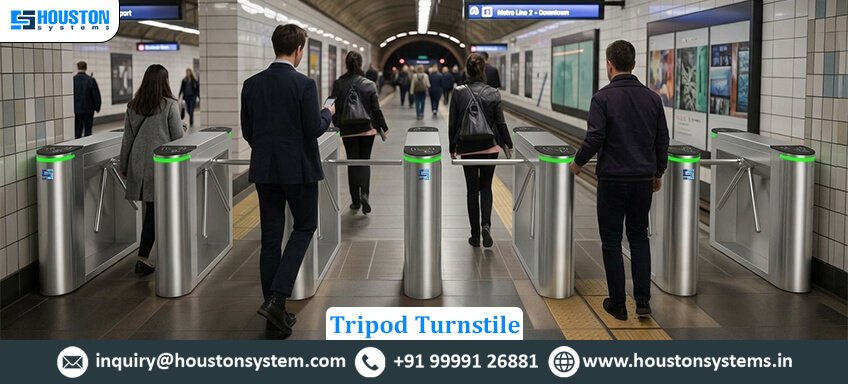
At 9:00 AM, a crowded office lobby tells you everything about a building’s entry system.
Employees slow down near the entrance. Security staff begin manually assisting people through access points. Lines form faster than they disappear. What initially looks like a minor delay quietly affects productivity, visitor experience, and operational flow.
Most organizations don’t notice these losses because they happen in small increments.
A few seconds per employee. A few minutes during shift changes. Repeated every day.
Over time, inefficient entry management becomes an operational problem—not just a security inconvenience.
That is why businesses are increasingly treating automated entry systems as infrastructure investments rather than optional security upgrades.
Entry Systems Influence More Than Security
Companies often evaluate access control systems based only on installation costs or hardware specifications.
But in practice, the bigger impact appears in daily operations.
An inefficient entry process can affect:
- Employee movement during peak hours
- Visitor handling efficiency
- Security consistency across multiple access points
- Staffing requirements for manual supervision
- Overall movement flow inside facilities
In large environments, these operational effects compound quickly.
A system that saves only a few seconds per user may create measurable efficiency gains when hundreds or thousands of people move through entry points every day.
Why Manual Entry Processes Become Expensive Over Time
Manual supervision works reasonably well in low-volume environments.
However, once facilities begin handling larger traffic volumes, the limitations become visible:
- Security staff are forced to manage crowd flow manually
- Verification consistency decreases during busy periods
- Queue formation slows movement
- Human error becomes more common under pressure
The issue is not that people are ineffective.
The issue is that manual systems struggle to maintain consistency under continuous load.
This is especially noticeable during:
- Morning office rush periods
- Industrial shift changes
- Event-based crowd movement
- Multi-entry facility operations
In these situations, delays spread outward. One congested entry point often affects surrounding movement across the building.
The Difference Between Open Access and Controlled Flow
One of the biggest operational advantages of automated entry infrastructure is structured flow management.
Instead of relying on open access or loosely monitored movement, structured entry systems create:
- Predictable movement patterns
- Controlled lane-based flow
- Consistent entry enforcement
- Improved throughput during peak demand
This changes how facilities operate during high-pressure periods.
Many organizations implement structured entry systems because they allow physical movement to remain controlled without slowing overall flow.
The value is not only security. It is operational stability.
Small Delays Become Large Operational Losses
In high-traffic facilities, even minor slowdowns matter.
For example:
- A 3–5 second delay per employee can significantly increase queue time during peak periods
- Uneven lane usage creates localized congestion
- Delayed entry processing affects attendance timing and workforce movement
These issues rarely appear dramatic in isolation.
But repeated daily across hundreds of users, they begin affecting:
- Workforce efficiency
- Entry consistency
- Employee experience
- Operational predictability
The organizations that scale effectively are usually the ones that reduce friction at movement-critical points.
ROI Is Often Measured Incorrectly
A common mistake is evaluating automated entry systems only through direct cost reduction.
The larger return often comes from:
- Reduced congestion
- Faster processing speed
- Better movement visibility
- More reliable access enforcement
- Lower dependency on manual coordination
These improvements strengthen operational consistency across the entire facility.
That consistency becomes increasingly valuable as organizations grow.
Integration Expands Long-Term Value
Modern entry systems become significantly more effective when connected with broader operational platforms.
This may include:
- Attendance systems
- Visitor management platforms
- Centralized security dashboards
- Multi-location monitoring environments
When entry infrastructure communicates with surrounding systems, organizations gain better visibility into how movement actually occurs throughout a facility.
This is one reason businesses continue adopting automated entry management as part of larger operational modernization strategies.
Facilities That Benefit Most From Automated Entry Infrastructure
The operational advantages are most visible in environments with continuous or repeated movement.
Examples include:
- Corporate offices with high employee traffic
- Manufacturing facilities operating multiple shifts
- Educational campuses with distributed entry points
- Transportation hubs handling continuous flow
In these environments, movement efficiency directly affects operational performance.
Final Perspective
The long-term value of automated entry systems is rarely created by hardware alone.
It comes from reducing friction, maintaining consistency, and supporting reliable movement under daily operational pressure.
Organizations that improve how people move through facilities often improve far more than security.
They improve efficiency, predictability, and overall operational control.
And in high-traffic environments, those advantages compound over time.