The Future of Digital Transformation with AI and Custom Software Solutions
By Will Jack 22-07-2026 93
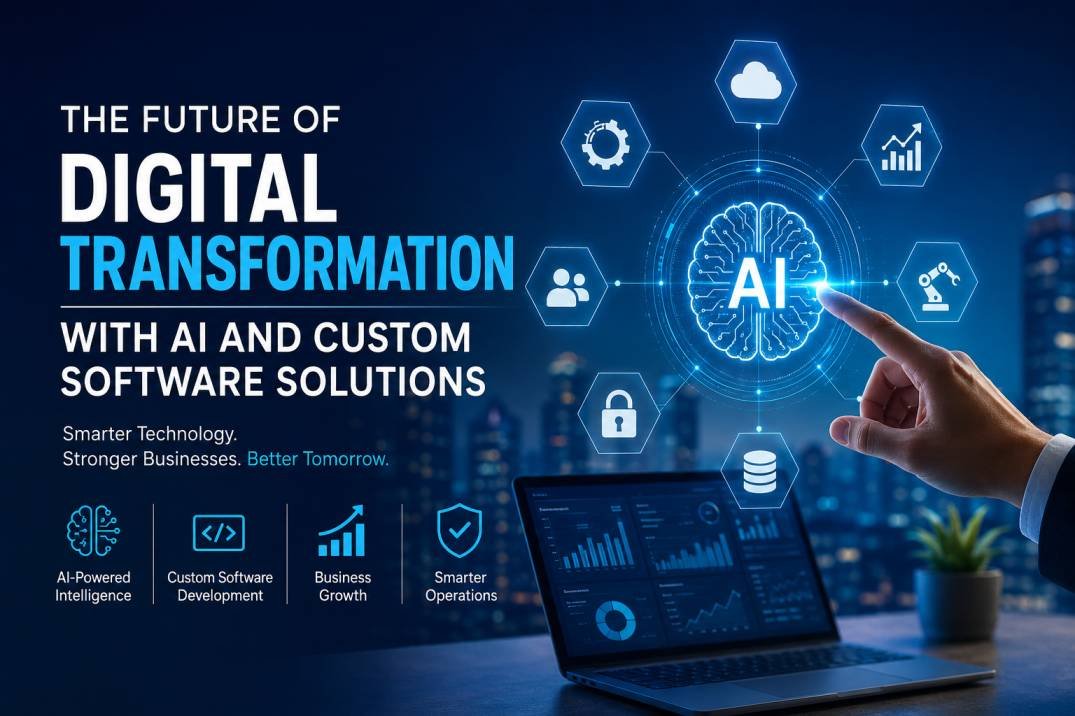
Digital transformation is no longer just a competitive advantage, it has become a business necessity. Organizations across industries are embracing advanced technologies to improve operational efficiency, deliver exceptional customer experiences, and stay ahead in an increasingly digital marketplace. As artificial intelligence (AI) continues to evolve, businesses are discovering new opportunities to automate workflows, analyze data intelligently, and build innovative digital products that drive sustainable growth.
While off-the-shelf software may address basic operational needs, modern enterprises require scalable and customized solutions that align with their unique business processes. The combination of AI and custom software solutions is reshaping how organizations operate, helping them become more agile, data-driven, and future-ready.
Digital Transformation in the AI Era
Digital transformation is the process of integrating digital technologies into every aspect of an organization to improve business operations, customer engagement, and overall performance. It involves more than simply adopting new software, it requires rethinking processes, embracing innovation, and creating a culture that supports continuous improvement.
Artificial intelligence has accelerated this transformation by enabling businesses to automate repetitive tasks, generate valuable insights from data, and make faster, more informed decisions. Organizations that leverage AI are improving productivity while delivering smarter and more personalized customer experiences.
Why Artificial Intelligence Is Transforming Modern Businesses
AI has become one of the most influential technologies in digital transformation strategies. Unlike traditional automation, AI systems can learn from historical data, recognize patterns, and improve performance over time.
Businesses are increasingly using AI to streamline customer service, automate document processing, forecast demand, optimize supply chains, detect fraud, and personalize marketing campaigns. These intelligent capabilities allow organizations to reduce operational costs while improving efficiency and decision-making.
The Growing Importance of Custom Software Solutions
Every business has unique goals, workflows, and operational challenges. Generic software often forces organizations to adapt their processes to fit predefined features, which can limit productivity and scalability.
Custom software solutions are designed specifically to meet an organization's requirements. They integrate seamlessly with existing systems, support business growth, and provide greater flexibility as business needs evolve.
Unlike standardized applications, custom-built platforms can incorporate advanced AI capabilities that automate complex business processes, improve user experiences, and deliver real-time business intelligence.
Businesses seeking long-term digital success often invest in AI and Custom Software Solutions that are tailored to their operational objectives and future growth plans.
How AI and Custom Software Work Together
The real power of digital transformation emerges when artificial intelligence is integrated into custom software applications.
Instead of relying on manual processes, organizations can automate repetitive workflows while enabling employees to focus on strategic initiatives. AI-powered custom applications can analyze customer behavior, predict future trends, recommend actions, and continuously optimize business performance.
Industries Leading the AI Revolution
Healthcare
Healthcare organizations are using AI-powered software to improve patient care, automate administrative tasks, assist with medical imaging, and enhance treatment planning. Digital healthcare platforms continue to improve both operational efficiency and patient outcomes.
Logistics and Transportation
AI is revolutionizing logistics by optimizing routes, predicting delivery times, reducing fuel consumption, improving fleet management, and enhancing warehouse operations. Intelligent logistics software helps businesses deliver faster while reducing operational expenses.
Retail and eCommerce
Retail businesses use AI-driven software to personalize shopping experiences, optimize inventory management, forecast consumer demand, and automate customer support through intelligent virtual assistants.
Manufacturing
Manufacturers rely on AI to monitor equipment performance, predict maintenance requirements, improve production quality, and automate quality inspections using computer vision technologies.
Banking and Financial Services
Financial institutions leverage AI-powered software for fraud detection, automated risk assessment, customer verification, algorithmic trading, and personalized financial services.
Emerging Technologies Driving Digital Transformation
The future of digital transformation extends beyond traditional AI. Several emerging technologies are reshaping business operations across industries.
Generative AI is enabling organizations to create content, generate software code, automate documentation, and enhance customer communication.
Machine learning continues to improve predictive analytics, allowing businesses to anticipate customer behavior and market trends more accurately.
Hyperautomation combines robotic process automation with artificial intelligence to automate increasingly complex business workflows.
Edge AI enables real-time decision-making by processing data closer to connected devices, reducing latency and improving responsiveness.
Cloud-native AI platforms provide scalable infrastructure that allows organizations to deploy intelligent applications quickly while supporting global business operations.
Business Benefits of AI-Powered Custom Software
Organizations investing in AI-powered custom software experience significant long-term advantages.
Automated workflows reduce repetitive manual work while improving employee productivity.
Advanced analytics provide deeper business insights, enabling leaders to make faster and more informed strategic decisions.
AI-powered personalization improves customer satisfaction by delivering relevant recommendations, targeted marketing, and responsive support.
Custom-built platforms also offer enhanced security, better scalability, and seamless integration with existing enterprise systems.
Perhaps most importantly, businesses gain the flexibility to innovate continuously as technology evolves.
Challenges Businesses Should Consider
Despite its enormous potential, digital transformation requires careful planning and execution.
Organizations must address data privacy regulations, cybersecurity risks, integration with legacy systems, employee training, and ethical AI governance.
Successful implementation also depends on maintaining high-quality data, selecting appropriate technologies, and establishing clear business objectives before launching AI initiatives.
Companies that approach transformation strategically are more likely to achieve sustainable success while minimizing implementation risks.
Best Practices for Successful AI-Driven Digital Transformation
Businesses should begin by identifying operational challenges and defining measurable objectives.
A scalable technology roadmap ensures that AI investments continue to deliver value as the organization grows.
Selecting experienced development partners helps organizations design secure, scalable, and future-ready software solutions.
Continuous monitoring, optimization, and employee training are equally important for maximizing long-term ROI and ensuring AI systems continue to improve over time.
Digital transformation should be viewed as an ongoing journey rather than a one-time technology upgrade.
The Future of Digital Transformation
Over the next decade, AI will become deeply integrated into nearly every business application. Intelligent automation, predictive analytics, autonomous decision-making, and personalized digital experiences will become standard expectations rather than competitive differentiators.
Organizations that embrace AI alongside custom software development will be better positioned to respond to changing customer expectations, improve operational resilience, and unlock new business opportunities.
As technology continues to evolve, successful businesses will focus on building flexible digital ecosystems capable of adapting to future innovations while maintaining security, scalability, and operational excellence.
Conclusion
The future of digital transformation is being shaped by artificial intelligence and custom software solutions. Together, these technologies enable businesses to automate operations, improve customer experiences, make smarter decisions, and accelerate innovation.
Rather than relying on one-size-fits-all software, organizations are increasingly investing in tailored digital solutions that align with their strategic objectives and long-term growth plans. Companies that embrace AI today will be better prepared to compete in tomorrow's rapidly evolving digital economy.