TL;DR
Event payments have come a long way from cash-only counters. As events became larger and attendees started expecting faster, more convenient ways to pay, cards, mobile wallets, QR codes, and contactless technologies gradually replaced traditional cash transactions.
Today, RFID wristbands, NFC-enabled devices, and digital wallets allow attendees to pay with minimal friction while giving organizers better visibility into sales, inventory, and attendee behavior. Understanding this evolution can help organizers choose a payment system that fits the scale and needs of their event.
Introduction
Imagine you are organizing an event with thousands of attendees.
There are food stalls, merchandise counters, bars, activity zones, and vendors spread across the venue. Now imagine every attendee carrying cash and every vendor manually accepting, counting, and giving change for every purchase.
It worked once. But as events became bigger, faster, and more technology-driven, the limitations of cash became difficult to ignore.
Long queues. Manual reconciliation. Cash handling. Human errors. Limited visibility into sales.
This created a simple question for event organizers: Is there a better way to handle payments?
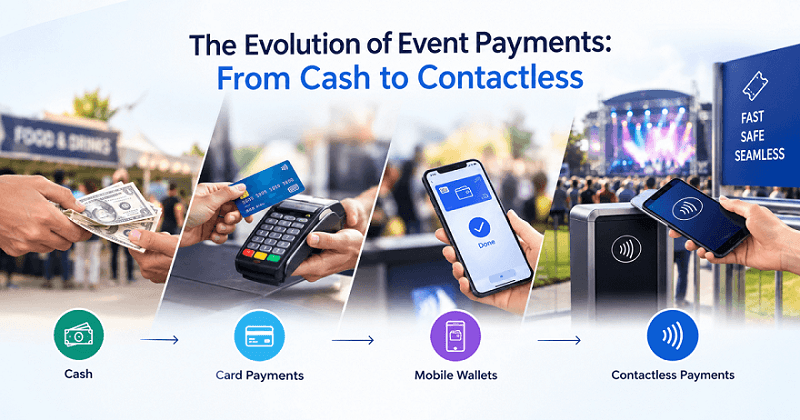
That question led to the gradual evolution from cash to cards, then digital payments, and eventually contactless and cashless payment system for events.
So, how exactly did we get here?
Where Did Event Payments Begin? The Era of Cash
For a long time, cash was the simplest payment option available at events.
An attendee would visit a food or merchandise counter, hand over cash, receive their purchase and change, and move on. For smaller gatherings, this process was relatively easy to manage.
But event organizers faced a different reality behind the scenes.
Every vendor needed to maintain cash, calculate sales, store money securely, and reconcile transactions after the event. At larger events, the volume of transactions made this increasingly complicated.
Cash also created friction for attendees. If someone ran out of money, they had to find an ATM or carry enough cash with them throughout the event.
As event attendance grew, organizers needed payment methods that could keep up with the crowd.
The First Big Shift: Cards Enter the Event World
The rise of debit and credit cards changed everyday payments, and events eventually followed the same path.
Instead of carrying large amounts of cash, attendees could simply pay using a card. For organizers, card payments reduced some of the challenges associated with physical cash.
But cards did not completely solve the event payment problem.
A traditional card transaction could still require a physical card, a payment terminal, authentication, and a stable internet connection. During busy periods, even a few extra seconds per transaction could contribute to queues.
For an event with thousands of people making purchases at the same time, those seconds mattered.
This pushed payment technology toward something faster and more convenient.
Contactless Payments Make Transactions Faster
The next major development was contactless payment technology.
Instead of inserting or swiping a card, attendees could simply tap a contactless card or compatible device on a payment terminal.
This seemingly small change had a significant impact on the payment experience.
The transaction became quicker. There was less physical handling. And attendees no longer needed to repeatedly insert a card or deal with cash.
At the same time, smartphones and smartwatches introduced another option: mobile wallets.
Now, an attendee could potentially pay using a device they were already carrying.
For event organizers, this was an important step toward reducing friction at payment points.
But there was still another problem.
What if an event wanted to make the entire payment experience contactless, not just the payment itself?
From Contactless Cards to Cashless Event Payments
This is where the concept of cashless event payments began to become particularly useful.
Instead of simply replacing cash with a card, cashless systems could create a dedicated payment ecosystem for the event.
Based on the system, an attendee might receive an RFID wristband, NFC-enabled card, or another digital payment credential. They could add money to their account and then use that credential to make purchases throughout the venue.
The idea was straightforward:
Top up once -> Tap to pay -> Keep moving.
For attendees, this reduced the need to repeatedly take out a wallet or phone.
For organizers, the advantages went much further.
Transactions could be recorded digitally, making it easier to monitor sales, understand purchasing patterns, manage vendors, and reconcile revenue.
This meant payment technology was no longer simply about collecting money. It became part of event operations.
Why RFID and NFC Became Important for Events
RFID and NFC helped take cashless payments a step further because they were designed around quick, contactless interactions.
With an RFID wristband, for example, an attendee can tap their wristband at a compatible POS terminal instead of taking out their wallet.
NFC technology works on a similar principle, allowing compatible devices or credentials to exchange information over a short distance.
For events, this is particularly useful because the payment credential can become part of the attendee experience.
A wristband can potentially serve multiple purposes, such as access control, identification, and payments, depending on the event's technology setup.
That creates a much more connected experience than simply replacing a cash counter with a card machine.
The Payment System Becomes an Event Management Tool
This is perhaps the most important part of the evolution.
In the early days, payment was mainly a transaction between an attendee and a vendor.
Today, event payment technology can provide organizers with operational data. A modern cashless system can help organizers monitor:
- Sales across different vendors
- Popular products and purchase patterns
- Transaction volumes during peak periods
- Inventory movement
- Vendor performance
- Top-up and refund activity
- Payment activity across the venue
Instead of waiting until the event ends to count cash and calculate sales, organizers can gain a much clearer picture of what is happening while the event is running.
That changes the role of payments from a back-office function into a source of actionable event intelligence.
Conclusion
The journey from cash to contactless payments was not a single technological leap. It was a gradual response to changing attendee expectations and increasingly complex event operations.
Cash introduced payments at events. Cards made transactions more convenient. Contactless technology made them faster. And RFID, NFC, mobile wallets, and modern cashless platforms have connected payments with broader event operations.
For today's event organizer, the question is no longer simply “How can I accept payments?”
It is “How can I make payments faster, easier, more secure, and more useful for the entire event?”
Understanding how event payments evolved makes that decision easier. Because when you know why the industry moved from cash to contactless, you can make a more informed choice about what comes next for your event.