The Critical Role of Your First Aid CPR Course Brisbane Skills in the Chain of Survival
By larabuck 24-10-2025 108
The chain of survival implies the timely performance of actions that can greatly influence the outcome of a victim suffering sudden cardiac arrest (SCA) or other life-threatening emergencies. This chain is only as stronger as its weakest link; for most of these out-of-hospital occurrences, the initial link can only depend on an intervening bystander. Therefore, taking a full first aid CPR course Brisbane is not only personal improvement, but also an intention of being that important, strong link connecting victim collapse with professional medical service.
This content further looks at how each knowledge and skill gained from a structured first aid CPR course Brisbane course directly relates to each step in the Chain of Survival, putting strong emphasis on the great responsibility and competence imparted to each student.
1. Early Recognition and Call for Help: The Foundation of Your First Aid CPR Course Brisbane Training
The very first and arguably the most important link in the Chain of Survival is immediate recognition of an emergency followed by calls to emergency medical services. It is important to avoid hesitancy at this link since that would greatly alter the prospects of a positive outcome.
Rapid Assessment Skills
One of the basic modules of the first aid CPR course Brisbane training is a structured assessment of the casualty. This includes the rapid checking of dangers to self, victim's response, and breathing. Participants are expected to note the difference between faint, seizures, and real cardiac arrest by the time a victim shows some unresponsiveness and is not breathing normally (producing agonal gasps). This speedy and accurate process of decision making is practiced in realistic simulations all through the course.
Activating the EMS
Knowing the local emergency number (Triple Zero - 000 in Australia), and to be able to convey information clearly and concisely, is paramount. Your first aid CPR course Brisbane teaches you to keep calm, give the precise location, describe the state of the emergency, and follow any instructions given by the dispatcher. They are also quickly enlisted with the right information and resources deployed through ambulance and paramedic teams to cut down the time of response and move to the next link in the chain immediately.
2. Early Cardiopulmonary Resuscitation (CPR): The Core Skill of a First Aid CPR Course Brisbane
The activation of early CPR is the initiation of the second link in the chain. As primi-facie acknowledgement of an emergency is done and medical personnel are called. Within minutes, cerebral cells die without circulation, and effective CPR is an artificial means of perfusion to provide the brain and heart with oxygenated blood while buying time until defibrillation.
Mastering High-Quality Compressions
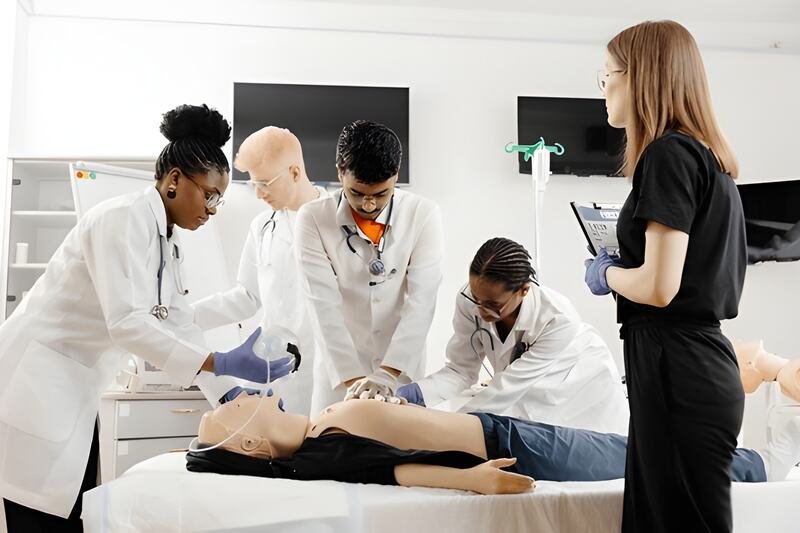
The technical skill of performing CPR is the penultimate component of first aid CPR course Brisbane. High-quality compressions must be well-defined extent (5-6 cm) and rate (100-120 beats per minute). Actual practice in the course usually includes feedback mannequins, thereby getting the students to ensure that their pressure and timing profiles are achieved. Such attention to detail, reinforced in practical assessment, is what makes the difference between knowledge and lifesaving skill.
Minimal Interruption Must Be Done
Another important soft skill gained, upon which this link's effectiveness rests, was discussed above-the ability to stay focused and resilient. Trainees during this intensely practical program learn how to reduce interruptions, thus maintaining critical blood flow: compression is to go on until an AED arrives or until EMS personnel makes that change.
3. Early Defibrillation: Integrating Skills from Your First Aid CPR Course Brisbane

The third link is early defibrillation and is usually needed when the SCA follows the electrical disaster in the heart, known as ventricular fibrillation (VF). By stopping the VF, a defibrillator (AED) will allow the natural pacemaker of the heart to restart a normal rhythm.
Confidence in Using an AED
The comprehensive first aid CPR course Brisbane covers considerable training in the use of Automated External Defibrillators. Candidates learn proper pad placement, how to follow audible instructions issued by the device, and the safety protocols for delivering a shock. In this manner, the AED is demystified—from something seemingly difficult to understand and operate to an easy-to-use, life-saving device. This practical mastery is a core reason why first aid CPR course Brisbane saves lives.
Unrestricted Integration with CPR
Integration of CPR and defibrillation in this manner is also taught. Trainees apply AED pads quickly while continuing compressions so that 'hands-off' time before a shock is minimised. That ability to transition seamlessly between CPR cycles and the use of the defibrillator, sometimes under simulated stress, is evidence of the effectiveness of team training delivered by a first aid CPR course in Brisbane.
4. Early Advanced Life Support (ALS) and Post-resuscitation Care
The earlier three links are, in fact, the responsibility of a bystander; advanced life support and integrated post-cardiac arrest care are performed by a paramedic and hospital staff. However, the success of ALS will always depend on the quality of interventions preceding it by the bystander.
Hand Over and Collaboration
Communication skills taught in a first-aid CPR course Brisbane are especially important during handover to EMS. An educated bystander will disarray piece of information as to what happened: when the collapse happened, when CPR commenced, and duration for which AED application took place, including the number of shocks delivered. Such communication is clear and useful, which allows paramedics to begin advanced interventions right after without clunky intermission.
The Difference Maker
The quality of the training in the first-aid CPR course Brisbane will determine how effective the entire Chain of Survival is. Effective bystander CPR maintains perfusion of oxygen and blood to the heart and brain of the patient, preventing secondary damage, and providing a stand-by effect of increased responsiveness of the heart towards advanced interventions taken by the paramedic. Hence, the bystander actions prepare the path for the best results from the ALS team, directly affecting the chances of survival of the victim and result in neurological status.
Conclusion
Becoming qualified through your first-aid CPR course Brisbane is a matter of proactive community safety. It arms you with skills, both technical and soft, to take an active role through all the critical stages of the Chain of Survival and, thus, fulfill that meaningful role of temporary lifeline. In doing so, you invest in the community's safety and are ready to make arguably the most critical difference in a life-or-death situation.