The Complete Guide to Choosing the Right Cold Press Juicer Machine for Your Home
By Hurom Juicers India 06-06-2026 156
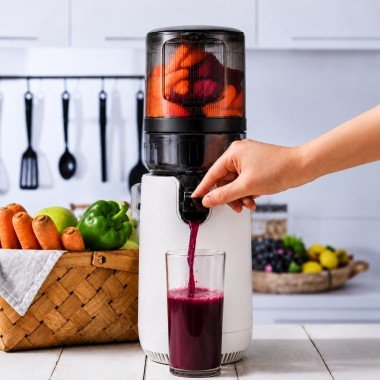
Every Indian household that has decided to take health seriously eventually arrives at the same question. Which juicer is actually worth buying? Not the one that looks impressive on a shelf, not the one that is cheapest, but the one that genuinely delivers real nutrition every morning without making daily life more complicated.
The answer, for most health-conscious Indian households in 2026, is a cold press juicer. And this guide explains everything - what it is, how it works, why it outperforms every alternative, and what to look for when choosing the right cold press juicer for home use.
What Is a Cold Press Juicer?
A cold press juicer - also called a slow juicer or masticating juicer that extracts juice by using a slow-rotating auger that operates at 40 to 43 RPM. This auger gently crushes and presses produce against a fine mesh, squeezing out every drop of juice without generating heat.
The term "cold press" specifically refers to the absence of heat during extraction — and that absence is everything. No heat means no damage to the vitamins, live enzymes, and antioxidants that exist in your produce. Everything nutritionally valuable in the whole fruit or vegetable survives the process and ends up in your glass, intact and bioavailable.
This is fundamentally different from how most Indian households currently juice — and that difference changes everything about the quality and nutritional value of what you drink every day.
How a Cold Press Juicer Machine Works
Understanding how a cold press juicer machine works helps explain why it produces results that no other juicing method can replicate.
The extraction happens in three precise stages:
Stage 1 — Crush
The slow auger rotates and crushes produce against the chamber wall, breaking down cell walls gently and releasing juice. Because the auger moves at just 40 to 43 RPM, no meaningful friction is generated and no heat is produced.
Stage 2 — Press and Filter
The crushed produce is pressed against a fine mesh screen. Juice passes through the mesh into the collection jug while pulp is directed into a separate container. The mesh separates juice from difficult-to-digest fibres, producing a smooth, clean result.
Stage 3 — Collect
The extracted juice flows smoothly into the collection jug with minimal foam and minimal oxidation. The pulp that comes out is noticeably dry — which is the most visible proof that the machine has extracted maximum juice from the produce.
The entire process is quiet, slow, and thorough. The result is juice that is richer in colour, denser in nutrition, and significantly longer-lasting than juice produced by any high-speed method.
Cold Press Juicer vs Centrifugal Juicer — The Key Difference
Most Indian kitchens currently use a centrifugal juicer — the type with fast-spinning blades that processes produce in seconds. It is familiar, affordable, and widely available. But here is what happens inside it that most users never consider.
A centrifugal juicer spins at 10,000 to 15,000 RPM. That speed generates significant heat through friction. Heat destroys heat-sensitive vitamins like Vitamin C and B-complex. It deactivates live enzymes. It causes rapid oxidation that begins degrading the juice within minutes. The juice foams up, separates quickly, and delivers a fraction of the nutritional value that the original produce contained.
A cold press juicer machine does the opposite at every step:
- Operates at 40 to 43 RPM — no heat generated
Preserves up to 60% more nutrients per glass
Produces zero foam — no rapid oxidation during extraction
Delivers drier pulp — meaning more juice from the same produce
Juice stays fresh and nutritionally intact for 48 to 72 hours in an airtight glass bottle
Operates at near-silent noise levels — practical for early Indian mornings
For Indian kitchens that regularly juice amla, beetroot, raw turmeric, ginger, pomegranate, and leafy greens — all of which contain heat-sensitive active compounds — the difference between centrifugal and cold press extraction is not marginal. It is the difference between juice that genuinely supports health and juice that mostly just looks like it should.
Why a Cold Press Juicer for Home Makes Sense in India
India has one of the richest fresh produce cultures in the world. The ingredients Indian households use every day for juicing — amla, raw turmeric, beetroot, carrots, pomegranate, ginger, wheatgrass, seasonal greens — are among the most nutritionally dense produce available anywhere.
But extracting that value properly is where most Indian kitchens fall short. Here is what makes a cold press juicer for home particularly suited to Indian daily use:
Handles the full range of Indian produce
Amla, beetroot, raw turmeric, sugarcane, pomegranate, leafy greens, and fibrous vegetables — a quality cold press juicer handles every one of these effortlessly while preserving their full nutritional profile. Centrifugal juicers struggle with many of these, particularly leafy greens, wheatgrass, and fibrous root vegetables.
Quiet enough for joint family homes
One of the most consistently cited frustrations with conventional juicers in Indian households is noise — particularly for early morning use in joint families with elderly members and young children. A genuine cold press juicer machine operates at under 60 dB — quieter than a normal conversation — making 5:30 AM juicing genuinely practical.
Higher yield means better economics
A cold press juicer extracts significantly more juice from the same quantity of produce. The drier pulp it leaves behind is proof of efficiency. Over weeks and months of daily use, this higher yield translates directly into less produce purchased and less money spent — making the initial investment genuinely cost-effective over time.
Multi-function value
The best cold press juicers for home use in India today support fresh juice, nut milk, sorbets, and smooth blends from a single machine. Fresh almond milk or cashew milk made at home — without preservatives, without added sugar, without the markups on packaged alternatives — is one of the most practically valuable functions a home juicer can offer Indian households.
What to Look for When Buying a Cold Press Juicer for Home
With so many options in the market, these are the specifications and features that genuinely determine whether a cold press juicer machine is worth its price:
RPM — the most critical number
A genuine cold press juicer must operate between 40 and 60 RPM. Machines marketed as cold press but running at higher speeds still generate heat, which undermines the entire purpose of cold press extraction. Always verify the RPM before purchasing.
Auger material and quality
The auger handles the mechanical pressure of daily juicing. Food-grade, BPA-free materials that resist cracking under pressure are non-negotiable. High-quality augers handle the dense produce of Indian kitchens — beetroot, raw turmeric, carrots — without degrading over years of daily use.
Hopper inlet size
A wider feeding inlet means less pre-cutting before every juice session. For a busy Indian morning where time is genuinely limited, this practical detail determines whether juicing happens every day or gets skipped. Look for inlets of at least 120mm for comfortable daily use with Indian produce.
Noise level
A true cold press juicer for home should operate under 60 dB. This is not just a comfort preference — in the context of Indian joint family homes and early morning schedules, it is the factor that determines whether the juicing habit actually survives long-term.
Motor warranty
A 10 to 15-year motor warranty is the industry benchmark for premium cold press juicer machines. It reflects genuine engineering confidence and is the strongest available signal of long-term durability and build quality. Short warranties — regardless of price — are worth questioning.
Ease of cleaning
A cold press juicer machine that takes 20 minutes to clean every morning will not be used every morning. Fewer detachable parts, quick-rinse components, and simple reassembly are what make daily juicing sustainable in a real Indian household routine.
Functions
Beyond juice — does the machine make nut milk, sorbet, and smooth blends? More functions from one machine means better long-term value and a smaller overall kitchen footprint.
Common Mistakes to Avoid When Buying a Cold Press Juicer
Even informed buyers make these mistakes — knowing them in advance saves both money and frustration:
Choosing based on price alone — a very cheap cold press juicer almost always uses low-quality auger materials that crack under daily pressure from Indian produce. The initial saving quickly becomes an expensive mistake
Not checking the RPM — machines that claim cold press functionality but run at higher speeds do not deliver the nutritional benefits associated with genuine cold press extraction
Overlooking cleaning ease — this is the most common reason good juicers stop being used. A complicated cleaning routine kills the habit within weeks
Ignoring warranty length — short motor warranties signal that the manufacturer does not expect the machine to last. A 10 to 15-year warranty signals the opposite
Buying a machine too large for the kitchen — check dimensions before purchasing. A machine that does not fit comfortably on your counter will not become part of your daily routine
Why Hurom Leads the Cold Press Juicer Category in India
Any honest guide to cold press juicers in India leads to one brand that consistently stands apart in terms of technology, history, and real-world performance — Hurom.
Hurom invented the world's first slow juicer in 1974. The patented Slow Squeeze Technology that powers every Hurom cold press juicer machine today has been developed and refined over five decades of dedicated research. It remains the global benchmark for cold press extraction quality — the standard against which every other machine in this category is measured.
What makes Hurom specifically suited to Indian households:
Designed for Indian produce — handles amla, beetroot, raw turmeric, pomegranate, leafy greens, and fibrous vegetables with ease
Ultra-quiet motors — practical for early morning use in joint family homes
10 to 15-year motor warranties — the strongest durability commitment in the category
Award-winning engineering — Red Dot Design Award 2025, Kitchen Innovation Award 2025, Forbes Vetted Best Juicer 2024
Complete range for every budget — from the compact E30-ST at ₹17,999 to the fully automated H400 at ₹40,999
Trusted by 10 million+ households across 80+ countries worldwide
Every Hurom cold press juicer for home is built with 100% BPA-free, food-grade components, backed by industry-leading warranties, and designed for the daily realities of Indian household use.
The Daily Habit That Changes Everything
A cold press juicer is not just a kitchen appliance. It is the foundation of a daily health habit that compounds over time in ways that are genuinely visible — in energy levels, digestion, skin clarity, weight management, and overall wellbeing.
The Indian kitchen already has everything it needs to build that habit. The amla. The beetroot. The turmeric. The ginger. The seasonal greens. The extraordinary produce that has been at the centre of Indian health culture for generations.
A quality cold press juicer machine extracts everything those ingredients have to offer, preserves every nutrient that makes them valuable, and delivers it into your glass every single morning — one slow, quiet, deliberate press at a time.
That is the difference. That is why it matters. And that is why more Indian households are making this choice every day in 2026.