Steel Plate Fabrication in Railway Rolling Stock: Where Accuracy Has No Shortcuts
By HimalayaMachinery 18-06-2026 92
Railway rolling stock sits in a category of fabricated steel structures where the demands on plate processing are unusually broad. A single freight wagon contains flat structural panels, curved body sections, cylindrical tank components in the case of tank wagons, and precision-cut frame members- all made from plate that has to be processed accurately and assembled to tight tolerances before it enters service on a network where vehicle interchangeability and dimensional consistency are operational requirements, not just quality preferences.
The rolling stock fabrication sector does not attract the same public attention as shipbuilding or aerospace, but from a steel processing standpoint it is one of the more technically demanding environments in which a fabrication shop can operate. The geometry requirements are strict, the material specifications are closely controlled, and the inspection regime covers both structural integrity and dimensional conformance to interoperability standards that apply across entire rail networks.
Looking at how this sector handles steel plate from receipt to finished component reveals a discipline around preparation and forming that is worth understanding regardless of which fabrication niche a shop operates in.
The Range of Components in a Freight Wagon
A standard open freight wagon- the kind used to carry bulk commodities, aggregates, or general freight- is built from a combination of flat and formed steel plate components. The underframe carries the load and connects the bogie assemblies that hold the wheels and suspension. The body sides and ends are flat or slightly curved structural panels. The floor may be flat plate or a fabricated structure depending on the wagon type and load requirements.
Tank wagons- used to carry liquids, gases, or powders- have a cylindrical or barrel-shaped tank body that is the structural and containment component of the wagon. These tanks are formed from rolled plate sections, welded into rings, and assembled into the complete shell before being mounted on the underframe. The tank has to meet pressure vessel requirements if it carries pressurised products, or structural containment requirements if it carries non-pressurised liquids.
Passenger vehicle bodies are more complex still: curved roof sections, profiled side panels, structural floor frames, and door aperture surrounds all require different forming operations. The geometry tolerances in passenger vehicle fabrication are tighter than for freight stock because dimensional consistency affects door fit, interior fitting installation, and the aerodynamic profile of the vehicle.
Why Incoming Plate Condition Matters in a Production Line Environment
Rolling stock fabrication at a production facility is organised as a flow line, not as one-off job fabrication. Wagons or vehicle bodies move through a sequence of assembly stages- underframe build, body assembly, welding, painting, fitting- each of which depends on the previous stage having been completed to the required dimensional tolerance. A component that arrives at the assembly stage out of tolerance holds up the line while the problem is investigated and corrected.
In this environment, incoming plate condition is not just a quality issue- it is a production flow issue. Plate that arrives with significant camber, bow, or surface wave introduces variability into the cutting and forming operations that produces dimensional scatter in the finished components. That scatter, accumulated across multiple components in a single wagon build, translates into fit-up problems at assembly.
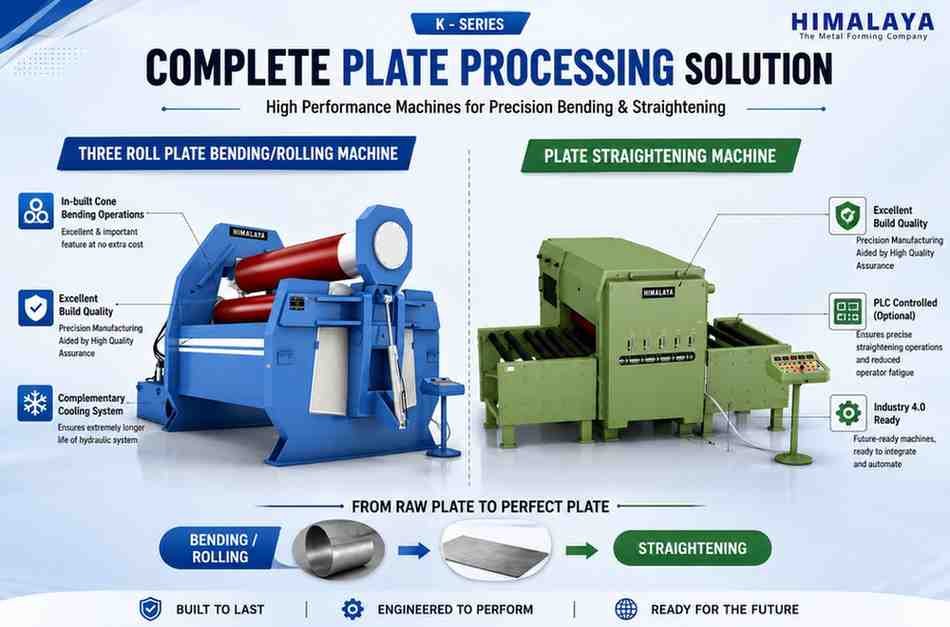
Production-oriented rolling stock shops treat incoming plate preparation as a fixed step before the plate enters the cutting line. A plate straightening machine positioned at the start of the plate processing sequence- before the cutting tables- takes incoming plate from whatever condition it arrived in and produces a consistent, flat starting point for everything downstream. The time investment is predictable and short. The benefit is that every component cut and formed from the straightened plate starts with the same geometric baseline, which is what makes the assembly process consistent and the line flow predictable.
The Thermal Cutting Dimension
Most rolling stock structural components are cut from plate using plasma or laser cutting equipment, which is fast and accurate but sensitive to the condition of the plate being cut. A plate with significant residual stress can move- sometimes noticeably- when the cutting torch releases the stress by cutting through the material. This movement introduces dimensional error in the cut part that was not present in the cutting program.
Straightened plate, with its reduced residual stress level, cuts more predictably. The cut parts match the cutting program more closely, which means less time spent on post-cut dimension checking and correction, and higher confidence that the parts will fit together correctly at assembly. In a production line environment, this consistency has a direct effect on throughput and yield.
Tank Wagon Shell Forming and the Precision It Requires
The cylindrical tank body of a tank wagon is one of the more demanding plate forming applications in rolling stock fabrication. The tank has to be round- genuinely round, within a defined tolerance- because out-of-roundness affects both the structural behaviour of the vessel and its interaction with the underframe mounting points. A tank that is oval in cross-section applies non-uniform loads to its mounting brackets and does not seal correctly against the end domes, which creates leak paths at the circumferential welds.
Tank diameter in railway tank wagons is constrained by the loading gauge- the maximum cross-sectional envelope within which a railway vehicle must fit to pass through tunnels and past platform edges. This means the tank diameter is often pushed close to the gauge limit to maximise capacity, which in turn means the forming tolerance has to be held tightly to avoid exceeding the gauge clearance.
For this work, a well-calibrated rolling machine with consistent roll geometry and accurately controlled roll gap is the right tool. The consistency of the machine geometry across the full roll length is critical: a roll that is slightly worn or misaligned in its bearings produces shells where the radius varies from one end to the other, which creates a conical rather than cylindrical form. That conical error, even if small, causes the shell rings to not mate correctly at the circumferential seam joints, which requires hand correction before welding and introduces the risk of weld joint misalignment in the finished vessel.
End Dome Forming and the Edge Geometry Requirement
Tank wagon shells are closed at each end by a dished or hemispherical end dome, which is pressed or spun from plate and then welded to the shell at a circumferential seam. The accuracy of this seam depends on both the shell roundness and the dome edge geometry- both have to match the same nominal diameter within the weld joint tolerance.
The plate edge treatment at the shell ends matters here. Flat sections at the leading and trailing edges of each shell plate section- the edge zones that did not receive full forming in the roll pass- disrupt the circular geometry of the shell at the point where the end dome joint will be located. Getting the edge pinch right in the forming process is therefore directly connected to the quality of the circumferential weld joint, which is the most structurally significant seam in the tank.
Structural Frame Fabrication and Flatness Requirements
The underframe of a freight wagon is a structural steel frame that carries the load of the cargo above and transfers it to the bogie assemblies below. It is built from a combination of rolled section material and plate- floor plate, web plates for the main longitudinal girders, and gusset plates at the connection points. The dimensional accuracy of the underframe affects how well the body components fit to it and how the completed wagon sits on its bogies.
Flat plate components in the underframe need to be flat- genuinely flat, not approximately flat. Gusset plates that are not flat cannot be welded into their connection positions without distortion being introduced into the frame. Web plates with bow or camber produce girders that are not straight, which affects how the floor loads are distributed and can introduce twist into the completed frame.
Shops that straighten incoming plate before cutting these components find that their frame assemblies require less correction before welding and less post-weld straightening after the thermal distortion of welding has had its effect. The pre-weld geometry is more consistent, which means the post-weld geometry is more predictable and requires less corrective work to bring back within tolerance.
Interoperability Standards and the Dimensional Tolerances They Set
Rail vehicles operating on a shared network have to meet interoperability standards that specify dimensional limits for critical parameters: loading gauge profile, bogie attachment geometry, coupler height and alignment, buffer projection. These standards exist because a wagon built by one manufacturer in one country needs to operate safely alongside vehicles built by different manufacturers in different countries on the same network.
For the fabricator, these interoperability requirements translate into dimensional tolerances that are non-negotiable and that apply to the finished assembled vehicle. Working backwards from the finished vehicle tolerance to the tolerance that needs to be maintained on each individual component requires understanding how dimensional errors in components accumulate through the assembly sequence.
The practical implication is that the tolerance on individual components has to be tighter than the tolerance on the finished vehicle, to leave room for the accumulated stack-up of multiple components. Shops that control their plate processing tightly- flat incoming plate, accurate forming, consistent cut geometry- have more tolerance budget available for the assembly stage. Shops that allow variability in the early processing steps find they have used up the tolerance budget before the vehicle is fully assembled.
The Maintenance and Overhaul Side of Rolling Stock Fabrication
Railway freight wagons have long operational lives- 25 to 40 years is not unusual- and require periodic maintenance and overhaul throughout that period. Floor plates wear and need replacement. Tank shells develop corrosion and need section replacement or internal lining treatment. Underframe components fatigue at high-stress locations and need inspection, assessment, and sometimes replacement.
Overhaul work has its own fabrication demands. Replacement floor plates have to match the geometry of the wagon floor frame- which means they have to be cut accurately from flat plate. Replacement shell sections for a tank wagon have to match the existing shell radius- which means the forming process has to be set up for that specific radius, often with a reference measurement taken from the existing shell rather than a drawing dimension.
Shops that handle both new build and overhaul work need the same plate processing capabilities for both types of job. The overhaul work is often less predictable than new build- the dimensions are driven by what the existing vehicle actually measures rather than what the drawing says- which places more emphasis on operator skill and process flexibility than on following a documented production routine. Good equipment that holds its settings reliably and a well-developed process for validating forming settings against actual measurements are both assets in this environment.
What the Rolling Stock Sector Reveals About Fabrication Fundamentals
Rolling stock fabrication brings together a wider range of plate processing operations than most other sectors- flat panel cutting, structural frame assembly, cylindrical shell forming, pressure vessel work- and applies them all within a production environment that demands consistency and dimensional control at volume.
The discipline that works in this environment is not complicated: start with flat, well-conditioned plate, form it accurately with calibrated equipment and documented settings, cut to precise dimensions from a stable geometric baseline, and assemble with enough dimensional consistency that the tolerance budget is not exhausted before the vehicle is complete.
These are fundamentals. They apply equally well to a shop building one-off industrial vessels as to one running a production line of freight wagons. What the rolling stock sector demonstrates is what those fundamentals look like when they are applied consistently under production pressure- and how much difference they make to the smoothness and predictability of the fabrication process from start to finish.