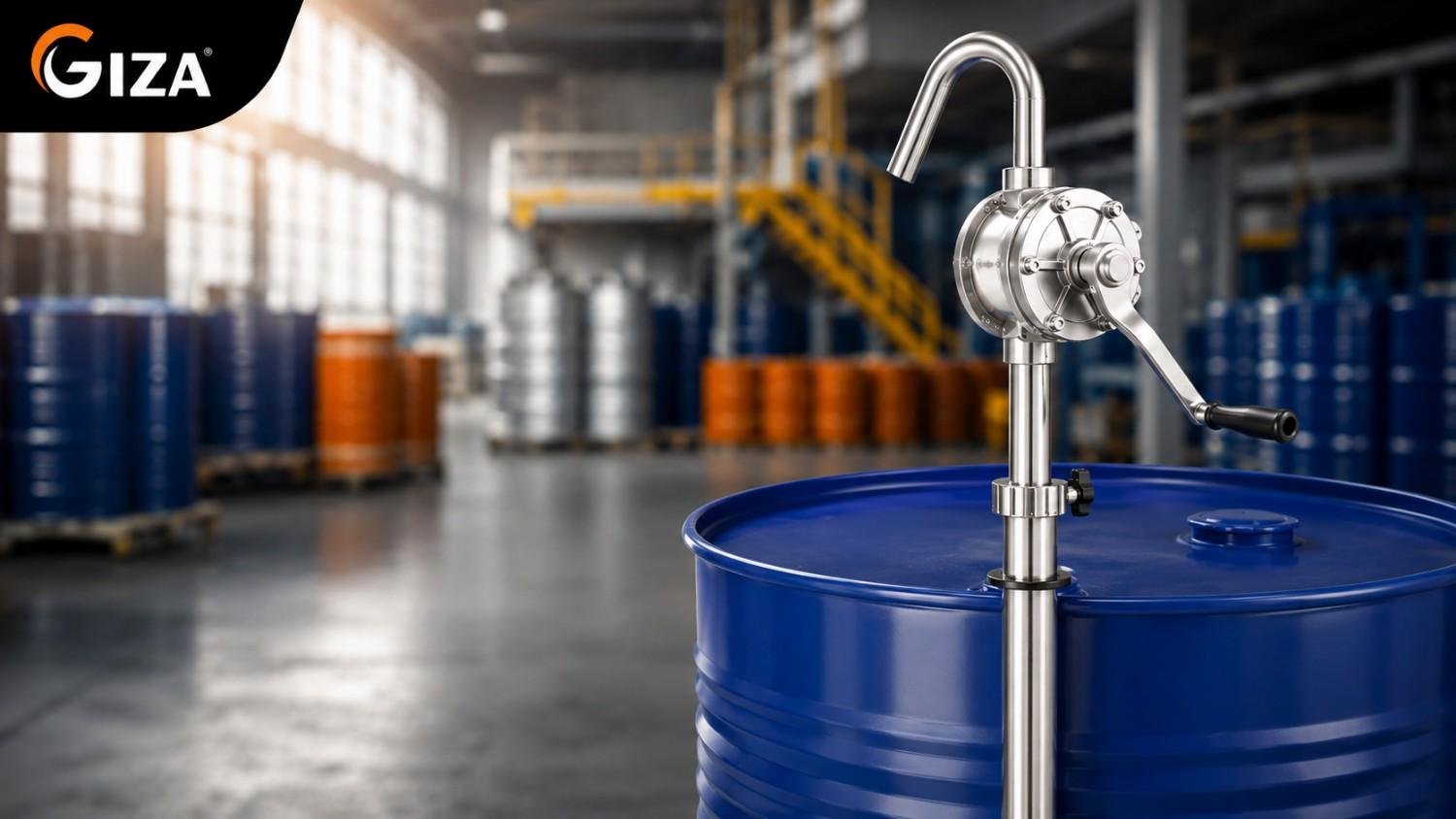
A drum is full, production is waiting, and the operator is still transferring liquid with a loose pipe and an unsuitable pump.
That is not a minor inconvenience. It creates spillage, contamination, labour loss and avoidable safety risks. An SS Rotary Barrel Pump gives industrial buyers a controlled, manually operated method for transferring compatible liquids from barrels, tanks and drums. Giza lists stainless steel pumps for handling oils, fuels, solvents, chemicals and other industrial liquids.
The difficult part is not finding a pump seller. It is matching the pump material, seals, flow requirement and liquid characteristics correctly.
SS Rotary Barrel Pump Specifications Buyers Should Compare
Common turning body types are typically rotary barrel pumps which use a handle to manually turn an internal pumping body. Liquid enters through the suction tube and is discharged through the outlet spout or hose connection.
Industrial stainless steel models are commonly offered in SS 304 and SS 316 grades. SS 304 suits many general industrial applications, while SS 316 is normally considered where stronger corrosion resistance is required. Giza’s published range mentions both 304- and 316-grade stainless steel for handling chemicals, oils, solvents and viscous liquids.
SS 304 Rotary Barrel Pump
SS 304 models are commonly selected for compatible oils, water-based media, lubricants and general-purpose liquid transfer. They can be commercially practical where SS 316 is unnecessary.
Cheap suppliers often describe every stainless steel pump simply as “SS.” That answer is useless. Ask for the exact grade used in the body, shaft, rotor, suction tube and wetted components.
SS 316 Rotary Barrel Pump
SS 316 offers better resistance in many demanding chemical-handling environments. It may be suitable for selected solvents, aggressive liquids and applications where corrosion or contamination would create a costly rejection.
And yet, SS 316 is not automatically compatible with every chemical.
Hand-Operated Rotary Models
These pumps require no electric motor or compressed-air supply. Published rotary pump specifications in the wider market range from around 200–300 ml per rotation, while some designs are rated by litres delivered over a fixed number of turns. Actual output depends on pump design and liquid viscosity.
The detail most buyers skip is seal material. A stainless steel body will not save the pump if the vanes, gasket or seal swell after repeated chemical exposure.
Five Questions That Expose a Weak Pump Supplier
Evaluate SS Rotary Barrel Pump Manufacturers using these five checks:
- What stainless steel grade touches the liquid?
A good answer lists every wetted component and its material. A bad answer is, “It is complete stainless steel,” without a specification sheet. - Has compatibility been checked against the actual liquid?
Share the liquid name, concentration, temperature and viscosity. “Suitable for all chemicals” is a careless answer, not technical guidance. - What is the measured output?
Ask whether the quoted flow is based on water or your operating liquid. A supplier quoting one universal flow figure for diesel, syrup and a viscous oil is overselling. - Which parts are replaceable?
Confirm the availability of vanes, seals, gaskets, handles and suction tubes. “Send the complete pump back if anything fails” is a weak after-sales policy. - How is each unit inspected?
Expect a defined leakage, rotation or functional inspection. Giza states that its rotary barrel pumps are inspected at each manufacturing stage by trained personnel. A bad supplier merely says the material “looks fine” before dispatch.
Benefits That Protect Cost, Safety and Buyer Margin
Controlled Drum Emptying
A rotary mechanism gives the operator more control than open pouring or improvised siphoning. That matters when one spilled batch can cost more than the pump.
No Electricity Required
Manual operation allows use in locations without a nearby electrical point. It also removes motor selection from routine barrel-emptying applications, though liquid flammability and site safety rules must still be reviewed.
Better Corrosion Resistance
SS 304 and SS 316 construction can offer longer working life than unsuitable mild-steel components when used with compatible media. Less corrosion. If the material does not corrode there will be less replacement orders, and less chance of rust contamination of the transferred liquid.
Lower Product Contamination Risk
A properly selected stainless steel pump can support cleaner transfer in pharmaceutical, chemical, food-related and manufacturing environments. Nobody tells you that poor cleaning between liquids can still cause cross-contamination. Material quality alone does not replace a cleaning procedure.
Reusable Industrial Construction
Replaceable seals and internal parts may extend service life. Buyers protect their margins when they repair a worn component instead of discarding the whole unit.
Easier Operator Control
Manual rotary action lets operators regulate transfer speed through handle movement. That can reduce splashing during filling of small containers, where large uncontrolled high-flow pumps can waste product.
Price Factors Across the Indian Supply Market
The price of an SS Rotary Barrel Pump in India is not determined by stainless steel weight alone. Grade, wetted-part construction, seal material, tube length, discharge arrangement, output, finish, packaging and order volume all influence the quotation.
SS 316 models generally cost more than comparable SS 304 versions because of material and application requirements. Custom suction tubes, hose assemblies and specialised seals can also raise the landed cost.
Across industrial centres such as Rajkot, Ahmedabad, Delhi, Pune, Mumbai, Hyderabad and Chennai, transport planning matters more than many buyers expect. A low ex-factory price can lose its advantage after poor packaging, small-lot freight and replacement delays are added.
Reliable SS Rotary Barrel Pump Suppliers should therefore quote the pump model, material grade, included accessories, taxes, freight basis and dispatch schedule separately. That makes offers comparable.
Experienced SS Rotary Barrel Pump Dealers and SS Rotary Barrel Pump Wholesalers in India from distributors & resellers need to also clarify carton quantity, spare-part availability and bulk-price slabs while accepting order.
How We Approach Industrial Pump Supply at Giza Pumps
At Giza Pumps, we manufacture rotary barrel pumps for controlled transfer of oils, lubricants, diesel, kerosene, chemicals and other compatible industrial liquids. Our published product range includes pumps made from SS 304, SS 316, polypropylene and other application-based materials.
We do not believe that one pump suits every drum and every liquid.
Our team checks pumps during different manufacturing stages rather than depending only on a final visual check. Giza also reports 30 years of industry experience in rotary barrel pump manufacturing and supply.
Send us the liquid name, concentration, approximate viscosity, operating temperature, barrel capacity, required quantity and delivery postcode.
We aim to respond within one working day with a suitable material recommendation and commercial quotation. MOQ is model- and specification-dependent; standard-unit, dealer and wholesale requirements are quoted separately.
Contact Giza Pumps with complete application details instead of requesting a price for an unspecified “SS pump.” That one step prevents most selection errors.
Conclusion
An SS Rotary Barrel Pump can reduce spillage, manual handling problems and replacement costs, but only when its materials match the liquid. Never approve a pump based solely on appearance or the lowest quotation. As chemical handling and production controls become stricter, documented compatibility and replaceable components will matter even more.
Frequently Asked Questions
1. Which SS Rotary Barrel Pump is suitable for chemical transfer?
SS 316 may be preferred for many demanding chemical applications, but the correct choice depends on concentration, temperature and seal compatibility. No stainless steel grade is universal.
2. What information do SS Rotary Barrel Pump Manufacturers need?
Share the liquid name, concentration, viscosity, operating temperature, drum size, required flow and quantity. Without these details, any recommendation is partly guesswork.
3. How do SS Rotary Barrel Pump Suppliers calculate price?
They consider SS grade, wetted components, seal material, suction-tube length, discharge accessories, quantity, packaging and freight. Custom chemical-resistant parts usually increase the price.
4. Can an SS rotary pump handle diesel and lubricating oil?
Many stainless steel rotary pumps are intended for oils, lubricants, diesel and kerosene. Compatibility still needs confirmation because viscosity and seal construction affect operation.
5. Do SS Rotary Barrel Pump Dealers keep spare parts?
Some dealers stock vanes, gaskets and seals; others sell only complete pumps. Confirm the spare-part list and lead time before placing a repeat or bulk order.
6. How should SS Rotary Barrel Pump Wholesalers in India be compared?
Compare material certificates, model specifications, inspection practices, carton quantity, replacement terms, dispatch lead time and spare availability—not only the unit price.
7. Does an SS Rotary Barrel Pump work with viscous liquids?
It can handle selected viscous liquids, but output generally falls as viscosity rises. Very thick media may require a different pump design, so provide a viscosity value before ordering.