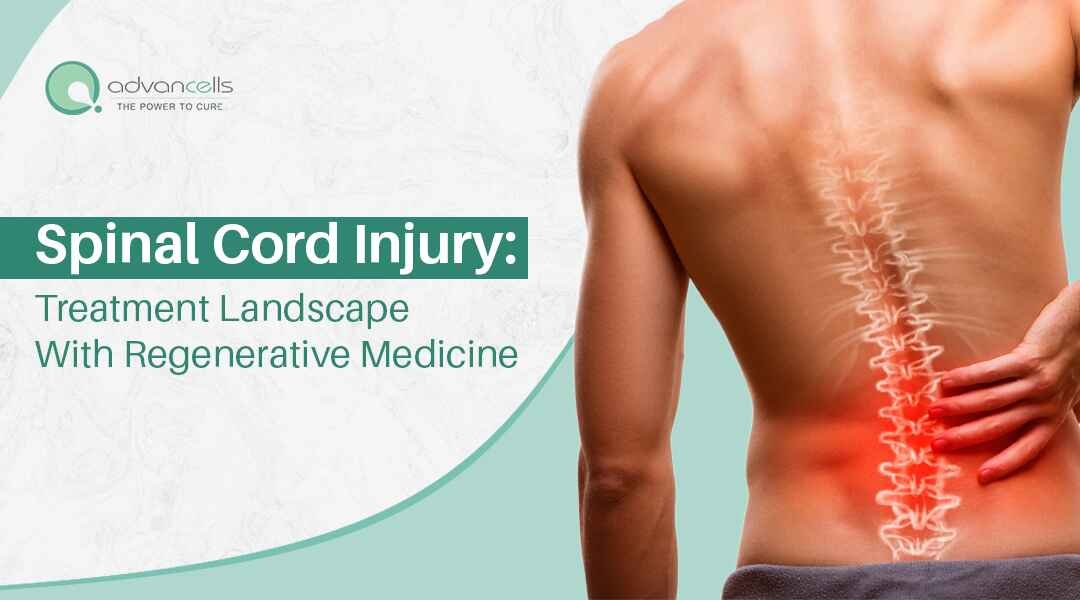
Spinal Cord Injury: Treatment Landscape with Regenerative Medicine
By Advancells Stem Cell Lab and Research 19-08-2026 102
Introduction
A spinal cord injury is associated with damage to the spinal cord, partially or completely. Traumatic or non-traumatic injuries can cause it. Often, spinal cord injury occurs suddenly after an accident or serious fall, and its effects can extend far beyond the initial injury. The spinal cord facilitates communication between the brain and other parts of the body. With spinal cord injury, the individual experiences compromised movement control, sensation, and disruption of several essential body functions.
Many experience weakness or changes in sensation, while others face significant movement loss or paralysis. The current Spinal Cord Injury Treatment focuses on injury stabilization, complications management, and long-term rehabilitation. In the past decade, regenerative medicine has been studied as a potential way to address some of the underlying damage.
What Causes Spinal Cord Injury?
Looking at spinal cord injury causes, trauma is one of the most common. Road traffic accidents, falls, sports injuries, and other high-impact events can damage the vertebrae or directly injure the spinal cord. This includes:
- Traumatic Injuries: Falls, accidents, violence, injury
- Non-Traumatic Injuries: Tumors, infections, inflammation, reduced blood supply, degenerative conditions, etc. In these cases, the damage may develop gradually rather than occurring at a single identifiable moment.
Knowing what caused the injury helps doctors understand the nature of the damage and decide what type of treatment and rehabilitation may be appropriate.
Types of Spinal Cord Injury
There are several spinal cord injury types, but one of the most useful ways to understand them is by looking at whether the injury is complete or incomplete.
- Complete Injury: Major loss of motor and sensory function below the level of damage
- Incomplete Injury: Communication between the brain and areas below the injury remains. The amount of remaining function can vary considerably.
SCI can also be described according to where the damage occurs. A cervical injury affects the neck region and can involve the arms, trunk, and legs. Thoracic injuries generally affect the trunk and lower body, while lumbar and sacral injuries primarily affect the lower part of the body and pelvic functions.
Because every injury is different, the level and severity of damage are important when discussing recovery and treatment.
Recognizing Spinal Cord Injury Symptoms
Spinal Cord Injury Symptoms depend largely on the location and extent of the damage. Common symptoms include:
- Weakness, loss of movement, numbness, tingling, or changes in the ability to feel touch, temperature, or pain
- Muscle spasms, unusual reflexes, or pain
- Loss of bladder and bowel control
How Is Spinal Cord Injury Diagnosed?
The Diagnosis Depends on a Detailed Patient's Assessment. The Key Criteria Include:
- Detailed neurological assessment including assessment of muscle strength, sensation, reflexes, coordination, and other functions to understand how the nervous system has been affected.
- Imaging, including X-rays or CT scans, can identify fractures
- MRI for a detailed view of the spinal cord, including areas of compression, swelling, bleeding, or tissue damage
- Together, these assessments help determine the level and severity of the injury and provide a baseline for tracking changes during treatment and rehabilitation.

Spinal Cord Injury Treatment: What Is Available Today?
There is no single treatment that works for every spinal cord injury. Spinal cord injury treatment usually involves several stages, beginning with emergency care and stabilization.
In the early phase, doctors focus on protecting the spine and preventing additional injury. Surgery is recommended in cases when the spinal cord is compressed or the spine is unstable.
Once the patient is medically stable, rehabilitation becomes an important part of recovery. Physiotherapy, occupational therapy, mobility training, and assistive technologies can help people work toward greater independence. Depending on the individual, medications and other treatments may also be used to manage pain, muscle spasms, bladder and bowel problems, and other complications.
These approaches aid in efficient symptom management; however, repairing the spinal cord damage remains a major challenge. Currently, regenerative medicine enables regeneration and repair of the damaged nerves.
How Regenerative Medicine Is Changing the Research Landscape
The idea behind regenerative medicine is relatively straightforward. Instead of focusing only on managing the consequences of spinal cord damage, researchers are looking for ways to support the body's ability to repair or restore damaged tissue.
After the initial injury a series of biological responses potentially triggers such as inflammation, cell death, disruption of neural connections, and scar formation. These responses can make it difficult for damaged nerve pathways to reconnect.
Researchers are therefore studying several regenerative strategies, including stem and stromal cell-based approaches, neural cells, biomaterials, tissue engineering, and extracellular vesicles. Depending on the approach, researchers are investigating whether these interventions could help protect surviving cells, regulate inflammation, support the local tissue environment, or encourage the formation of new neural connections.
Importantly, this field is still developing. Promising results in laboratory and early-stage studies do not automatically mean that an approach is proven or suitable for routine clinical use. Factors such as the type of injury, timing, cell source, treatment method, and rehabilitation protocol can all influence outcomes.
What Could the Future of SCI Treatment Look Like?
The future may not depend on one treatment working on its own. Researchers are increasingly interested in combining regenerative strategies with rehabilitation, neuromodulation, biomaterials, and other technologies. This approach recognizes that spinal cord injury is not a single biological problem. Different processes occur at different stages of injury, and addressing several of them together may eventually offer a better path toward functional recovery. For now, continued clinical research is needed to determine which regenerative approaches are safe, effective, and appropriate for different patient groups.
Conclusion
Spinal cord injury can have profound and lasting effects, but our understanding of the condition continues to improve. Current treatment remains centered on stabilization, complication management, and intensive rehabilitation, while regenerative medicine is exploring new possibilities for supporting repair. The area of regenerative medicine with stem cell therapy is rapidly evolving but is still at an early stage of development. There is a need for rigorous large-scale clinical trail to establish the long-term efficacy and safety of the treatment.