Smart Parking Guidance System for Efficient Parking Space Management
By Global Outreach 01-10-2026 24
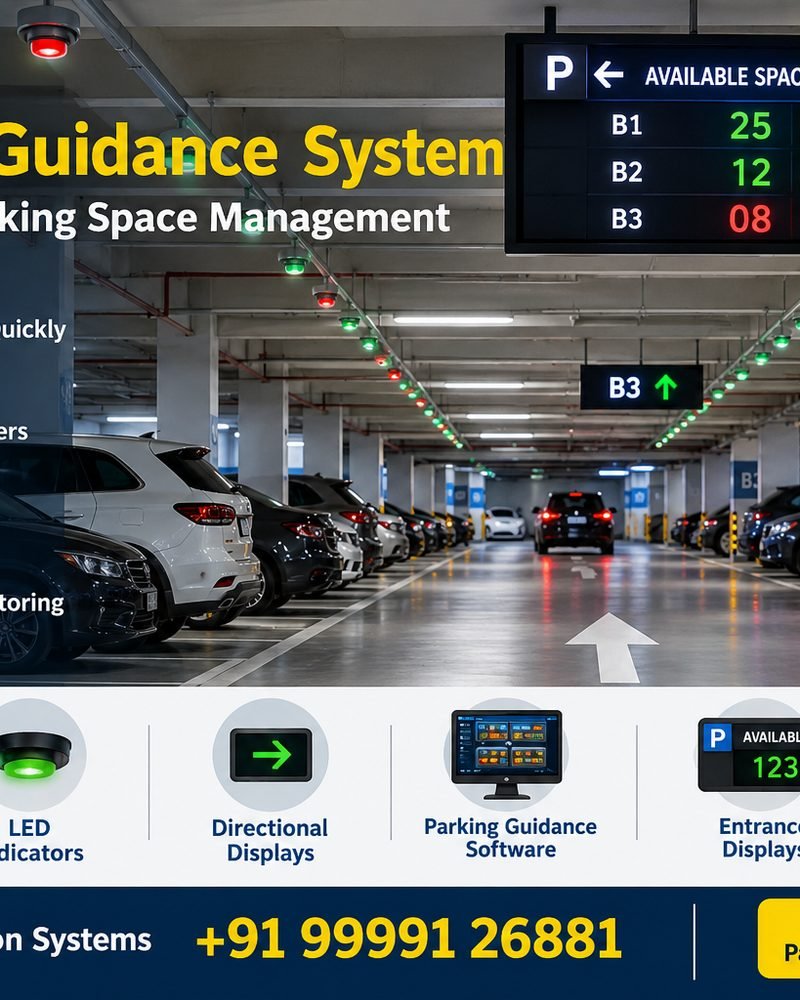
Finding an available parking space can become difficult in busy shopping malls, hospitals, airports, hotels, corporate campuses, residential complexes and multi-level parking facilities. Drivers may spend considerable time moving through parking areas looking for vacant spaces, particularly during peak hours.
A Parking Guidance System helps address this challenge by providing information about available parking spaces and guiding drivers toward suitable locations. By combining parking sensors, LED indicators, digital displays and centralized software, a modern parking guidance solution can make parking areas easier to navigate and manage.
What Is a Parking Guidance System?
A Parking Guidance System (PGS) is a technology-based solution that detects parking-space availability and provides guidance to drivers.
Depending on the project requirements, a system can use sensors or other detection technologies to determine whether individual parking spaces are occupied or vacant. The collected information can then be processed by parking guidance software and displayed through LED indicators, directional displays or digital signage.
A typical Parking Guidance System may include:
- Parking occupancy sensors
- LED space indicators
- Directional LED displays
- Parking guidance software
- Central monitoring dashboard
- Entrance information displays
- Zone-level displays
- Vehicle detection systems
- Network communication equipment
- Optional ANPR integration
The exact configuration depends on the parking facility, number of spaces, traffic volume and operational requirements.
How Does a Parking Guidance System Work?
A typical parking guidance process can follow this sequence:
Vehicle Enters → Parking Availability Detection → Information Processing → Directional Guidance → Available Space Identification → Vehicle Parks
Sensors installed near parking spaces can detect whether spaces are occupied or available. This information is transmitted to the central system.
The Parking Guidance Software processes the information and updates displays throughout the facility.
For example, an entrance display may show the number of available spaces in different parking zones. As the driver moves through the facility, directional displays can provide information about available areas.
LED indicators installed above individual spaces can also show whether a particular space is available or occupied.
Key Components of a Parking Guidance System
1. Parking Occupancy Sensors
Sensors are used to determine the status of parking spaces. Depending on the selected technology, sensors can detect whether a vehicle is present in a designated parking position.
2. LED Parking Indicators
LED indicators can be installed above individual parking spaces. Different visual indicators can communicate the current status of a space to drivers.
3. Directional Displays
Directional displays can guide drivers toward parking zones with available spaces. They can be installed at intersections, ramps, entrances and other important points within a parking facility.
4. Central Parking Guidance Software
Parking Guidance Software collects and processes parking occupancy information. Administrators can use the software to monitor parking zones and configure the guidance system.
5. Entrance Displays
Large displays near parking entrances can provide information about available spaces across different zones or floors.
6. Central Monitoring Dashboard
A centralized dashboard can provide parking operators with an overview of parking availability and system activity.
Benefits of a Smart Parking Guidance System
A Smart Parking Guidance System can provide several benefits for both drivers and parking operators.
Faster Parking Space Identification
Drivers can receive information about available parking areas instead of searching through multiple sections manually.
Better Parking Area Utilization
Real-time occupancy information can help distribute vehicles across available parking areas and improve utilization.
Improved Driver Experience
Clear directional information can make it easier for drivers to navigate large or complex parking facilities.
Reduced Unnecessary Circulation
When drivers know where available spaces are located, unnecessary movement within the parking area can potentially be reduced.
Real-Time Information
The system can continuously update parking availability as vehicles enter, park and leave.
Centralized Monitoring
Parking operators can monitor parking zones and occupancy information from a centralized interface.
Scalable Solution
A parking guidance solution can be designed for small facilities as well as large multi-level parking structures.
Applications of Parking Guidance Systems
Parking Guidance Systems can be deployed across many types of facilities.
Shopping Malls
Large shopping centers can use parking guidance technology to help customers locate available spaces more efficiently.
Hospitals
Hospitals often experience continuous vehicle movement. Parking guidance can help visitors and staff identify available parking areas.
Airports
Airport parking facilities can use zone-based guidance to help drivers navigate large parking areas.
Corporate Offices
Corporate campuses can use parking guidance systems to organize employee and visitor parking.
Hotels
Hotels can provide visitors with clearer information about available parking areas.
Residential Complexes
Large residential communities can use parking guidance technology to manage designated parking areas and improve navigation.
Multi-Level Parking Facilities
Multi-level parking structures can benefit from floor-level displays, directional indicators and real-time occupancy information.
Parking Guidance System with ANPR
ANPR technology can be integrated into a parking guidance solution when vehicle identification is required.
Automatic Number Plate Recognition can identify vehicles at designated entry or exit points. When combined with parking occupancy information, ANPR can support additional parking-management functions depending on the project configuration.
For larger facilities, integrating ANPR, parking guidance software and occupancy detection can provide a more comprehensive parking technology solution.
Parking Guidance System and Parking Management System
A Parking Guidance System and a Parking Management System address different aspects of parking operations.
A Parking Guidance System primarily focuses on helping drivers locate available parking spaces and navigate through the facility.
A Parking Management System generally focuses on vehicle entry, exit, access control, transactions and parking operations.
Both solutions can be integrated when a facility requires complete parking automation.
Factors to Consider Before Selecting a PGS
Before selecting a Parking Guidance System, organizations should evaluate:
- Total number of parking spaces
- Number of parking floors
- Parking layout
- Vehicle traffic volume
- Sensor technology
- LED indicator requirements
- Directional display requirements
- Central software requirements
- Network infrastructure
- ANPR integration
- Existing parking-system integration
- Indoor or outdoor installation
- Maintenance requirements
- Future expansion
The overall project cost depends on parking capacity, sensor technology, display requirements, software configuration, installation and integration requirements.
Why Choose a Smart Parking Guidance Solution?
A properly designed Parking Guidance Solution can provide real-time information to drivers while giving parking operators better visibility into space utilization.
By combining occupancy detection, LED indicators, directional displays and centralized software, facilities can create a more structured parking environment.
For large parking facilities, a Smart Parking Guidance System can also be integrated with other parking technologies such as ANPR, RFID, boom barriers and Parking Management Software.
Conclusion
Modern parking facilities require more than simply providing physical parking spaces. Drivers also need clear information to locate available spaces efficiently, while facility operators need better visibility into parking utilization.
A Parking Guidance System can connect parking-space detection, digital displays and centralized software to provide real-time guidance throughout a parking facility.
Houston Systems provides parking automation and guidance solutions designed for commercial, institutional, residential and