The web is a boundless engine of possibility—business, productivity, communication, and creativity flow through virtual pipes. But with those possibilities comes one nagging thorn: repetition. Copying data from system to system, running reports, posting schedules, or handling customer interactions are just some of the repetitive grunt work that overwhelms most of our online activity.
Historically, getting this done required writing custom code or hiring coders to build automations—an arduous, expensive process. And the no-code revolution. Now, incredibly capable no-code automation software lets anyone—no coding required—create web automations that free up hours of work every week. The work of the future isn't more drudgery, but wiser automation.
This piece demystifies how no-code web automation operates, what types of tasks you can automate that are common, and what platforms are at the forefront. And yeah, we'll touch on how directories and tools such as Aviyne.com are making it easier for professionals to find and deploy automation solutions in a rush.
Why Web Automation Is More Important Now Than Ever
Consider the number of hours a week you're spending performing the same online tasks:
Downloading and renaming reports.
Uploading to the cloud.
Copying leads from a form into a CRM.
Scheduling posts on social media.
Sending reminder emails for bills or appointments.
Each one alone only takes a few minutes. But group them together, and you're talking hours—occasionally days—of lost productivity.
Automation wipes out the drudgery. Outsourcing repetitive tasks to software, you can:
Reclaim hours for creative and strategic work.
Cut down on human error, as the system is following instructions repetitively.
Scale workflows, running dozens or hundreds of tasks at a time.
Save money, as automation will frequently be less expensive than hiring a person.
In short: automation doesn't just make your job easier. It makes it smarter.
What Is No-Code Automation?
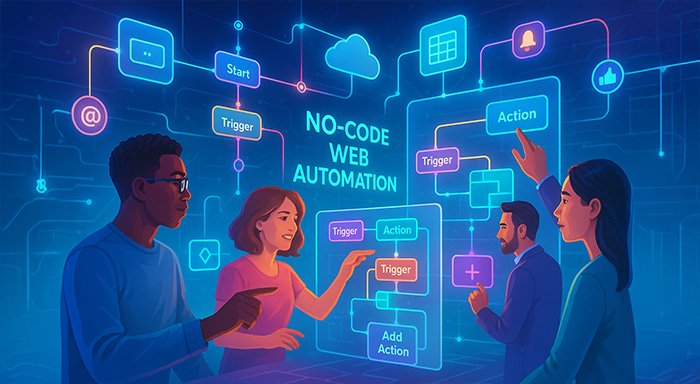
"No-code" is that you don't have to be a coder in order to make automations. Instead of scripting, you're working with visual editors—drag-and-drop blocks, triggers, and actions—to set up workflows.
Example:
Trigger: Receive a new email with an attachment.
Action 1: Save attachment to Google Drive.
Action 2: Alert your team in Slack.
In a no-code platform, you'd just choose "Email" as the trigger, and nest "Save File" and "Send Message" as actions. The platform gives you the technical plumbing.
This levels the playing field for automation. Marketing teams, HR managers, small business owners, and even freelancers can automate without recruiting developers.
Daily Chores You Can Automate
Let's ground this. Here are some boring web tasks that can be automated with no-code tools:
Social Media Management
Automatically post on Twitter, LinkedIn, and Instagram.
Publish trending content to schedule posting.
Data Collection & Reporting
Gather survey results and feed them into a dashboard.
Automatically populate spreadsheets with new form submissions.
E-commerce Operations
Sync orders from your website to your accounting platform.
Send inventory reminders whenever inventory dips below a threshold.
Customer Support
Route support inquiries to the correct team in real-time.
Send reminders automatically once a ticket has been solved.
Personal Productivity
Auto-book every new meeting from email to your calendar.
Auto-save interesting stories to read later.
The moment you begin to explore, you see that automation can touch almost every part of online living.
Top No-Code Automation Platforms
There are a couple of major players dominating the no-code automation space. Each is strong depending on your use cases:
Zapier – The defacto standard for cross-platform integrations. Integrates with thousands of applications and is ideal for small businesses.
Make (formerly Integromat) – Offers powerful, advanced workflows with rich visual editing. Ideal for tech users wanting no-code ease of use without losing functionality.
IFTTT – Simple, consumer-oriented automations, perfect for solo productivity and smart home projects.
n8n – Coder-friendly and open-source but simple enough for those who don't code. Perfect for those needing customization with no vendor lock-in.
HubSpot Workflows / Monday Automations – Baked-in automation capability in common business platforms, aimed at sales, marketing, and operations teams.
Platforms such as Aviyne.com are worth more than ever before because they enable experts to get past the noise. With no-code platforms so prevalent today, Aviyne is a marker, indicating where each of the platforms excel and how to get all of them to function with actual business plans.
Conquering Frequent Misconceptions
Despite the growing creation of no-code automation, certain myths continue to keep individuals at bay:
"How complicated." Most no-code systems, though, are intended for non-tech people. If you can use a smartphone, you can automate.
"Automate will eliminate jobs." Automation won't replace jobs—it'll replace the drudge parts of them. It enables employees to work on higher-value tasks.
"Only for large corporations." Most freelancers and small businesses depend heavily upon automation. Saving an hour a week sums up to dozens of hours a year.
Reality: automation is affordable, available, and already transforming the way people work at every level.
The Future of Web Automation
We’re moving toward a world where automation is ambient—woven into daily workflows almost invisibly. Here’s where the next wave is headed:
AI-enhanced automation – Not just if-this-then-that rules, but intelligent decisions. For example, AI detecting customer sentiment and triggering personalized responses.
Hyper-integration – Tools will plug into nearly any app and platform out there, making silos even smaller.
Citizen developers – Everyday workers will create their own automated platforms, just like they already create with spreadsheets or presentations.
Marketplaces & directories – Sites such as Aviyne.com will become hubs, enabling people to find automation faster than ever.
The distinction between "manual" and "automated" work will become increasingly blurred until automation is the sole reality.
Final Thoughts
Web automation isn't about taking people's jobs—it's about taking them up. No-code means silos are coming down, empowering people and companies to automate mundane tasks that used to drain energy and time.
Begin small if you are just starting with automation. Automate one boring task that you detest the most, be it renaming files or logging leads. Then, grow step by step. The snowball effect will impress you.
With this new age, productivity is no longer a question of who does the most work, but rather who does the smartest work automatically. And with no-code apps, directories such as Aviyne.com, and expanding ecosystems of resources, the ability to automate is no longer behind code. It's in your hand.