Safety Goggles: How to Choose the Right Eye Protection for Every Industrial Hazard
By Karan Sharma 14-07-2026 80
Across industries ranging from construction and fabrication to pharmaceutical manufacturing and chemical processing, safety goggles and protective spectacles are among the most critical and frequently underestimated items of personal protective equipment. Eye injuries in industrial settings are overwhelmingly preventable, yet they remain one of the most commonly reported workplace injuries in India and globally. The reason is rarely the absence of protective eyewear; it is more often a mismatch between the hazard and the type of protection chosen. Selecting the right product requires understanding both the risk and the range of solutions available.
Understanding the Hazard First
No single type of protective eyewear is appropriate for every environment. The correct starting point is always an assessment of the specific hazards present. Flying particles from grinding, drilling, or chipping operations call for high-impact-resistant spectacles. Chemical and liquid splash hazards in laboratories or processing plants require fully sealed goggles with indirect ventilation. Welding operations generate both intense visible light and infrared and ultraviolet radiation, which demand shaded lenses to specific optical grades. Dust and fine airborne particulates from cement, mining, or construction work require wraparound coverage with minimal gaps. Getting this classification right before selecting a product is the foundation of effective eye protection.
Types of Protective Eyewear
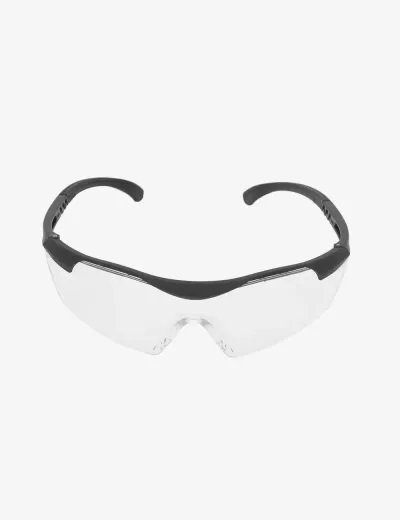
Safety spectacles are the most widely used form of eye protection in general industrial settings. They feature polycarbonate lenses that are substantially more impact-resistant than standard optical lenses and are available with anti-scratch, anti-fog, and UV-protective coatings. Over-the-glasses (OTG) spectacles accommodate workers who already wear prescription eyeglasses, providing certified protection without requiring custom solutions.
Chemical splash goggles provide a sealed enclosure around the eye, making them the appropriate choice for any environment where liquid hazards may arise. Products like the KARAM ES009 feature a soft PVC shroud with four one-way ventilation caps, providing both a secure seal and adequate airflow for extended wear.
Welding eyewear addresses a distinctly different set of hazards. Gas welding spectacles and electric arc welding goggles use shaded lenses calibrated to specific optical grades, ranging from shade 3 for torch cutting to shade 5 or higher for electric arc work. They protect against UV and IR radiation at wavelengths that would cause cumulative and permanent damage to the retina without being noticeable to the user in the short term.
Key Technical Features to Evaluate
Lens material is the starting point for any performance assessment. Polycarbonate offers the best combination of impact resistance, optical clarity, and light weight for most industrial applications. Anti-fog coatings are critical in high-humidity environments, during physically demanding tasks, or anywhere temperature differentials cause condensation on lenses. Anti-scratch coatings extend lens life significantly in dusty or particle-heavy conditions, reducing the frequency of replacement and the associated cost.
Certification Standards
Any safety eyewear considered for industrial use must carry certification from a recognised testing body. EN 166 is the European standard covering protection against mechanical impacts, chemicals, and optical clarity. ANSI Z87.1 is the US standard specifying high-impact resistance and lens performance. IS 5983 is India's standard governing optical performance, construction standards, and impact resistance for protective eyewear. These certifications are the buyer's assurance that the product has been independently tested and confirmed to meet defined minimum performance thresholds.
Conclusion
Choosing the right safety eyewear for a specific industrial environment is one of the most direct investments an organisation can make in protecting its workforce from permanent, preventable injury. Whether the risk is mechanical impact, chemical splash, welding radiation, or UV exposure, the correct certified product worn consistently and correctly makes the difference between a near-miss and a life-altering outcome.
Tags : safety goggles safety eyewear