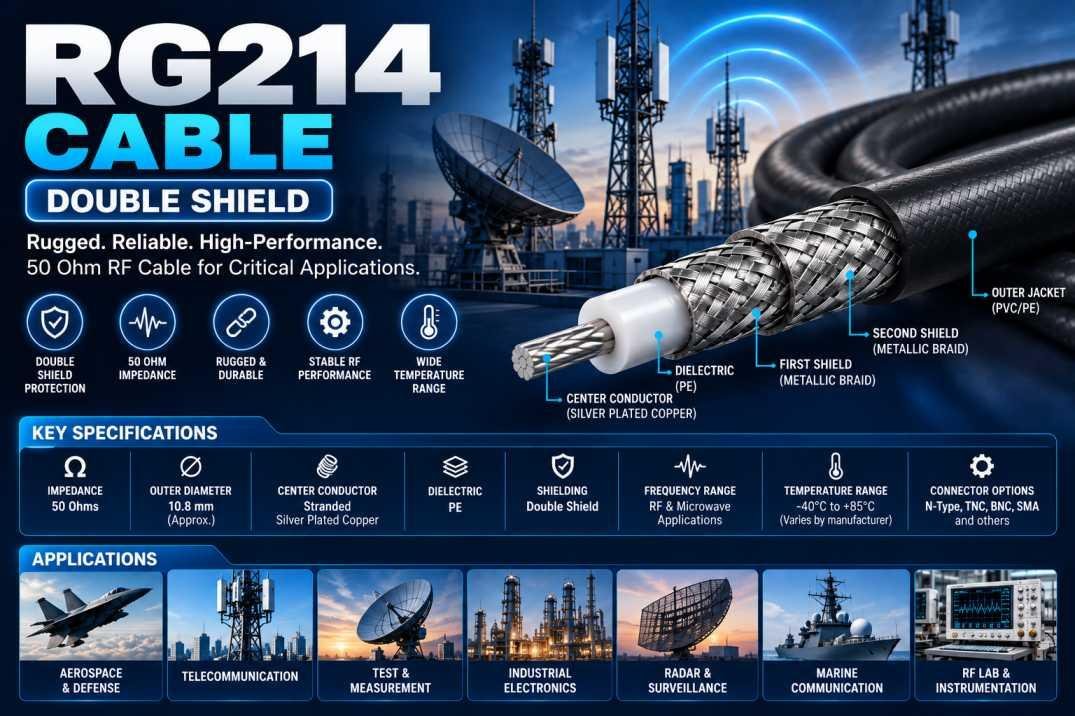
RG214 Cable is a high-performance, double-shielded coaxial cable designed for reliable RF and microwave signal transmission. Its 50-ohm impedance, strong shielding, flexible construction, and excellent electrical performance make it suitable for demanding applications in telecommunications, aerospace, defense, test and measurement, instrumentation, and wireless communication systems.
Understanding the size, impedance, construction, and performance characteristics of RG214 Cable is important when selecting an RF cable for high-frequency applications where signal integrity and electromagnetic interference protection are critical.
What Is RG214 Cable?
RG214 Cable is a 50-ohm coaxial cable generally used for RF signal transmission. It features a center conductor, dielectric insulation, multiple shielding layers, and an outer protective jacket.
The double-shielded construction provides improved protection against electromagnetic interference (EMI) and radio-frequency interference (RFI). This makes RG214 Cable particularly useful in environments where external electrical noise can affect sensitive RF signals.
Its robust construction also supports applications requiring dependable mechanical and electrical performance.
RG214 Cable Size and Construction
Cable size is an important specification because it influences installation flexibility, attenuation, power handling, and connector compatibility.
RG214 Cable is typically larger and more robust than compact RF cables such as RG316. Its construction commonly includes:
The exact dimensions and materials can vary according to the manufacturer and specific cable configuration. Therefore, the manufacturer's datasheet should always be checked before final selection.
RG214 Cable Impedance
One of the most important specifications of RG214 Cable is its 50-ohm impedance. RF systems are commonly designed around standardized impedance values, and maintaining impedance compatibility between the cable, connectors, antennas, and equipment helps minimize signal reflections.
Impedance mismatch can result in increased VSWR, return loss, and signal degradation. Using a properly matched 50-ohm RG214 Cable helps maintain consistent RF transmission throughout the system.
This makes RG214 Cable suitable for RF test equipment, communication systems, transmitters, receivers, antennas, and other 50-ohm RF infrastructure.
RG214 Cable Performance
The performance of RG214 Cable depends on factors such as operating frequency, cable length, conductor construction, dielectric material, shielding quality, connectors, and installation method.
Low Signal Loss
RG214 Cable is designed for dependable RF transmission with controlled attenuation. Lower signal loss is especially important in systems where cables are used between antennas, RF equipment, test instruments, and communication modules.
Double Shielding
The double-shield configuration provides additional protection against EMI and RFI. This is valuable in industrial, laboratory, telecom, aerospace, and defense environments where multiple electronic systems operate close to each other.
Stable RF Transmission
A controlled 50-ohm impedance helps support stable signal transmission and reduces unwanted reflections when the cable is correctly matched with the rest of the RF system.
Mechanical Reliability
The robust construction of RG214 Cable makes it suitable for applications that require dependable cable performance under regular handling and demanding operating conditions.
Applications of RG214 Cable
RG214 Cable is widely used across professional RF and microwave applications, including:
- Telecommunications equipment
- Wireless communication systems
- Aerospace electronics
- Defense communication systems
- RF test and measurement
- Laboratory instrumentation
- Antenna connections
- Transmitter and receiver systems
- Industrial electronics
- Microwave equipment
- Signal monitoring systems
- RF laboratory setups
Its combination of shielding, impedance control, and reliable construction makes it suitable for both equipment-level connections and specialized RF cable assemblies.
RG214 Cable Connector Options
RG214 Cable can be terminated with different RF connectors depending on system requirements. Common connector families used with RF cable assemblies include N-Type, TNC, BNC, SMA, and other compatible 50-ohm connectors.
Connector selection should consider frequency range, VSWR, power handling, environmental conditions, mechanical requirements, and equipment interface.
Proper termination is equally important because poor connector installation can negatively affect the performance of the complete RG214 Cable assembly.
How to Select the Right RG214 Cable
When selecting RG214 Cable, consider the following factors:
- Impedance: Confirm that the system requires 50-ohm cable.
- Cable Size: Check available installation space and connector compatibility.
- Operating Frequency: Verify that the cable supports the required frequency range.
- Attenuation: Select a cable with suitable insertion-loss characteristics.
- Shielding: Consider double shielding for electrically noisy environments.
- Temperature: Check the cable's operating temperature requirements.
- Length: Minimize unnecessary cable length to reduce transmission loss.
- Connectors: Select compatible, high-quality RF connectors.
- Assembly Quality: Ensure professional termination and testing.
RG214 Cable for High-Performance RF Systems
RG214 Cable provides a practical solution for applications requiring controlled impedance, strong shielding, reliable signal transmission, and durable RF connectivity. Its double-shielded construction makes it particularly useful where protection from electromagnetic interference is important.
For critical RF applications, cable selection should always be based on the complete electrical and mechanical requirements of the system rather than cable type alone. Frequency, attenuation, VSWR, connector performance, environmental conditions, and cable length should all be evaluated before deployment.
Frequently Asked Questions About RG214 Cable
1. What is RG214 Cable?
RG214 Cable is a 50-ohm coaxial RF cable commonly used for telecommunications, aerospace, defense, instrumentation, and RF test applications.
2. Is RG214 Cable 50 Ohm?
Yes. RG214 Cable is designed as a 50-ohm coaxial cable for RF and microwave signal transmission.
3. Is RG214 Cable double shielded?
Yes. RG214 Cable commonly uses a double-shielded construction to provide enhanced protection against EMI and RFI.
4. What is RG214 Cable used for?
It is used in RF communication, antenna systems, test equipment, aerospace electronics, defense systems, instrumentation, and industrial applications.
5. Can RG214 Cable be used for high-frequency applications?
Yes. RG214 Cable is designed for RF applications, but its actual maximum operating frequency and attenuation should be verified from the manufacturer's datasheet.
6. What connectors can be used with RG214 Cable?
Depending on the application, RG214 Cable can be assembled with compatible 50-ohm connectors such as N-Type, TNC, BNC, and SMA.
7. Why is shielding important in RG214 Cable?
Double shielding helps reduce the impact of external electromagnetic and radio-frequency interference on transmitted signals.
8. How does cable length affect RG214 Cable performance?
Longer cable lengths generally introduce greater signal attenuation. Selecting the appropriate cable length helps maintain RF system performance.
Tags : RG214 Cable