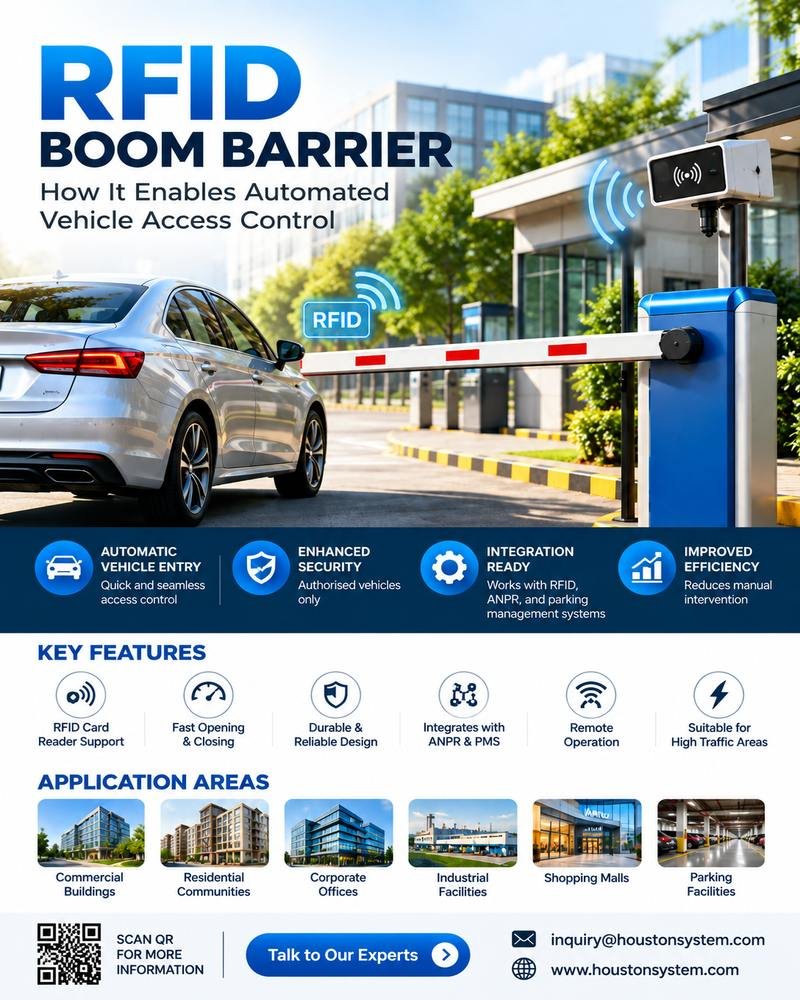
Managing vehicle entry and exit manually can become difficult when a facility handles frequent traffic. Residential communities, corporate offices, industrial facilities, parking areas, warehouses, and commercial properties often need a reliable way to identify authorized vehicles and control access.
An RFID boom barrier combines radio-frequency identification technology with an automated boom barrier to create a controlled vehicle entry and exit process. The system can identify authorized RFID tags and automatically operate the barrier, reducing the need for manual gate operation.
What Is an RFID Boom Barrier?
An RFID boom barrier is an automated vehicle access-control system in which an RFID reader communicates with RFID tags assigned to authorized vehicles.
When a vehicle carrying a valid RFID tag approaches the entrance, the reader captures the tag information. The access-control system verifies the credentials and, when authorization is successful, sends a command to the boom barrier to raise its arm.
After the vehicle passes through, the barrier can return to its closed position.
A typical process is:
Vehicle Approaches → RFID Tag Detection → Authorization → Barrier Opens → Vehicle Passes → Barrier Closes
How Does an RFID Boom Barrier System Work?
An RFID-based vehicle access system generally consists of several components working together.
RFID Tag
An RFID tag is assigned to an authorized vehicle. Depending on the application, it can be attached to the vehicle windshield or installed in another suitable location.
RFID Reader
The reader detects the RFID tag when the vehicle approaches the designated access lane and sends the identification data to the access-control system.
Access-Control System
The software or controller checks whether the detected RFID credential is authorized.
Boom Barrier
After successful authorization, the controller sends an opening command to the boom barrier.
Safety Sensors
Safety sensors can help detect vehicles or obstacles in the operating area and support safer barrier operation.
Key Features of RFID Boom Barriers
Automated Vehicle Identification
RFID allows authorized vehicles to be identified without requiring security personnel to manually verify every vehicle.
Automatic Entry and Exit
Once the RFID credential is successfully authenticated, the boom barrier can automatically open to allow the vehicle to pass.
Access Authorization
Administrators can manage authorized RFID credentials and control which vehicles are permitted to enter a particular facility.
Parking Management Integration
An RFID boom barrier can be integrated with parking management software to support automated entry, exit, vehicle records, and parking operations.
Access Records
Depending on the software configuration, vehicle access events can be recorded for monitoring and reporting purposes.
Safety Integration
Sensors and other safety components can be incorporated into the system according to site requirements.
Applications of RFID Boom Barrier Systems
RFID boom barriers are suitable for locations where controlled vehicle access is required.
Common applications include:
- Residential societies
- Corporate offices
- IT parks
- Industrial facilities
- Warehouses
- Commercial buildings
- Shopping malls
- Hotels
- Hospitals
- Educational campuses
- Private parking facilities
- Government premises
The configuration should be selected according to traffic volume, lane width, security requirements, and the type of RFID technology being used.
RFID Boom Barrier for Residential Societies
Residential communities often have a large number of registered vehicles entering and leaving throughout the day.
An RFID boom barrier can allow authorized residents and registered vehicles to pass through the entrance without requiring manual verification for every vehicle.
The system can also help security personnel focus on visitors, temporary vehicles, deliveries, and other access requests.
RFID Boom Barrier for Corporate Offices
Corporate facilities can use RFID-based vehicle access control to manage employee parking and authorized vehicle movement.
Each registered vehicle can be associated with an RFID credential. When the vehicle reaches the entry point, the system can verify the credential and operate the barrier accordingly.
This can help create a more organized entrance while reducing repetitive manual gate operations.
RFID Boom Barrier for Parking Management
RFID technology can become part of an automated parking management system.
A typical configuration may include:
RFID Identification → Access Verification → Boom Barrier → Parking Entry → Centralized Software
At the exit, the system can verify the vehicle again and update the relevant parking record.
This type of integration can be particularly useful for facilities with regular users and controlled parking access.
RFID Boom Barrier vs Manual Vehicle Gate
A manual gate generally requires security personnel to physically operate or authorize vehicle entry.
An RFID boom barrier automates a significant part of the identification and access process.
RFID Boom Barrier
- Automated vehicle identification
- Reduced manual intervention
- Electronic access authorization
- Parking system integration
- Access event recording
- Faster processing for registered vehicles
Manual Gate
- Requires greater human involvement
- Manual verification
- Limited automation
- Separate record-keeping may be required
The appropriate solution depends on the site's traffic volume, security requirements, budget, and existing infrastructure.
Benefits of an RFID Boom Barrier
An appropriately configured RFID boom barrier can provide several operational benefits:
- Automated vehicle access
- Controlled entry and exit
- Faster processing of registered vehicles
- Reduced manual gate operation
- Integration with parking management systems
- Centralized access management
- Better monitoring of vehicle movements
- Scalable access authorization
- Improved convenience for regular users
The actual benefits depend on the RFID technology, software, barrier configuration, and site conditions.
How to Choose an RFID Boom Barrier
Before purchasing an RFID boom barrier system, organizations should evaluate several factors.
Traffic Volume
Determine the number of vehicles expected during normal and peak periods.
RFID Technology
Choose an RFID configuration appropriate for the required reading range, vehicle identification process, and operating environment.
Barrier Arm Length
The arm length should match the entrance lane and site layout.
Opening Speed
Higher traffic facilities may require faster barrier operation to minimize waiting times.
Software Integration
Check compatibility with parking management, access control, visitor management, or other required software.
Safety Features
Consider safety sensors and appropriate control mechanisms for the installation environment.
Installation and Maintenance
Evaluate installation support, spare parts, warranty coverage, and maintenance services before selecting a supplier.
RFID Boom Barrier with ANPR
RFID and ANPR can also be used together where a facility requires multiple vehicle identification methods.
For example, RFID can identify registered vehicles while ANPR can capture and verify vehicle number plates.
A combined system can provide additional identification information and flexibility for parking and vehicle access applications.
RFID Boom Barrier Manufacturer in India
Organizations looking for an RFID boom barrier manufacturer in India should consider the manufacturer's product capabilities, integration options, installation support, customization requirements, and after-sales service.
Houston Systems provides vehicle access-control and parking automation solutions that can be configured for applications such as residential communities, corporate facilities, industrial sites, commercial parking areas, and institutional premises.
The appropriate configuration can be selected according to vehicle traffic, lane dimensions, RFID requirements, access-control architecture, safety requirements, and software integration needs.
Conclusion
An RFID boom barrier provides an automated approach to vehicle identification and controlled access. By combining RFID technology with an automatic barrier, organizations can streamline vehicle entry and exit while reducing repetitive manual gate operations.
For the best results, the system should be selected according to traffic volume, RFID requirements, lane configuration, safety features, software integration, installation conditions, and long-term maintenance needs.
When integrated with parking management or access-control software, an RFID boom barrier can become an important component of a modern automated vehicle access-control system.