Reverse Engineering Services Provider Offering Advanced Solutions in India
By Integrated Solutions 21-04-2026 222
Reverse Engineering Services are not about copying a part and hoping it works. That’s where most procurement mistakes begin—and where budgets quietly leak.
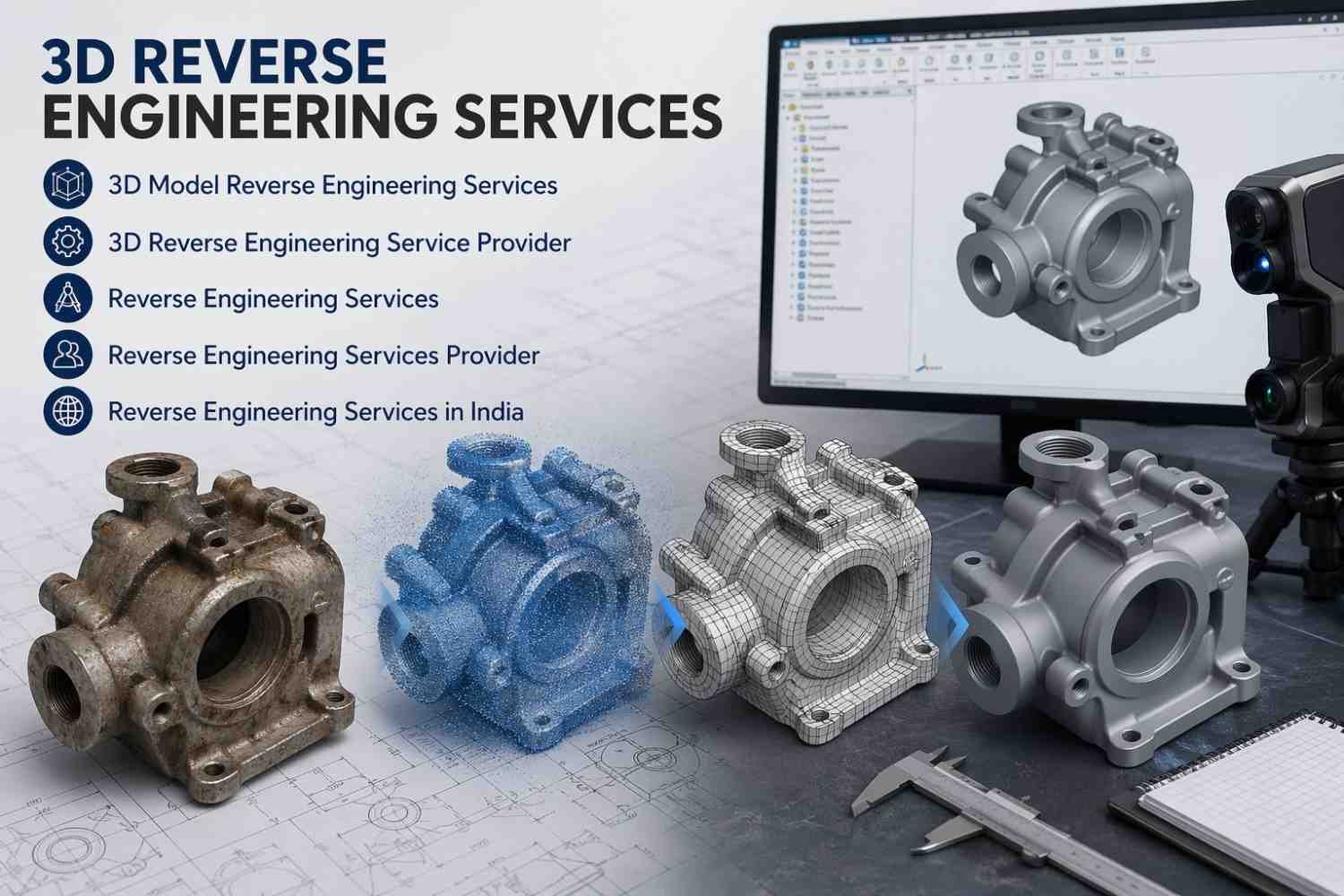
What actually happens on the ground is more technical: a failed component is physically studied, scanned, measured, and rebuilt into a manufacturable design using engineering logic, not guesswork. That’s the real work behind Reverse Engineering Services in India.
Most buyers only realise its importance when a critical machine part is discontinued or an imported spare gets stuck at customs. One missing component can halt production lines worth lakhs per hour. Industry downtime reports show losses ranging from 8% to 15% of annual output in manufacturing setups due to spare part unavailability.
And yet, many teams still choose a Reverse Engineering Services Provider based only on price. That decision usually comes back later as repeated breakdowns.
What Reverse Engineering Services Actually Include
3D Scanning for Geometry Capture
Modern 3D Reverse Engineering Services start with laser or structured light scanning. The result is not a CAD model—it’s a dense point cloud that represents the real object.
Here’s what most buyers miss: worn-out surfaces get scanned as “truth.” That means a damaged gear tooth or eroded shaft can be incorrectly reproduced if correction logic is not applied.
Scanning accuracy typically ranges between 0.01 mm and 0.05 mm depending on the machine class used.
CAD Reconstruction in 3D Model Reverse Engineering Services
After scanning, engineers convert mesh data into usable CAD models. This is where real engineering happens.
A weak 3D Reverse Engineering Service Provider will only clean geometry. A strong one rebuilds design intent—clearances, fits, and tolerances that actually match working conditions.
That difference decides whether a part runs for 2 months or 2 years.
Material Identification and Validation
Material guessing is one of the biggest failure points in Reverse Engineering Services Provider workflows.
We test hardness, compare wear patterns, and map equivalent grades using industrial standards. Studies in maintenance engineering show that nearly 20% of reverse-engineered part failures come from wrong material substitution—not design errors.
Which means copying shape without understanding material behaviour is a costly mistake.
How to Evaluate a Reverse Engineering Services Provider
Most supplier evaluations fail because buyers ask surface-level questions. Use these instead:
- Accuracy confirmation
Bad answer: “We are precise.”
Good answer: “We provide scan deviation reports with calibrated equipment logs.” - Ownership of CAD files
Bad answer: “We can share files if required.”
Good answer: “You fully own all outputs from 3D Reverse Engineering Services.” - Material substitution method
Bad answer: “We use equivalent materials.”
Good answer: “We validate ASTM/IS grades with test data support.” - Failure responsibility clarity
Bad answer: “We will adjust if issues arise.”
Good answer: “Tolerance responsibility is defined before production starts.” - Traceable measurement system
Bad answer: “We use standard tools.”
Good answer: “We provide calibration-linked measurement reports.”
And here’s the uncomfortable reality—if a Reverse Engineering Services Provider avoids documentation, they are not ready for industrial procurement work.
Benefits of Reverse Engineering Services in India
- Reduces dependency on OEM supply chains
When OEMs discontinue parts, production doesn’t have to stop. - Extends machine lifespan significantly
Equipment from 2010 doesn’t become useless just because support ended in 2020. - Cuts downtime from sourcing delays by up to 60%
Internal manufacturing reports consistently show faster turnaround using 3D Model Reverse Engineering Services. - Reduces procurement cost pressure
OEM spare parts often carry 25–40% brand-driven markup. - Improves component performance through redesign
Weak designs can be structurally improved instead of blindly copied. - Supports legacy machinery maintenance
Especially useful in textiles, pharma, and heavy fabrication industries.
And yet, buyers still sometimes choose the cheapest vendor. That decision usually shows up later as repeated breakdown cycles.
Reverse Engineering Services in India
Reverse Engineering Services in India have evolved from small workshop scanning setups to full-scale industrial engineering clusters in Pune, Ahmedabad, and NCR regions.
India contributes roughly 12–15% of global mid-level industrial CAD outsourcing capacity according to manufacturing service reports. That means capability exists—but consistency varies widely.
Location also impacts turnaround speed. Industrial zones in Gujarat, for example, reduce iteration time because scanning, machining, and validation teams often operate within 50–70 km networks.
We operate within this ecosystem to support fast-cycle Reverse Engineering Services Provider requirements without cross-region delays.
About Us
We’ve been delivering Reverse Engineering Services since 2013, mostly for clients who come to us after another vendor failed their project.
One operational decision we made in 2021 still stands—we stopped accepting material-critical reverse engineering projects without physical testing. Too many failures were traced back to incorrect assumptions.
We don’t treat 3D Reverse Engineering Services as scanning work. It’s engineering reconstruction. If a part fails in the field, we want to understand why before rebuilding it.
That’s what years of industrial feedback teaches you.
If you need Reverse Engineering Services in India, send us the physical part, application details, and failure context.
Integrated Solutions responds within 24–48 hours with feasibility feedback. MOQ depends on complexity, not arbitrary volume. We also support urgent 3D Model Reverse Engineering Services for breakdown-critical parts.
Conclusion
Reverse Engineering Services are not about copying—they are about reconstructing functionality under real-world constraints. Choosing the right Reverse Engineering Services Provider directly impacts downtime, cost, and reliability.
India’s engineering capability is growing fast—but precision still separates average vendors from reliable ones.
FAQs
What are Reverse Engineering Services used for?
They are used to recreate discontinued or unavailable machine parts. Most industries depend on Reverse Engineering Services Provider teams when OEM supply stops unexpectedly.
What makes Reverse Engineering Services in India competitive?
India offers faster iteration cycles and strong machining ecosystems. However, quality varies widely across 3D Reverse Engineering Services providers, so evaluation is critical.
What is included in 3D Reverse Engineering Services?
It includes scanning, CAD modeling, tolerance correction, and design reconstruction. A strong 3D Model Reverse Engineering Services workflow also validates material assumptions.
Are 3D Reverse Engineering Services Provider outputs always exact?
No. Accuracy depends on scanning quality, wear correction, and engineering interpretation. Geometry alone does not guarantee performance.
How do I choose a Reverse Engineering Services Provider?
Check for calibration reports, material validation methods, and CAD ownership clarity. Weak providers avoid technical documentation.
Do Reverse Engineering Services guarantee identical performance?
Not always. Even with identical geometry, material grade differences can change performance significantly.
Why is India growing in Reverse Engineering Services?
Because of strong manufacturing clusters and cost efficiency. But consistency varies, especially in advanced 3D Reverse Engineering Services work.