Retrofit Emission Control Device (RECD) for DG Sets and Environmental Compliance under CPCB Norms
By Aceget Private Limited 25-04-2026 249
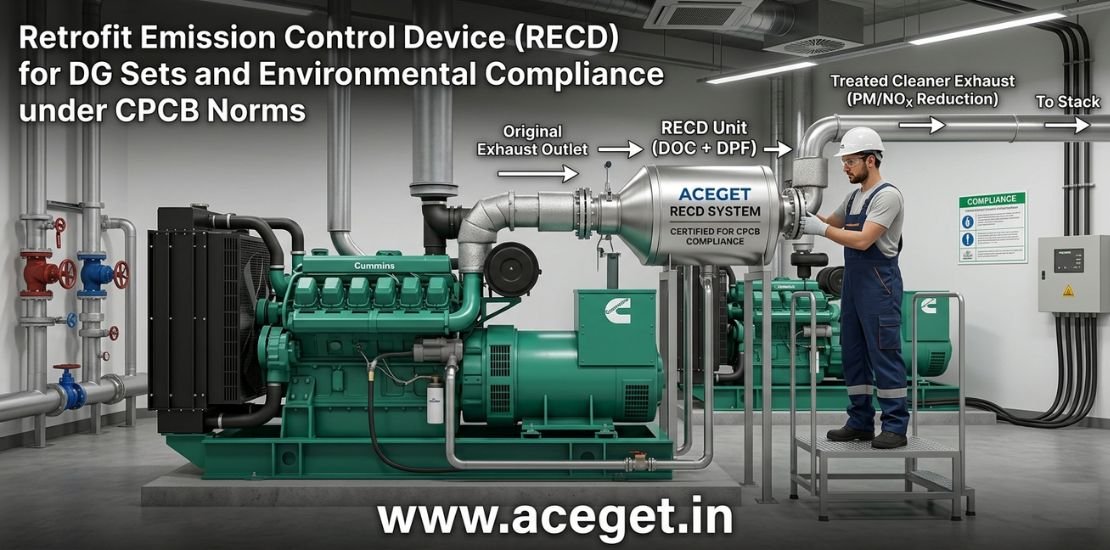
In India’s rapidly growing industrial and urban landscape, diesel generator (DG) sets remain essential for ensuring uninterrupted power supply. From hospitals and data centers to residential complexes and construction sites, DG sets act as reliable backup systems. However, this convenience comes with a major environmental cost. DG sets emit harmful pollutants such as particulate matter (PM), nitrogen oxides (NOx), carbon monoxide (CO), and hydrocarbons (HC), all of which contribute significantly to air pollution and public health risks.
To address this challenge, regulatory authorities like the Central Pollution Control Board (CPCB) have introduced stringent emission norms. One of the most effective solutions to meet these standards especially for existing DG sets is the adoption of Retrofit Emission Control Devices (RECDs).
What is a Retrofit Emission Control Device (RECD)?
A Retrofit Emission Control Device (RECD) is an advanced pollution-control system that is installed on existing diesel generator sets to reduce harmful exhaust emissions. Unlike replacing old generators with new compliant models, retrofitting allows industries to upgrade their current equipment in a cost-effective and environmentally responsible manner.
RECDs work by integrating various emission control technologies such as diesel particulate filters (DPFs), diesel oxidation catalysts (DOCs), and selective catalytic reduction (SCR) systems. These technologies collectively help in filtering, oxidizing, and converting harmful gases into less harmful substances.
DG sets, particularly older ones, are among the major contributors to localized air pollution in urban areas. Studies and regulatory observations indicate that these generators emit substantial quantities of PM2.5 and NOx, which are directly linked to respiratory and cardiovascular diseases.
Key reasons why RECDs are essential include:
- Pollution Reduction: RECDs significantly cut down harmful emissions from DG exhaust.
- Regulatory Compliance: They help existing DG sets meet updated CPCB emission norms.
- Cost Efficiency: Retrofitting is more economical than replacing entire DG systems.
- Operational Continuity: Businesses can continue using existing assets without disruption.
In regions like NCR, authorities have already mandated emission-control retrofits or alternative fuel solutions for DG sets to curb rising pollution levels.
CPCB Emission Norms for DG Sets
The Central Pollution Control Board (CPCB), under the Ministry of Environment, Forest and Climate Change, has established strict emission standards for diesel generators. These norms aim to limit pollutants and improve air quality across the country.
Key Highlights of CPCB Norms
- Emission Limits:
CPCB norms define permissible limits for:- Nitrogen Oxides (NOx)
- Hydrocarbons (HC)
- Carbon Monoxide (CO)
- Particulate Matter (PM)
- Smoke opacity
- Applicability:
The updated emission standards apply to:- New DG sets (mandatory compliance from July 2025 onwards)
- Existing DG sets through retrofitting or upgrades
- Mandatory Retrofitting:
DG sets manufactured between July 2004 and June 2023 are often required to install CPCB-approved RECDs to meet emission limits. - Testing and Certification:
Compliance must be verified through CPCB-approved testing procedures and certified laboratories. - Stack and Exhaust Norms:
CPCB also prescribes stack height and exhaust discharge requirements to ensure proper dispersion of pollutants.
CPCB-Approved RECD: What It Means
Not all emission control devices qualify for compliance. For an RECD to be considered valid under CPCB norms, it must meet specific approval criteria:
- Tested under CPCB protocols
- Certified emission reduction performance
- Installed as per prescribed guidelines
- Supported by documentation for inspection and audit
Approval is not just about the device itself but also about the vendor and installation process. Authorities verify the credibility of suppliers, test reports, and maintenance records during inspections.
Working Principle of RECD
RECD systems function through a multi-stage process:
- Filtration: Captures particulate matter using filters such as DPFs.
- Oxidation: Converts CO and hydrocarbons into carbon dioxide and water.
- Reduction: Reduces NOx emissions using catalytic processes like SCR.
- Regeneration: Cleans filters automatically to maintain efficiency.
- Monitoring: Ensures continuous compliance through sensors and diagnostics.
Conclusion
Retrofit Emission Control Devices (RECDs) have emerged as a practical and effective solution to address the environmental impact of diesel generator sets. By enabling existing DG sets to comply with stringent CPCB emission norms, RECDs bridge the gap between operational necessity and environmental responsibility.
For businesses and institutions relying on DG power, adopting CPCB-approved RECD systems is not just about regulatory compliance, it is about contributing to cleaner air, healthier communities, and a more sustainable future.