Invoice matching sounds simple: make sure what you ordered, what arrived, and what you are being billed for. But procurement cycles, multiple vendors, and thousands of transactions every month without a single mismatch can be challenging.
Even a small discrepancy can turn into a costly issue, such as overpayment, a compliance challenge, and, in the worst case, “executed fraud”.
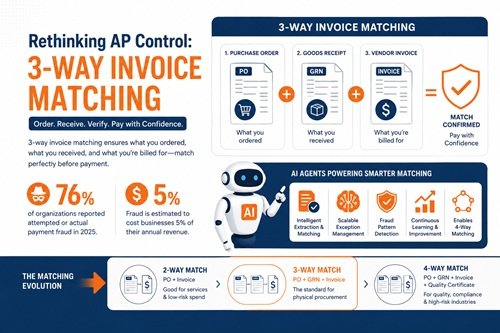
The stakes are real. 76% of organizations reported attempted or actual payment fraud in 2025. Many involving deep-fake audio and video to impersonate vendors. Fraud is estimated to cost businesses 5% of their annual revenue.
For enterprises, strategizing where automation can deliver maximum leverage, invoice matching is the most suitable place to start. In this blog, the progression from 2-way, 3-way to a 4-way match, accelerated by AI agents, is the roadmap that is worth exploring.
What 2-Way Matching Gets Right (and Wrong)
2-way Matching compares two documents: the purchase order (PO) and the vendor’s invoice. If the quantities and prices mentioned on the invoice align with what was ordered on the PO, payment gets approved.
In the case of services, recurring agreements, or low-risk supplier relationships, such control may be adequate. There is no actual delivery to check, and payment terms are usually predetermined and fixed.
But physical goods, capital equipment, or anything involving a supply chain, 2-way matching has a significant blind spot: it confirms what was ordered, not what was received.
It cannot catch quantity shortfalls, damaged shipments, or partial deliveries. Essentially, it verifies paperwork against paperwork, with no check against physical reality. That gap is where 3-way matching makes its case.
Why Is 3-Way Matching the Standard for Physical Procurement?
3-way matching adds a third document to the process: the Goods Receipt Note (GRN), also considered as a receiving report or delivery receipt.
The logic follows the full procurement chain:
intent (PO) → delivery (GRN) → payment request (invoice).
All three must agree on quantities, unit prices, line-item descriptions, and PO reference numbers before a payment is released.
3-way matching ensures you only pay for what was ordered, received, and correctly invoiced." That third check, which is confirmation of receipt, is what separates it from a 2-way process and why it has become the standard for most procurement-intensive businesses.
3-way invoice matching in its manual form comes with its own costs. It is labor-intensive, prone to human error under high invoice volumes, and slows down the approval cycle, which can result in missed early payment discounts or late payment penalties.
The Evolution of High Stakes Procurement with 4-Way Matching
For industries such as pharma, manufacturing, construction, and defense contracting, where compliance and regulatory standards are a high priority, 3-way matching can still lag in one dimension. The dimension is whether the received goods meet a certain specification.
4-way matching brings in a fourth document: a quality acceptance certificate. Before any payment is approved, the system verifies that the PO, GRN, and invoice are all aligned. Along with the fact that the goods have passed a formal quality or conformance check.
For example, there is an organization dealing with pharmaceuticals that gets their ingredients delivered from their suppliers. While the GRN will confirm the receipt of the right amount of ingredients, the determination of whether they are pure enough to warrant payment depends on laboratory testing.
Paying before that confirmation exposes the company to settling for substandard materials. Four-way matching prevents that by hardwiring the quality checkpoint into the approval chain.
Where AI Agents Change the Equation
Whether any finance team is running 2-way, 3-way, or 4-way matching, the manual approach of each process shares the same structural problem. It requires human eyes on every document, every line item, and in every comparison. At low invoice volumes, that is manageable, but at scale, it becomes the bottleneck.
AI assistants are purpose-built, autonomous systems that cross-verify every document, enforce compliance, evolve from outcomes, and flag anomalies. Here is where they make the difference:
AI-powered automated document extraction and matching- These AI agents leverage intelligent document processing capabilities to extract data from invoices, purchase orders, and good receipts notes in any format, including PDFs, scanned documents, EDI feeds, and vendor portals.
Scalable exception management- The true strength of AI in matching is not its capability to process clean invoices automatically. That is relatively easy to achieve through automation. It is its ability to handle exceptions effectively. Rather than sending all exceptions to human reviewers.
Pattern recognition of fraud- Analyzing transaction history can help AI systems recognize patterns that are missed by human reviewers. For example, duplicate invoices submitted with different invoice numbers, suppliers who bill at rates that differ from contracted rates, and other anomalies related to invoices.
Continuous improvement- Unlike rule-based automation systems, AI agents continuously learn from experience. They learn from the decision of human reviewers regarding exceptions that have been reviewed previously. They understand the types of discrepancies that were flagged and those that were accepted.
4-way matching enablement- AI integrates across ERP, WMS, QMS, and supplier portals, making 4-way matching practically executable for large organizations, reducing what was a multi-day, multi-team process into an automated workflow with human review reserved for genuine edge cases.
What Is the Road Ahead for Finance Leaders?
The matching framework, 2-way, 3-way, 4-way, is not a ladder where every organization needs to climb to the top. It is a toolkit calibrated to risk, industry, and procurement complexity.
What is common to all matching processes, irrespective of the specific matching level used, is that the AI-enabled automation makes a difference regarding how efficient and precise that type of matching becomes. It helps overcome human labor limitations, deal with exceptions efficiently, fight fraud on a grand scale, and implement 3-way and 4-way matching despite its previously excessive costs.
With the help of AI-based AP automation tools, organizations can set up more stringent matching rules and perform this task much faster and more efficiently without increasing personnel involved. This, in a nutshell, is what happens now in the realm of accounts payable: matching done with fewer hands.