Starting a programming journey can feel overwhelming, especially when you are unsure where to begin. That is why Python is widely recommended as the first step. Python is simple, readable, powerful, and widely used across industries. When learning python for beginners, the most important part is understanding core fundamentals before writing any actual program. Once those basics are clear, the transition into real coding becomes smoother and faster.
What Makes Python Ideal for Beginners?
Python is considered beginner-friendly primarily because its syntax resembles natural language. Many programming languages demand complex structures or lengthy declarations, making them difficult to understand initially. However, python for beginners removes this barrier.
Key advantages include:
Clean and readable syntax
Large community support
Availability of thousands of learning resources
Multiple real-world use cases
Easy-to-understand structure
Beginners also appreciate how quickly Python produces results. Even simple tasks provide clarity on the logic, which increases motivation to learn deeper concepts.
Understanding the Core Basics Before Coding
Before starting to write Python programs, one must understand the foundational concepts that define how Python works. Skipping basics often leads to confusion later, especially when building larger applications.
Below are the essential concepts that every learner must understand early.
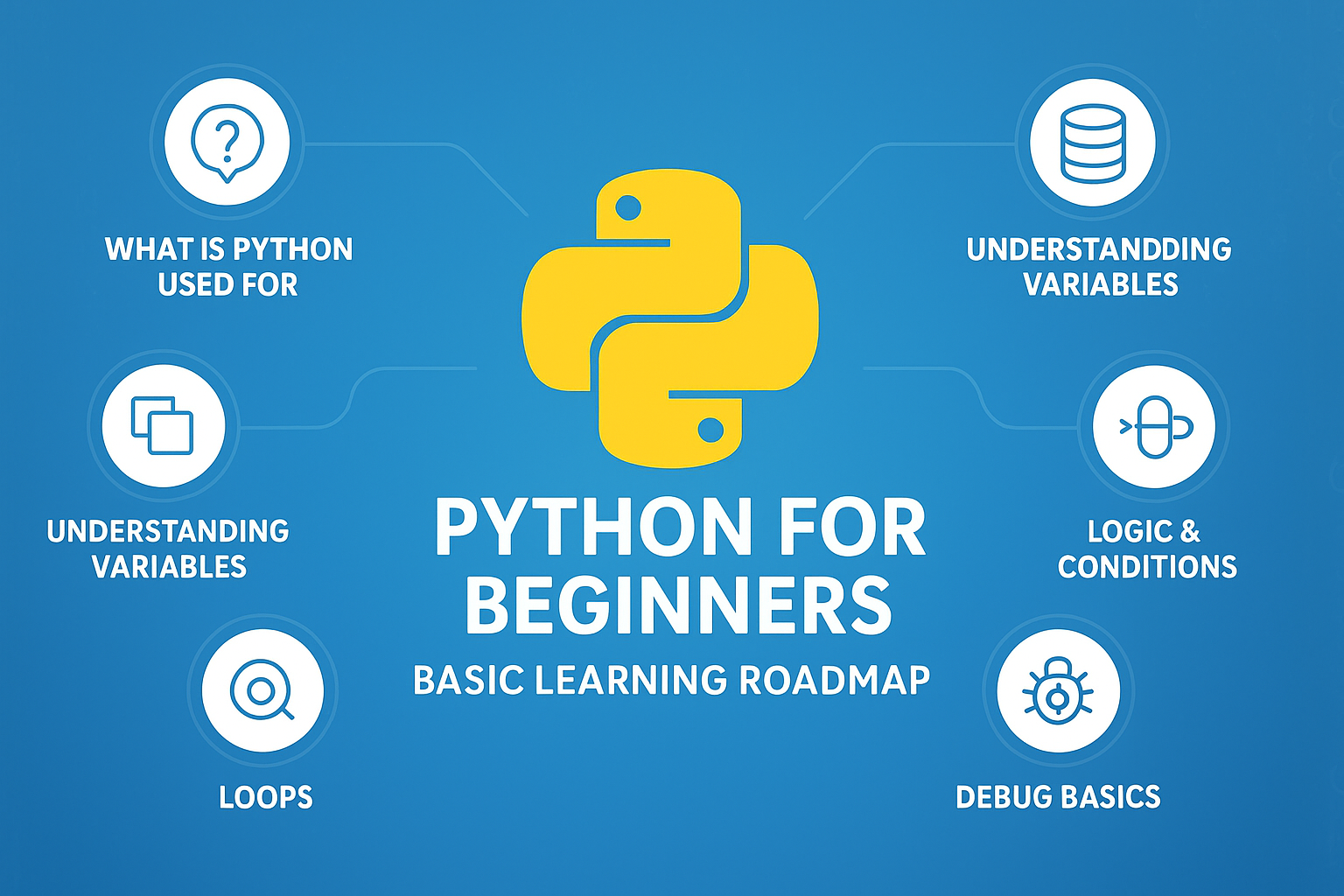
1. Understanding What Python Is Used For
Python is an all-round language widely used in multiple fields including:
Automation
Data analytics
AI and Machine Learning
Backend development
APIs
Application scripting
Testing and DevOps
This broad usage motivates learners to continue their journey beyond basic syntax.
2. Variables and Data Values
Almost everything in Python revolves around values stored inside variables. In real usage, applications store data such as name, age, marks, salary, score, or price using variables.
Before writing a program, learners should understand:
Variables hold values
Each value has a type
Data inside variables can be changed
This understanding is important before moving into logic building.
3. Python Data Types Beginners Must Know
Learning python for beginners becomes easier when they know what types of values Python supports.
Some primary data types include:
Numeric values
Text values
Boolean values (true or false)
Collections (lists, sets, tuples, dictionaries)
Each has a special purpose:
Lists store multiple items
Dictionaries store paired values
Tuples store constant values
Sets hold unique elements
Understanding data types helps beginners decide how to store and manage information.
4. Input and Output Understanding
Before coding real programs, one must know how programs accept information and how they display output. Input is what users give to the program, and output is what the program shows back.
This is fundamental in every application, including:
Forms in applications
Online calculators
Shopping websites
Games
Business dashboards
Learning I/O gives confidence to interact with users logically.
5. Basic Logical Flow and Conditions
Almost every program operates based on conditions. For example:
Show discount only if a user is new
Allow login only after verifying details
Display pass result only if marks exceed a limit
Logical learning strengthens thinking ability rather than just coding ability.
Python for beginners teaches conditional logic in an extremely beginner-friendly format.
6. Looping Ideas and Repeated Tasks
Many real-world applications repeat certain actions. Loops help achieve these repeated processes.
Examples include:
Calculating totals repeatedly
Checking values in lists
Generating multiple responses
Beginners must understand why loops exist, how they reduce manual work, and where they fit in real systems.
7. Functions and Logic Reusability
Functions represent blocks of logic that can be reused anytime. This concept helps beginners avoid repetition. It also improves readability and organization.
Functions are used in:
Login modules
Calculators
Web applications
Billing systems
Data processing
Python for beginners helps students learn function basics before designing multi-functional systems.
8. Basic Error Thinking and Debug Understanding
Errors are common in programming. Instead of getting frustrated, beginners should learn how to think logically and trace issues.
Key concepts include:
Identifying incorrect values
Fixing logical mistakes
Understanding execution flow
Debugging ability improves slowly but becomes the most valuable skill over time.
Why Understanding Concepts Matters Before Coding
Many students directly start typing code without understanding the reasoning behind it. This slows learning progress. Python for beginners becomes effective only when learners understand the concept behind each step.
Concept clarity results in:
Independent learning
Ability to build real systems
Faster troubleshooting
Better logic building
Sustainable confidence
Once basics are clear, advanced modules become easier.
Beyond Basics – Where Python Leads You Next
After mastering the foundational topics, students can explore advanced areas depending on interest.
Options include:
Data and Analytics Learning
Working with charts, analysis, business data
Machine Learning
Training models, predicting data, automating decisions
Backend Development
Building APIs, processors, and authentication modules
Automation
Writing scripts to finish repetitive tasks automatically
Python connects all these fields smoothly, making it highly valuable for any career direction.
Conclusion
Learning python for beginners is not about memorizing syntax; it is about developing structured thinking. When students understand fundamentals such as data values, loops, decisions, and reusable logic, the path to real coding becomes joyful and meaningful. These basics form the foundation of every Python program, from simple calculators to AI models. By mastering basics before writing code, learners build lifelong programming skills with confidence and clarity.
Tags : .....