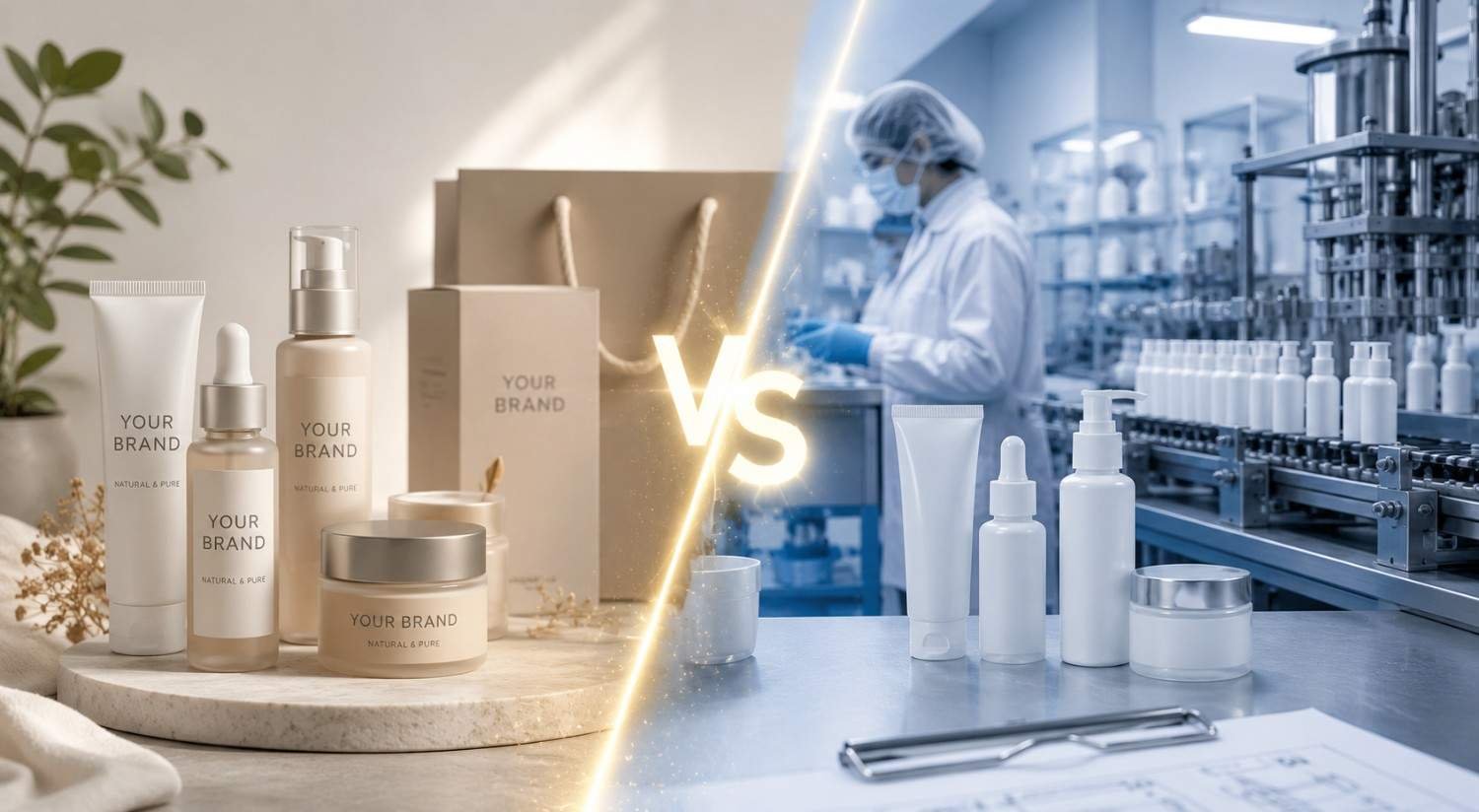
The skincare industry is expanding rapidly; however, most companies fail to grow past their initial 1,000 orders. The majority of entrepreneurs find it hard to decide whether to focus on either private label or facial mask OEM because it is unclear how both strategies influence scalability. This dilem ma is mostly faced by skincare categories such as facial masks and OEM manufacturing.
The following guide gives an explanation of private label vs OEM skincare in easy-to-understand language to help you select the strategy that will enable your business to grow easily. It is based on industry expertise gained through manufacturing and branding.
What Does OEM Skincare Actually Mean?
Original Equipment Manufacturer is abbreviated OEM. In skincare, this term refers to a process where you cooperate with the manufacturer to develop a product specifically for you.
So, what do we understand by a facial mask OEM? Facial masks produced OEM-style are developed and manufactured exclusively based on your specifications and formulas, including the exact list of active ingredients and desired properties.
Why Do Brands Go OEM
The reason why some brands choose to go OEM is that they have a unique concept of what should be done. They are passionate about their idea and would like to see it realised, having control over its execution. Here's why OEM may work for you:
- Full formula ownership – no one else can sell such a product
- Formula customised specifically for your skin's target concerns
- More chances of building stronger IP (patent)
- Great marketing angle ("produced only for us")
However, one disadvantage of such an approach is that it takes time. It takes 3 to 6 months to get a ready facial mask.
What Is Private Label Skincare?
The private label strategy is quite simple because you will be utilising a pre-existing formula, whether it is a clay mask, sheet mask, or sleeping mask. Your only job will be branding and perhaps making some changes to the smell or packaging of the product.
Consider this process as being analogous to selecting an item from a menu, instead of having a custom dish created for you.
Where Private Label Works Well
The private label approach is ideal for those who require speed within their production processes. This may be necessary in instances where you are seeking to enter new markets or launch your products quickly.
Furthermore, this strategy makes it easy for you to stay compliant with various standards across the ASEAN markets.
Where the Facial Mask OEM Fits in Modern Skincare Trends
Today’s skincare customers are more concerned with ingredients and brand loyalty.
Facial mask OEM match this trend by providing:
- Transparency about ingredients
- Personalised skincare treatment
- Premium branding opportunity
OEM brands can therefore react quickly to emerging trends such as:
- Clean beauty
- Vegan skincare
- Korean skincare routine
This makes OEM much more forward-thinking than private labelling.
Private Label vs OEM Skincare: Key Differences
Both private label and OEM skincare have their merits, and each applies in a particular stage of brand development. While one aims at quick delivery and minimum costs, the other emphasises long-term benefits for the brand.
Speed to Market
The clear advantage belongs to private label skincare, where the development process is almost done. The brand will be ready within several weeks.
OEM skincare products take longer to produce as they involve all the necessary processes of testing and approval. But, as a rule, a more polished product emerges in the end.
Product Uniqueness
Here, OEM skincare definitely has an edge due to the possibility of creating unique products, which is especially useful for competing brands in the market.
Private label skincare products are used by many different brands; hence, they do not offer any uniqueness in themselves.
Costs
Private label entails a relatively low cost structure, which makes it ideal for newcomers in the business or smaller brands.
OEM comes with a higher cost structure due to research and development processes that precede manufacturing. However, it ends up earning higher margins down the line.
Scalability
Skin care that is OEM-oriented enjoys better scalability in the future as it creates a more recognisable brand, a strong pricing strategy, and customer loyalty.
Private label enjoys higher scalability in the initial stages, but its scaling potential becomes limited once competition rises and products are no longer unique.
Choosing the Right OEM Skincare Supplier in Singapore
Once you've made up your mind that OEM is the way forward, the supplier relationship takes precedence above everything else. The OEM skincare supplier is not just your manufacturer; they should be your formulation partner.
What to Look For
When considering OEM skincare suppliers, remember to ask yourself these:
- Do they perform their own research and development, or do they collaborate with external partners?
- Are they able to provide the necessary regulatory documentation?
- What's the minimum batch size, and does it fit your initial production volume?
- Are they certified GMP or at least adhere to similar quality standards?
- Have they worked with any Singaporean or regional brands before?
Singapore provides great access to reputable suppliers with regional distribution experience, specifically with regard to the HSA regulations and selling across the border into Malaysia, Indonesia, and beyond.
Private Label vs OEM: Which Scales Better?
The question of scaling will depend upon your objectives.
Private labelling is great if you have the objective of:
- Quick market entry
- Risk-free testing
- Short-term earnings
OEM skin care products will serve the purpose in case you need:
- A strong brand positioning
- High-profit margin
- Scalability in the long term
In most cases, brands begin with private labelling and gradually move toward OEM after getting to know their audience.
Conclusion
Both private label and facial mask OEMs present opportunities for a good start. However, each method is best suited for certain stages of the business process. Whereas private label allows you to launch quickly with little risk, OEM ensures profitable growth and sustainable competitive advantage through innovative formulations.
An OEM facial mask emerges as one of the most profitable niches in the segment, owing to its frequent use and popular demand from consumers. The selection of a reliable OEM skincare company determines whether your brand will experience average growth or perform impressively.
FAQs
What's the difference between OEM and private label skincare?
The OEM will have products made to your brand's specification with its own formula, while private label means using an existing formula that will be used by several brands at the same time. OEM is more differentiated, while the private label allows for faster entry.
How can I choose an OEM facial mask manufacturer in Singapore?
Select a manufacturer with GMP certification, a research team in-house, and compliance with HSA documentation. Also, consider requesting references and make sure you'll get the opportunity to visit or inspect their production facility virtually.
Is OEM more expensive than private labelling?
While you will be paying for development costs, you get ownership of the formula, which means reduced competition later and lower costs in the long run. Moreover, a unique product will make your advertising easier in comparison to generic formulas.
What is the minimum order quantity for a facial mask OEM?
This will depend on a specific OEM manufacturer, yet usually, the minimum will be somewhere between 500 and 3,000 units per SKU. This number may differ among suppliers in Singapore.