Normal Smile Design vs Ultimate Smile Design: What Patients Should Know Before Choosing a Path
By Sanna Khan 17-08-2026 184
Normal Smile Design vs Ultimate Smile Design: What Patients Should Know Before Choosing a Path
Most people don't think much about how their smile gets planned — they just want it to look better. But behind almost every cosmetic dental case, there are really two different ways a dentist can approach the work. One treats each problem as it comes up: a stain here, a chip there, a gap that's bothered you for years. The other steps back and asks a bigger question — what should your whole smile look like, on your face, before any of it is touched? That second approach is often called Ultimate Smile Design, and understanding how it differs from a more traditional process can save patients from a lot of guesswork.
What Is Normal Smile Design, Exactly?
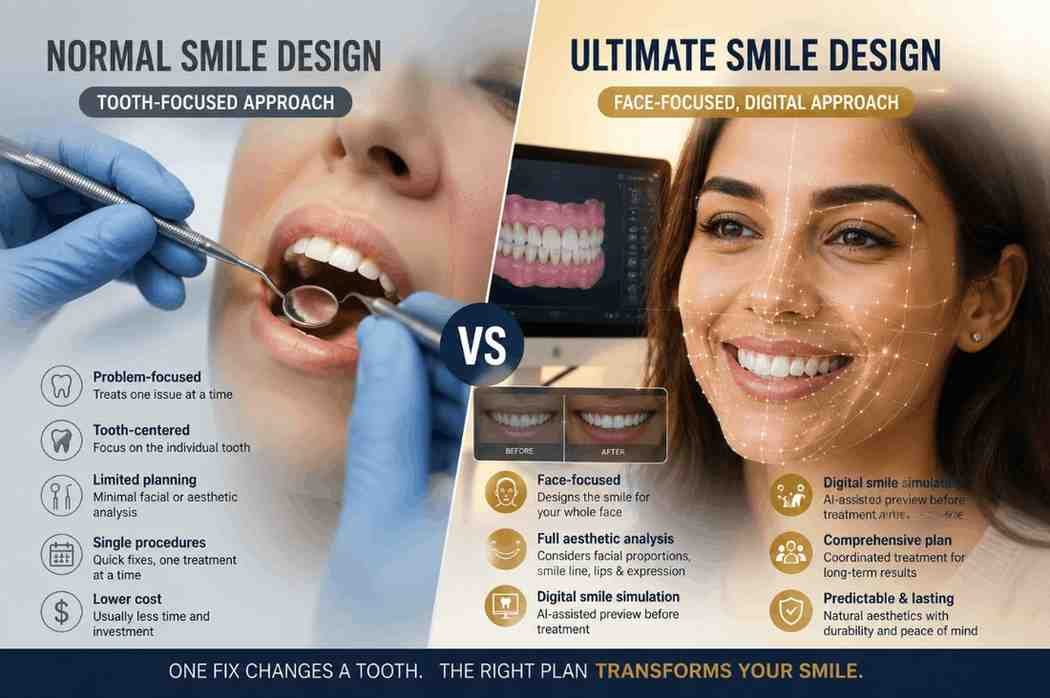
Think of it as problem-first dentistry. A patient comes in with something specific bothering them — discoloration, a chipped edge, an old filling that's yellowed — and the dentist recommends a fix aimed squarely at that issue. It might be whitening, bonding, a single veneer, or a crown.
This approach isn't wrong. For an isolated concern, it's often the faster, simpler, and more affordable route. The treatment is planned mainly around the tooth in question, sometimes with digital scans thrown in to speed up impressions or improve accuracy — but the scope rarely extends beyond the mouth itself.
What Makes Ultimate Smile Design Different?
This is where the planning philosophy flips. Instead of starting with a damaged tooth, the process starts with the finished picture: what should this person's smile look like once everything is done? Getting there usually means evaluating things a single-tooth fix never touches, like:
- Facial proportions and symmetry
- The smile line — how much tooth shows when someone talks, laughs, or smiles naturally
- Lip movement and expression, not just a static bite
- Personal aesthetic goals, alongside the clinical assessment
Digital tools tend to do more heavy lifting here too. Facial photography, 3D scans, and AI-assisted simulation are often combined to generate a preview of the new smile before treatment ever starts, so there's far less guessing about the outcome. A more detailed side-by-side of how the two methods actually compare — in planning, technology, and results — is laid out in this piece on normal vs Ultimate Smile Design, which is worth a read if you're weighing the two.
Why the Difference Actually Matters
Picture two chefs given the same ingredients and the same recipe. One turns out a solid, satisfying meal. The other turns out something memorable. The materials weren't the difference — the planning, technique, and vision were.
Cosmetic dentistry works the same way. Two dentists can use nearly identical materials — porcelain, composite, the same brand of veneer — and still land on very different results, because the philosophy behind the plan changes everything downstream. A tooth-by-tooth approach can leave a smile technically "fixed" but subtly mismatched to a patient's face. A face-first approach is built to avoid that mismatch from the start.
Who Actually Needs the Comprehensive Approach?
Not everyone does, and that's worth saying plainly. If you have one clear issue — a stain before a big event, a single chipped front tooth — a normal, targeted fix is often exactly right. There's no need for a full facial workup to whiten one tooth.
The comprehensive route tends to make more sense when:
- You're planning multiple treatments at once — veneers, whitening, aligners, gum contouring — rather than one isolated fix
- You want to see a digital preview of the result before committing to anything irreversible
- Your goal is a full smile makeover, not a single repair
- You care about how the new smile will look in motion — talking, laughing — not just in a mirror
Questions Worth Asking Before You Commit
Before signing off on any cosmetic treatment, it's reasonable to ask your dentist:
- Are you planning this tooth on its own, or as part of my whole smile?
- Can I see a digital simulation or preview of the expected outcome?
- Is this a single procedure, or part of a coordinated treatment plan?
- What's the expected durability, and is any warranty included?
The answers usually reveal which philosophy you're getting — and whether it lines up with what you actually want.
Author Bio
Sanna Khan writes about cosmetic dentistry and modern approaches to smile design, with a focus on helping readers separate real dental facts from marketing noise.