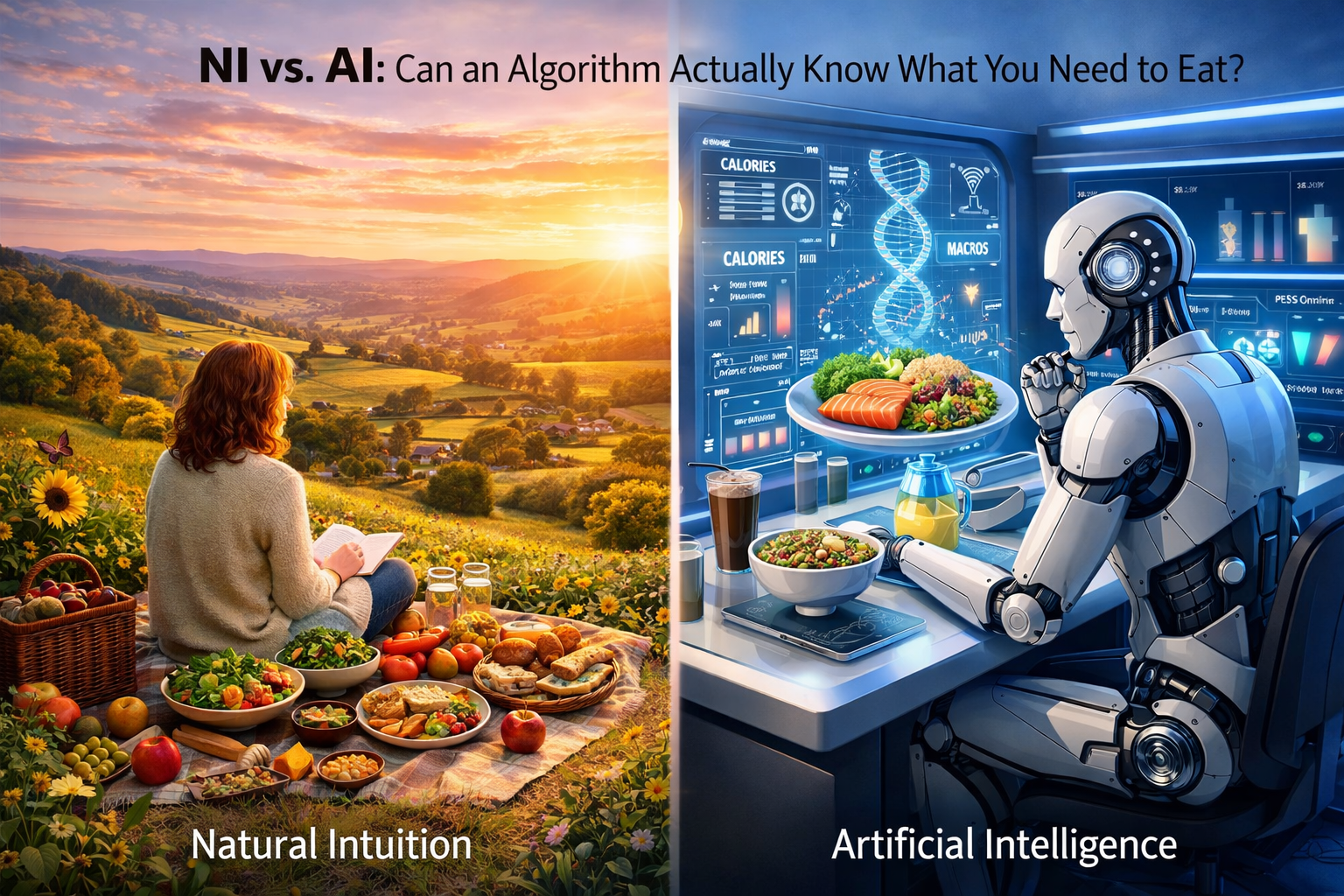
You open an app. You log your breakfast. The algorithm tells you that you need more Vitamin D and to cut back on sodium. Simple, right? But here's the thing — the app doesn't know that you skipped breakfast yesterday because you were exhausted after your daughter's school recital. It doesn't know that the "extra sodium" came from your grandmother's homemade pickle recipe or that you've been under work stress that's quietly messing with your cortisol and sleep. And that's exactly the gap no algorithm can close.
At FS National School of Health and Performance Sciences, we believe that eating well isn't a data problem — it's a human one. And that's why Nutrition Intelligence (NI) exists.
First, Let's Give AI Its Due
We're not here to dismiss technology. AI tools in nutrition have genuinely come a long way. Apps today can track macros with remarkable speed, flag potential nutrient deficiencies based on your food logs, and even offer meal suggestions based on your calorie goals. For someone just starting their health journey, that kind of structure can be a great first step.
But "a great first step" is not the same as "the right path for you." And that's a distinction that matters enormously when it comes to your health.
What AI Actually Sees — And What It Misses
When you use an AI-driven nutrition app, it processes the data you give it. That's it. It works from patterns in population-level research—meaning its suggestions are built for an "average" person who, let's be honest, doesn't really exist.
Here's what AI cannot factor in:
• Your relationship with food—whether eating is joyful, stressful, or complicated by past experiences
• Your cultural food identity—the dals, rotis, and festival foods that are part of who you are
• Your lifestyle rhythms—early morning shifts, late-night study sessions, irregular meal windows
• Your medical history—thyroid conditions, PCOS, IBS, or any clinical nuance that changes the equation
• Your emotional state—because stress, grief, and anxiety rewire how your body processes food
This is where Nutrition Intelligence (NI)—the kind we develop and practice at FS National School—becomes not just helpful but essential.
So What Is Nutrition Intelligence (NI), Really?
Nutrition Intelligence (NI) is the trained ability to understand, interpret, and apply nutritional knowledge in a deeply personalized, contextual, and empathetic way. It's the difference between knowing that fibre is good for digestion and understanding why this particular student at FS National School is bloated every Tuesday after her weekly cheat meal—and knowing exactly what to do about it.
NI is not just about what the research says. It's about how to apply it—to a real person, in a real life, with real limitations and real goals.
"AI delivers information. NI delivers intelligence. The first tells you what to eat. The second helps you understand why, when, and how — and whether it even makes sense for your life."
A Story That No Algorithm Could Write
Consider Priya, a 28-year-old marketing professional. She used a popular AI nutrition app for three months, followed every suggestion meticulously, and still felt constantly tired, bloated, and oddly unsatisfied after meals.
The app was technically "correct." Her calories were balanced. Her macros were on point. But when she sat down with a trained nutrition professional at FS National School, the real picture emerged: Priya was eating "clean" but skipping meals during high-stress deadlines, then overcorrecting with large evening meals. Her digestion was in chaos. Her iron levels were low because she was pairing iron-rich foods with tea — a common cultural habit the AI had no framework to address.
The fix wasn't a new meal plan. It was a conversation. It required Nutrition Intelligence (NI) — the human kind.
Why FS National School Builds NI — Not Just AI Literacy
At FS National School, our nutrition programs are built on a core belief: the future of health belongs to professionals who can think, not just to tools that can calculate.
We train our students to develop Nutrition Intelligence (NI) that encompasses the following:
• Deep clinical knowledge — understanding nutrients, metabolism, and disease interactions at a practitioner level
• Empathetic communication — building the kind of trust where clients actually share what's really going on
• Cultural competence — respecting and working within diverse food traditions, not against them
• Behavioral science—understanding why people eat the way they do, not just what they eat
• Critical thinking — knowing when research applies to a client and when it simply doesn't
These are not things you can download. They are skills you develop — in classrooms, through practice, and with the right mentorship.
Can AI and NI Work Together?
Absolutely — and in fact, the best nutrition practitioners today know how to use both. AI can be a powerful tool in the hands of someone with true Nutrition Intelligence (NI). It can handle the tracking, the logging, the pattern recognition. But it takes a trained human mind to interpret what those patterns mean in the context of a person's life.
Think of it this way: a calculator is brilliant at maths. But it can't tell you which equation to solve. That's your job.
The Bottom Line
An algorithm can tell you that almonds are a healthy snack. It cannot tell you that your client is allergic, that they can't afford almonds this week, or that they've been avoiding them since a bad memory from childhood. It cannot sit across from someone, look them in the eye, and say — "I hear you. Let's figure this out together."
Nutrition Intelligence (NI) can.
At FS National School of Health And Performance Sciences, we're not training students to compete with AI. We're training them to do what AI never will — to bring humanity, wisdom, and intelligence to the most personal aspect of a person's life: how they nourish themselves.
Ready to build real Nutrition Intelligence? Explore nutrition certification programmes at FS National School of Health and Performance Sciences and join the next generation of NI-led health professionals.