Nepal and Bhutan Tour: The Complete Guide to Planning Your Himalayan Journey in 2026
By Peregrine Treks and Tours 24-03-2026 381
A Nepal and Bhutan tour is one of the most complete Himalayan journeys a traveller can take. In a single trip, you experience two profoundly different kingdoms one open and dramatic, shaped by trekking culture and ancient Hindu-Buddhist traditions, and the other intentionally protected, quietly spiritual, and unlike anywhere else on earth. Together, Nepal and Bhutan offer a combination of landscapes, history, and living culture that no single destination can match.
Nepal and Bhutan tour packages typically run between 10 and 18 days depending on how deeply you want to explore each country. The journey usually begins in Kathmandu, moves through the temples and trekking trails of Nepal, and then crosses into Bhutan via a short flight to Paro. Both countries share the Himalayan range as a backdrop, but the experience in each is entirely distinct.
Quick Facts
Primary destination: Nepal and Bhutan
Typical duration: 10 to 18 days
Starting point: Kathmandu, Nepal
Bhutan entry: Paro International Airport
Best season: Spring (March to May) and Autumn (September to November)
Permit needed: Bhutan visa clearance letter + Sustainable Development Fee (SDF)
Who it suits: Cultural travellers, first-time Himalayan visitors, luxury travellers, spiritual seekers
Why Combine Nepal and Bhutan in One Tour
The Nepal and Bhutan tour makes sense as a combined journey for several reasons that go beyond simple convenience.
Both countries sit in the eastern Himalayas and share a common Buddhist heritage, yet they have evolved in entirely different directions. Nepal is one of the world's great open trekking destinations diverse, vibrant, and full of contrasts between ancient temple culture and the raw scale of the world's highest mountains. Bhutan, by contrast, has deliberately limited its exposure to mass tourism through the Sustainable Development Fee and a licensing system that ensures every visitor travels with a guide. The result is a country that feels genuinely untouched, where monasteries cling to cliffsides above pristine valleys and where Gross National Happiness is measured alongside GDP as a national policy.
Combining them in a single Nepal and Bhutan tour lets you experience both extremes of the Himalayan world the epic and accessible on one side, the rare and carefully preserved on the other. Kathmandu and Paro are connected by direct flights operated by Bhutan Airlines and Druk Air, making the transition between countries seamless.
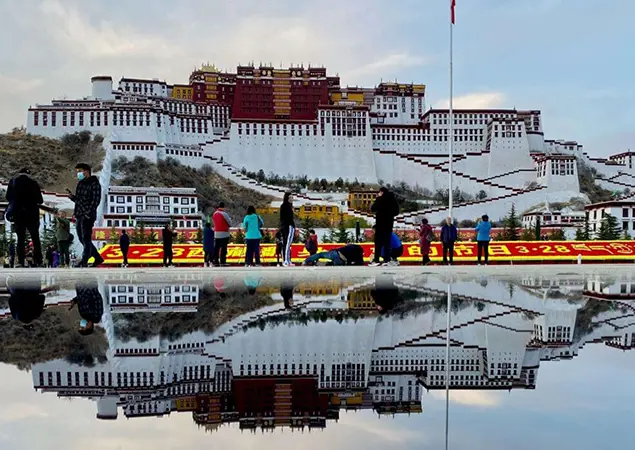
For travellers considering adding a third country, Nepal Bhutan Tibet tour packages extend the journey further into the Tibetan Plateau, adding Lhasa, the Potala Palace, and the sacred landscapes around Mount Kailash. The three destinations form a natural cultural and spiritual arc across the roof of the world.
What to Expect in Nepal
Nepal is where most combined tours begin. Kathmandu serves as the entry point, and most itineraries spend three to five days here before flying to Bhutan.
Kathmandu Valley
Kathmandu is one of the most historically layered cities in Asia. The valley contains seven UNESCO World Heritage Sites within a short drive of each other, including three royal durbar squares, two of the most important Buddhist stupas in the world, and the sacred Hindu temple of Pashupatinath. Our detailed guide to Kathmandu Valley UNESCO World Heritage Sites covers each site in full, including the best time to visit and what to expect at each location.
Pashupatinath Temple on the banks of the Bagmati River is one of the most sacred Hindu temples in the subcontinent. The evening aarti ceremony here is one of the most moving experiences Kathmandu offers. Boudhanath Stupa the largest stupa in Nepal and one of the largest in the world sits at the centre of a thriving Tibetan Buddhist community and is a natural starting point for understanding the spiritual traditions you will encounter more deeply in Bhutan. Swayambhunath, known as the Monkey Temple, offers panoramic views over the valley from its hilltop position and is one of the oldest religious sites in Nepal.
Beyond the UNESCO sites, the bazaars of Thamel and Asan, the old city lanes of Patan, and the afternoon light over the Himalayan rim from Nagarkot or Dhulikhel all add layers to the Kathmandu experience that most travellers do not want to rush.
Pokhara
Many Nepal and Bhutan tour itineraries extend beyond Kathmandu to include Pokhara, Nepal's second city and the gateway to the Annapurna region. Pokhara sits at the edge of Phewa Lake with direct views of the Annapurna massif and Machhapuchhre, and the reflection of the peaks on the water at dawn is one of Nepal's most photographed scenes.
From Pokhara, travellers can add a short trek — the Ghorepani Poon Hill Trekking route is the most popular, taking four to five days and reaching the famous Poon Hill viewpoint at 3,210 metres for a sunrise panorama over the Annapurna range. This is the most accessible way to include a Himalayan trekking experience within a combined Nepal and Bhutan tour without extending the overall itinerary significantly.
For those who want a full trekking experience before crossing into Bhutan, the Annapurna Base Camp Trek or the Everest Base Camp Trek can be combined with a Bhutan extension at the end. The Nepal Trekking Tour is a good starting point for seeing how this works in practice.
Chitwan National Park
Some combined itineraries include a night or two at Chitwan National Park in the southern Terai lowlands. Chitwan is a UNESCO World Heritage Site and one of the best places in Asia to see one-horned rhinoceros and Bengal tigers in a protected wild habitat. It offers a complete change of climate and landscape from the mountains and adds a strong wildlife dimension to the Nepal portion of the tour. The [Kathmandu Pokhara Chitwan Tour is a popular option for travellers who want to cover all three of Nepal's major zones the mountains, the lakeside, and the jungle before flying to Bhutan.
What to Expect in Bhutan
Bhutan is the second chapter of the Nepal and Bhutan tour, and for many travellers it becomes the emotional highlight of the entire journey.
Entry and the Sustainable Development Fee
All international visitors to Bhutan except citizens of India, Bangladesh, and the Maldives must obtain a visa clearance letter before arrival. This is arranged through a licensed Bhutanese tour operator and takes around five to seven working days to process. The visa is stamped in your passport on arrival at Paro airport. A one-time visa processing fee of USD 40 applies.
In addition to the visa, all visitors pay the Bhutan Sustainable Development Fee (SDF) of USD 100 per person per night. This fee is not a tour package cost it is a government charge that goes directly toward funding Bhutan's free healthcare, education, and environmental conservation programmes. For a 6-night stay in Bhutan, the SDF alone is USD 600 per person. For a full breakdown of what to budget, our Bhutan travel cost guide covers every expense in detail.
Indian citizens pay a reduced SDF of approximately INR 1,200 per night and do not require a pre-approved visa. They can obtain an entry permit at the border or at Paro airport.
Paro
Every flight into Bhutan lands at Paro, a valley town at 2,250 metres surrounded by terraced rice fields, traditional farmhouses, and the Paro Chhu river. The descent into Paro airport one of the most technically demanding commercial approaches in the world already signals that you have arrived somewhere extraordinary.
Paro's most iconic sight is Tiger's Nest Monastery (Paro Taktsang), a 17th-century monastery complex built into a sheer cliff face at 3,120 metres above the valley floor. The hike to the viewpoint takes two to three hours from the valley and involves a steep trail through blue pine and oak forest. At the viewpoint, the monastery appears to grow directly out of the rock face, defying both gravity and logic. It is one of the defining images of Bhutan and one of the most memorable single days in all of Asian travel.
Paro also contains the National Museum of Bhutan, housed in a circular dzong tower above the valley, and the Rinpung Dzong, a massive fortress-monastery that serves as both a government administrative building and a place of worship a combination that is characteristic of Bhutanese architecture throughout the country.
Thimphu
Thimphu, Bhutan's capital city, sits at 2,320 metres and is one of the only national capitals in the world without traffic lights. The city's pace is unhurried, its architecture follows strict traditional guidelines, and its streets feel more like a large, prosperous town than a capital. Most Nepal and Bhutan tour itineraries include two nights in Thimphu.
Key stops in Thimphu include the Tashichho Dzong, the seat of Bhutan's government and the summer residence of the Je Khenpo, the chief abbot of Bhutan. The Buddha Dordenma statue a 51-metre golden Buddha seated above the city on a forested hillside is visible from across the valley and has become a defining landmark of modern Thimphu. The **National Folk Heritage Museum, Centenary Farmers Market**, and several traditional arts centres give a complete picture of both ancient and contemporary Bhutanese life.
Punakha
Punakha, the former capital of Bhutan, sits at 1,200 metres in a warm, fertile valley where two rivers the Mo Chhu and Pho Chhu meet. The drop in altitude from Thimphu makes it noticeably warmer, and the valley is covered in rice and wheat fields for most of the year.
The Punakha Dzong, built at the confluence of the two rivers in 1637, is widely considered the most beautiful building in Bhutan. It serves as the winter residence of the Je Khenpo and hosts the dramatic Punakha Tshechu festival each spring. The surrounding valley also contains the Chimi Lhakhang, known as the Fertility Temple, set in a small hilltop surrounded by farmland. Our detailed blog on Chimi Lhakhang covers the history, symbolism, and what to expect when visiting this unique and significant Bhutanese temple.
The drive from Thimphu to Punakha crosses the **Dochula Pass** at 3,100 metres, where 108 memorial chortens stand in rows on the hillside with the Bhutanese Himalaya stretching behind them on clear days. This is one of the most photographed spots in the country and a natural acclimatisation stop.
Bhutan Trekking Option
For those who want to add a trekking dimension to the Bhutan portion of the Nepal and Bhutan tour, the Jomolhari Base Camp Trek Bhutan is the most rewarding option. The route heads north from Paro through remote yak pastures and high-altitude valleys to the base of Jomolhari (7,326 m), one of the most sacred peaks in Bhutan. The standard route takes around eight days and reaches a maximum altitude of approximately 4,900 metres. It is a serious mountain trek but one that passes through extraordinarily pristine Himalayan wilderness.
Nepal Bhutan Tibet Tour Packages — Adding the Third Kingdom
For travellers who want to go further, Nepal Bhutan Tibet tour packages extend the combined journey into Tibet, adding a third and entirely distinct Himalayan culture to the experience.
Tibet is the highest plateau on earth and home to a civilisation that developed its own form of Mahayana Buddhism, its own art, its own medicine, and its own political and religious governance over more than a thousand years. A visit to Lhasa adds the Potala Palace the former winter residence of the Dalai Lama and one of the most architecturally significant buildings in Asia along with the Jokhang Temple, the most sacred temple in Tibetan Buddhism, and the Barkhor Circuit, the ancient pilgrim route around the Jokhang that has been walked continuously for over 1,300 years.
Entry to Tibet requires both a Chinese visa and a separate Tibet Travel Permit. These are arranged through your tour operator and cannot be obtained independently. Peregrine offers the Nepal and Tibet Tour as a structured journey that covers Kathmandu and the key Tibetan sites in an efficient combined itinerary. For those drawn specifically to the spiritual dimension of Tibet, the Mount Kailash Tour from Nepal adds the most sacred site in Tibetan Buddhism Mount Kailash and Lake Mansarovar in far western Tibet to a Nepal itinerary.
The Lhasa Tour from Kathmandu is the most efficient way to add Tibet to a Nepal base, using the Kathmandu–Lhasa flight and covering the major sites of the Tibetan capital in four to five days.
A full Nepal Bhutan Tibet tour package covering all three destinations typically runs 18 to 22 days and covers Kathmandu, key Nepal highlights, Lhasa, and then Paro and Thimphu in Bhutan, finishing with the Tiger's Nest before the international departure. It is the most comprehensive Himalayan cultural journey available and suits travellers who want to experience the full spiritual and geographical arc of the eastern Himalayan world in a single trip.
Nepal and Bhutan Tour Itinerary — Sample Structure
Below is a representative sample itinerary for a 14-day Nepal and Bhutan tour Actual itineraries vary depending on your interests, available time, and whether you wish to include trekking or Chitwan.
| Day | Location | Highlights |
| Day 1 | Arrive Kathmandu | Airport transfer, welcome dinner, rest |
| Day 2 | Kathmandu | Pashupatinath, Boudhanath Stupa, Thamel |
| Day 3 | Kathmandu | Swayambhunath, Patan Durbar Square, Bhaktapur |
| Day 4 | Pokhara | Drive or fly to Pokhara, Phewa Lake, Sarangkot sunset |
| Day 5 | Pokhara | Day hike toward Poon Hill foothills, mountain views, free afternoon |
| Day 6 | Kathmandu | Return to Kathmandu, pre-departure preparation, farewell dinner |
| Day 7 | Fly to Paro, Bhutan | Scenic Paro approach, check in, Paro Rinpung Dzong |
| Day 8 | Paro | Tiger's Nest (Paro Taktsang) full day hike |
| Day 9 | Thimphu | National Museum, Buddha Dordenma, Tashichho Dzong |
| Day 10 | Thimphu | Craft workshops, traditional arts, local market |
| Day 11 | Punakha | Dochula Pass, Punakha Dzong, Chimi Lhakhang |
| Day 12 | Punakha to Paro | Hike above Punakha valley, scenic drive back to Paro |
| Day 13 | Paro | Free morning, souvenir shopping, farewell dinner |
| Day 14 | Depart Paro | International departure |
For a longer version that includes Chitwan wildlife safari, the Annapurna region, or a Bhutan trek, speak with our team through the Plan Your Trip page and we will build a customised itinerary around your interests and available dates.
Nepal and Bhutan Tour Cost — What to Budget
Nepal and Bhutan tour cost varies significantly depending on the level of service, group size, duration, and season. Here is a general framework for planning your budget in 2026.
| Cost Component | Nepal (Per Person) | Bhutan (Per Person) |
| Guided tour package | USD 500 – 1,200 | USD 1,500 – 2,500 |
| Sustainable Development Fee (Bhutan) | — | USD 100 per night |
| Bhutan visa fee | — | USD 40 (one-time) |
| Nepal visa fee | USD 30 – 50 | — |
| Domestic flights (within Nepal) | USD 100 – 200 | — |
| Paro flight (from Kathmandu) | — | USD 250 – 450 one way |
| Travel insurance | USD 80 – 150 | Included in above estimate |
| Tips for guide and driver | USD 80 – 150 | USD 80 – 150 |
| Personal expenses | USD 100 – 200 | USD 100 – 200 |
Total estimated cost for a 14-day Nepal and Bhutan tour: USD 3,500 – 6,000 per person, depending on accommodation standard, group size, and season.
For a comprehensive breakdown of Bhutan-specific costs, see our Bhutan travel cost guide. For Nepal tour-specific pricing, explore the full range of Nepal tour packages on our website.
Peregrine's dedicated Nepal and Bhutan Tour package is priced from USD 4,460 per person and covers both countries with all accommodation, guide support, ground transfers, permits, and domestic flights included. It is one of the most complete combined Himalayan packages available at a transparent all-in price.
Permits and Visas for a Nepal and Bhutan Tour
Understanding the entry requirements for both countries before you travel prevents delays and last-minute complications.
Nepal Visa
Most nationalities can obtain a Nepal tourist visa on arrival at Tribhuvan International Airport in Kathmandu. A 15-day visa costs USD 30, a 30-day visa costs USD 50, and a 90-day visa costs USD 125. You will need a passport photograph and a completed arrival card. Some nationalities require a pre-approved visa check the current requirements before travel.
Indian and SAARC nationals do not require a visa for Nepal.
Bhutan Visa
All international visitors except citizens of India, Bangladesh, and the Maldives require a visa clearance letter before arrival in Bhutan. This clearance letter is issued by the Tourism Council of Bhutan through a licensed Bhutanese tour operator. The process takes five to seven working days and must be completed before you fly to Paro. Your operator arranges this on your behalf as part of the booking process.
The Sustainable Development Fee (SDF) of USD 100 per person per night must be paid in full when the visa clearance is processed it cannot be paid on arrival. For a 7-night stay in Bhutan, that is USD 700 per person in SDF alone, on top of all other tour costs.
Indian citizens receive a permit at the border or Paro airport and pay the reduced SDF rate of approximately INR 1,200 per night.
For detailed Bhutan entry information, the [Bhutan Tour Guide](https://peregrinetreks.com/blog/bhutan-tour-guide) on our blog covers visa requirements, the SDF, and Bhutan entry rules in full.
Best Time for a Nepal and Bhutan Tour
Both Nepal and Bhutan share broadly similar seasonal patterns, which makes planning a combined tour relatively straightforward. The two peak trekking and travel seasons in Nepal are spring and autumn, and these are also the two best times to visit Bhutan.
Spring March to May is the most popular season for a Nepal and Bhutan tour. In Nepal, rhododendrons bloom at altitude from late February through April, the skies are clear in the mornings before afternoon cloud builds, and temperatures are comfortable at lower elevations. In Bhutan, spring is festival season the Paro Tshechu, held each spring in the Paro Dzong courtyard, is one of the most important religious festivals in the country and draws pilgrims and visitors from across Bhutan and the region. The Tshechu features masked dances, sacred performances, and the unfurling of a giant thangka on the final morning. If your travel dates allow it, timing your Bhutan visit to coincide with Paro Tshechu adds a dimension to the journey that is genuinely irreplaceable.
Autumn — September to November** is the second peak season. Post-monsoon skies in both Nepal and Bhutan are at their clearest, mountain views are at their sharpest, and the air has a cool freshness after the rains. October is widely considered the single best month for Himalayan travel across the region. The Thimphu Tshechu festival takes place each September, offering a similar festival experience to the Paro Tshechu for autumn travellers.
Winter — December to February** is quiet in both countries. Nepal's lower elevations and Pokhara are pleasant in winter, but high passes and trekking routes above 3,000 metres become cold and sometimes snowbound. Bhutan's Punakha valley is warmer than the rest of the country and is particularly beautiful in winter when jacaranda trees bloom purple along the Punakha Dzong walls. Some travellers specifically choose February for the Punakha Drubchen and Punakha Tshechu festivals.
Monsoon — June to August** is not recommended for most Nepal and Bhutan touring itineraries. Rainfall is heavy in both countries, visibility is limited, and trekking routes can be affected by landslides. Bhutan's eastern regions receive some of the heaviest rainfall in Asia during monsoon. Most operators do not run fixed-date group departures during this period.
Why Book Your Nepal and Bhutan Tour with Peregrine Treks
Peregrine Treks has been operating Himalayan journeys across Nepal, Bhutan, Tibet, and beyond for over two decades. We hold a licensed Bhutanese tour operator partnership, which means we can process your Bhutan visa clearance and SDF payment directly — there is no need to book separately through multiple agents.
Our Nepal and Bhutan Tour package is designed to cover the best of both countries within a realistic timeframe, with experienced local guides in each country, hand-selected accommodation at every stop, all internal flights, and complete permit management. We also run dedicated Bhutan vacation packages, a Bhutan Luxury Tour, and the India Bhutan Nepal Tour for travellers who want to include India as a third destination.
For travellers specifically interested in the Tibet extension, we operate the Nepal and Tibet Tour and the Lhasa Tour from Kathmandu, and can combine these with a Bhutan visit on request.
We operate with a [Best Price Guarantee and full transparency on what is included in every package. Our team is available to answer questions through the Contact Us page, or you can start building your trip directly on the Plan Your Trip page.
Frequently Asked Questions About the Nepal and Bhutan Tour
How long should a Nepal and Bhutan tour be?
A minimum of 12 days is recommended to cover both countries at a comfortable pace around 5 days in Nepal and 6 nights in Bhutan. For a more relaxed and immersive experience, 14 to 16 days is ideal. Adding trekking in Nepal or a Bhutan trek extends the trip further. Our Nepal and Bhutan Tour runs as a structured itinerary that balances both countries well within a 14-day window.
Can I visit Nepal and Bhutan independently without a guide?
In Nepal, independent travel is fully possible and legal. In Bhutan, a licensed guide is mandatory for all travel beyond Paro and Thimphu. For a combined tour, most travellers find it significantly easier and more rewarding to book through a single operator who manages both countries together, handling all visa processing, permits, accommodation, and transfers in one booking.
What is included in the Bhutan SDF and do I have to pay it separately?
The Bhutan Sustainable Development Fee (USD 100 per person per night) is a government charge paid directly to the Tourism Council of Bhutan. It covers Bhutan's free healthcare, education, and infrastructure programmes. It is paid in advance when processing your visa clearance and must be included in your total Bhutan budget. It is not a tour operator fee. For a full explanation, see our Bhutan travel cost guide.
Can Indian citizens join a Nepal and Bhutan tour?
Yes. Indian citizens do not require a visa for Nepal and receive a permit on arrival in Bhutan. The SDF for Indian citizens is approximately INR 1,200 per night — significantly lower than the international rate. Indian travellers can also enter Bhutan by land through the Phuntsholing border crossing if not flying directly to Paro. The India Bhutan Nepal Tour is specifically designed for travellers routing through India as well.
What is a Nepal Bhutan Tibet tour package and how long does it take?
A Nepal Bhutan Tibet tour package typically covers Kathmandu and key Nepal sights, then Lhasa and the major Tibetan cultural sites, then Paro and Thimphu in Bhutan. A complete three-country itinerary takes a minimum of 16 to 18 days and up to 22 days for a more relaxed pace. Tibet entry requires both a Chinese visa and a Tibet Travel Permit, arranged through your operator. Our Nepal and Tibet Tour and Lhasa Tour from Kathmandu cover the Tibet portion in detail.
What is the best single add-on trek for a Nepal and Bhutan tour?
For trekkers who want a mountain experience within a combined Nepal and Bhutan tour without significantly extending the itinerary, the Ghorepani Poon Hill Trekking route is the most practical option it takes four to five days, reaches a dramatic Himalayan viewpoint, and begins and ends in Pokhara. For those with more time, the Annapurna Base Camp Trek or Everest Base Camp Trek can be added before the Bhutan leg. The Jomolhari Base Camp Trek Bhutan is the best trekking option within Bhutan itself.