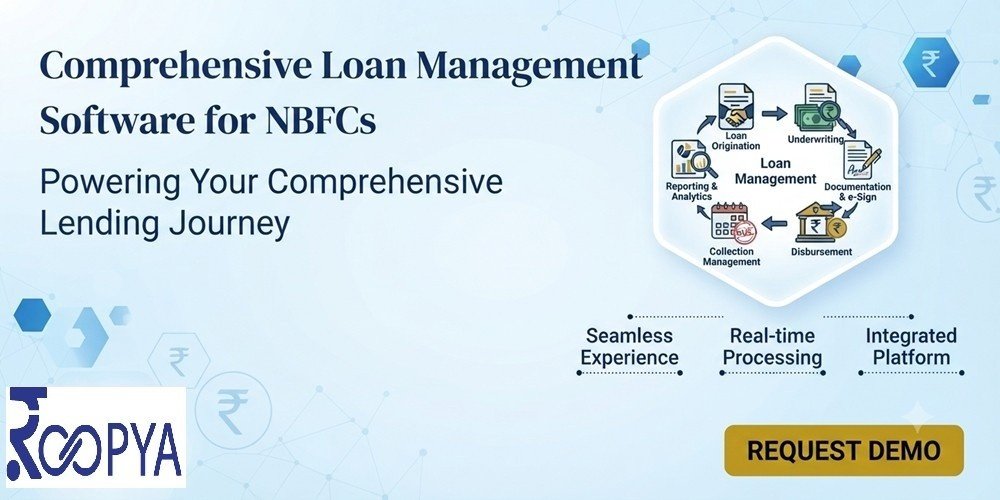
At Roopya (roopya.money), we work with banks, NBFCs, and fintech lenders who are trying to solve the same underlying problem: their lending operations have outgrown spreadsheets, disconnected point tools, and manual back-office processes. This guide walks through what a modern loan management system (LMS) actually does, why it matters for banks and NBFCs specifically, what to look for when evaluating a platform, and how Roopya approaches the problem differently.
What Is Loan Management Software?
Loan management software is a digital platform that manages the entire lifecycle of a loan — from the moment a customer applies, through underwriting, disbursal, repayment tracking, and closure or recovery. Rather than treating origination, servicing, and collections as separate systems bolted together, a true LMS unifies them on one platform with a single source of truth for every loan account.
For banks and NBFCs, this typically covers:
- Loan origination — digital application capture, KYC, credit bureau checks, and eligibility rules.
- Underwriting and credit decisioning — automated scoring, policy-based approvals, and manual override workflows for exceptions.
- Loan servicing — EMI schedules, interest accrual, disbursement tracking, and account statements.
- Collections and recovery — repayment reminders, delinquency buckets, and collections workflows.
- Compliance and reporting — RBI/regulator-ready reports, audit trails, and NPA classification.
- Customer and partner portals — self-service access for borrowers, DSAs, and co-lending partners.
The difference between a basic loan tracking tool and a genuine loan management system is depth: an LMS should be able to handle complex product structures (secured, unsecured, co-lending, gold loans, BNPL, working capital), configurable workflows, and integrations with credit bureaus, payment rails, and core banking systems — without custom development for every change.
Why Banks and NBFCs Need a Dedicated LMS
Many banks and NBFCs still run parts of their lending operations on legacy core banking modules, Excel-based tracking, or a patchwork of vendor tools that don't talk to each other. This creates four recurring problems.
1. Slow, Manual Loan Processing
When origination, underwriting, and disbursal live in separate systems, every handoff introduces delay and risk of error. Loan officers re-key data, credit checks are run manually, and approvals get stuck in email threads. This directly hurts turnaround time (TAT) — one of the most competitive metrics in lending today, especially as digital-first NBFCs and fintechs compete on speed.
2. Compliance and Audit Risk
Regulators such as the RBI require detailed, accurate, and timely reporting on asset classification, provisioning, and lending practices. Manual processes make it hard to maintain a clean audit trail, and every manual step is a point where errors — and compliance risk — can creep in. A modern LMS builds compliance into the workflow itself, rather than treating it as a reporting exercise done after the fact.
3. Poor Visibility Into Portfolio Health
Without a unified system, getting a real-time view of the loan book — delinquency trends, product-wise performance, branch-wise collections efficiency — often means pulling data from multiple systems and reconciling it manually. That delay means decisions get made on stale data, which is especially costly during periods of rising defaults or economic stress.
4. Difficulty Scaling New Products
Launching a new loan product — say, a co-lending partnership or a new unsecured personal loan variant — often means months of IT work on legacy systems. A configurable LMS is built so that product, policy, and workflow changes can be made without a full development cycle, which matters enormously for NBFCs and fintechs trying to move quickly in a competitive market.
Core Features to Look for in a Loan Management System
Not all loan management platforms are built the same way. When evaluating an LMS for a bank, NBFC, or fintech, these are the capabilities that tend to separate a genuinely useful platform from a system that will need to be replaced in two years.
End-to-End Loan Lifecycle Coverage
The platform should manage origination, underwriting, disbursement, servicing, and collections in one system, so data flows automatically between stages instead of being re-entered.
Configurable Workflows and Credit Policies
Every lender's credit policy, approval hierarchy, and product rules are different — and they change often. Look for a platform where business teams, not just developers, can configure eligibility rules, approval matrices, and product parameters.
Multi-Product, Multi-Entity Support
Banks and NBFCs frequently run several loan products — secured, unsecured, gold loans, business loans, co-lending arrangements — sometimes across multiple branches or legal entities. The LMS should handle this without requiring separate instances for each product line.
Robust Integrations
A loan management system rarely operates in isolation. It needs to connect cleanly with credit bureaus (CIBIL, Experian, CRIF), KYC/Aadhaar-based verification, payment and NACH/UPI rails, accounting systems, and core banking platforms via APIs.
Automated Collections and Delinquency Management
The system should automatically bucket accounts by days-past-due, trigger reminders across channels (SMS, WhatsApp, email, IVR), and give collections teams a prioritised worklist rather than a static report.
Regulatory Reporting and Audit Trails
Every action — approval, disbursement, waiver, restructuring — should be logged with a timestamp and user ID, and the system should be able to generate regulator-ready reports without manual compilation.
Data Security and Access Control
Given the sensitivity of financial and personal data involved, role-based access control, encryption at rest and in transit, and detailed activity logging are non-negotiable for banks and NBFCs operating under RBI guidelines.
Cloud-Native and API-First Architecture
A cloud-native, API-first platform is easier to scale, faster to integrate with existing systems, and generally lowers the total cost of ownership compared to on-premise, monolithic systems.
How Roopya Approaches Loan Management
Roopya (roopya.money) is built specifically for the operational realities of banks, NBFCs, and fintech lenders in India — lenders who need a platform that is configurable enough to support multiple products and partners, but structured enough to stay compliant and auditable at scale.
A few principles guide how the platform is designed:
- Single platform, full lifecycle: origination, underwriting, servicing, and collections run on one system, so there's one source of truth for every loan account instead of data scattered across tools.
- Configuration over custom code: credit policies, approval workflows, and product parameters can be adjusted by business and risk teams without waiting on a development cycle for every change.
- Built for co-lending and partnerships: as co-lending and BaaS (banking-as-a-service) models grow, the platform is designed to handle multi-party loan structures, partner-wise reporting, and reconciliation cleanly.
- Compliance by design: audit trails, asset classification, and regulator-ready reporting are part of the core workflow, not an add-on module.
- Open integration layer: APIs for credit bureaus, KYC providers, payment rails, and core banking systems, so the LMS fits into an existing technology stack rather than requiring a rip-and-replace.
The goal is straightforward: give lending teams a system that reduces turnaround time, keeps operations compliant, and gives leadership real visibility into portfolio performance — without the multi-year, high-risk implementation that legacy core banking upgrades often involve.
Benefits of Implementing a Modern LMS
Lenders that move from fragmented systems to a unified loan management platform typically see improvements across several dimensions:
- Faster turnaround time: automated underwriting and straight-through processing reduce the time from application to disbursement.
- Lower operating cost: less manual data entry and reconciliation means loan officers and operations teams can manage larger portfolios without proportional headcount growth.
- Better asset quality: systematic, rules-based underwriting and proactive collections workflows help reduce delinquency and improve recovery rates.
- Stronger compliance posture: built-in audit trails and automated regulatory reports reduce the risk of compliance breaches and the effort required for audits.
- Improved borrower experience: self-service portals, faster decisions, and transparent repayment schedules improve customer satisfaction and retention.
- Scalability: a configurable platform makes it possible to launch new products or enter new partnerships without a lengthy IT project.
Who Should Use a Loan Management System?
While the underlying need — managing the loan lifecycle efficiently and compliantly — is the same, different types of lenders use an LMS in slightly different ways:
- Banks: typically use an LMS to complement or modernise core banking loan modules, especially for retail and MSME lending where speed and product flexibility matter.
- NBFCs: rely on an LMS as their primary lending operations backbone, since NBFCs often move faster on product innovation than banks and need a system that keeps pace.
- Fintech lenders: use an LMS to power digital-first, API-driven lending journeys, often integrated with embedded finance, BNPL, or co-lending partnerships.
- Co-lending partners: banks and NBFCs partnering under co-lending models need shared visibility, reconciliation, and reporting — something a modern LMS is built to support.
Common Mistakes When Choosing a Loan Management System
Selecting the wrong LMS is expensive to undo, so it's worth being deliberate about the evaluation process. Some of the most common mistakes lenders make:
- Choosing a system based only on origination features, without evaluating servicing and collections capability.
- Underestimating the effort required to integrate with existing credit bureau, KYC, and payment systems.
- Picking a rigid platform that requires vendor development for every policy or workflow change.
- Overlooking data security and access-control requirements until late in implementation.
- Not validating how the system handles regulatory reporting specific to the lender's category (bank vs NBFC).
A useful test during evaluation is to ask a prospective vendor to walk through a real scenario — for example, restructuring a delinquent loan, or launching a new product variant — and see how much of that requires configuration versus custom development.
Getting Started with Roopya
If your lending operations are still spread across spreadsheets, legacy systems, and manual processes, the cost isn't just inefficiency — it's slower growth, higher compliance risk, and a weaker borrower experience compared to competitors who have already modernised. Roopya is built to help banks, NBFCs, and fintech lenders move to a single, compliant, configurable loan management platform without a disruptive, multi-year implementation.
To see how Roopya's loan management software fits your lending operations — whether you're a bank modernising a retail lending desk, an NBFC scaling a new product line, or a fintech building a digital lending journey — visit roopya.money to learn more or request a demo.
Tags : Loan Management Software