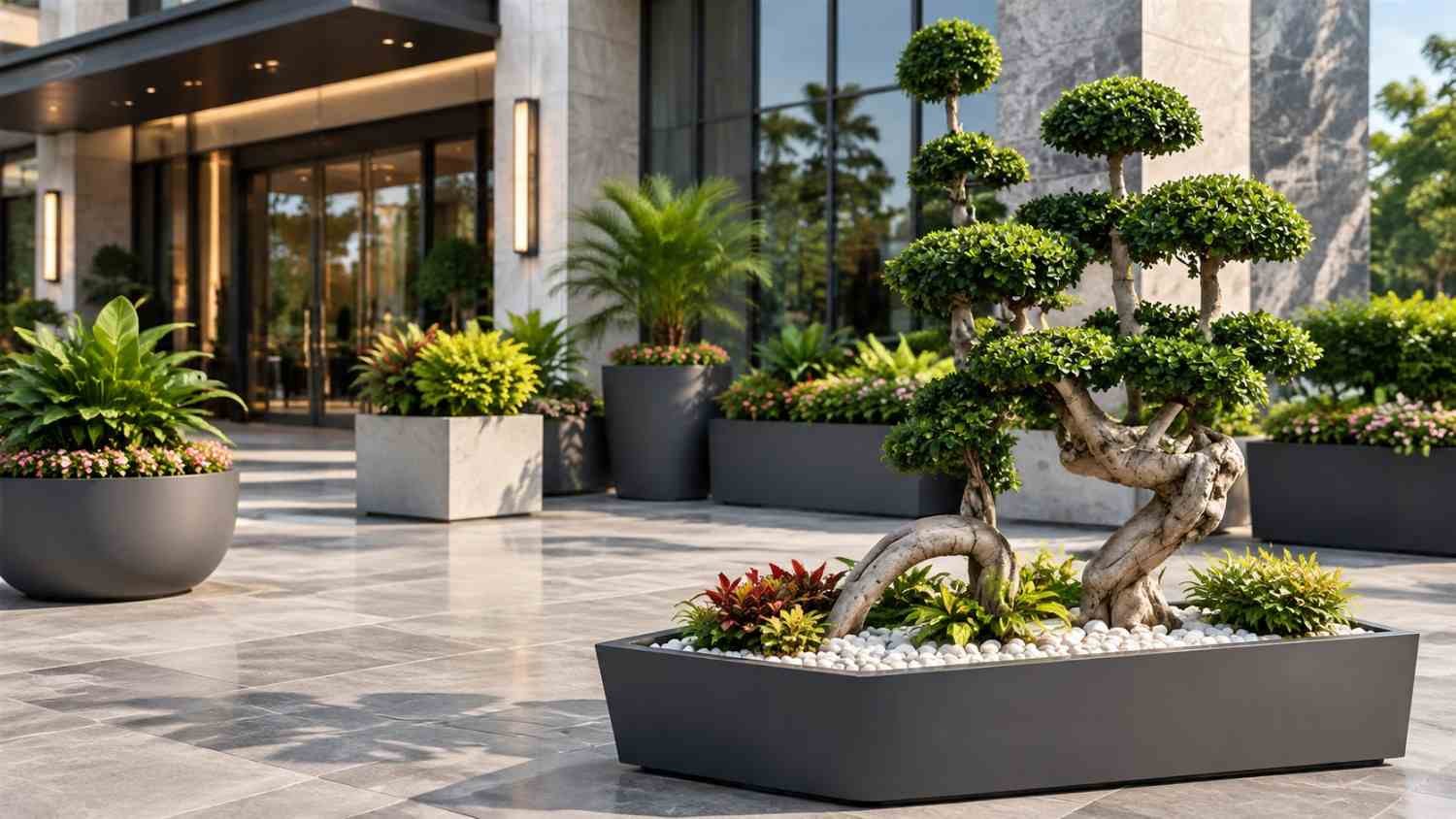
A mall developer in Noida ordered sixteen oversized planters for an atrium centrepiece, and the installation team discovered on delivery day that the units couldn't pass through the loading dock doorway. Nobody had checked the disassembly option before manufacturing. That's the kind of mistake that happens when a Large Planter gets treated as a simple scaled-up version of a smaller pot, rather than a separate engineering decision involving weight, transport, and structural load that most standard planters never face.
Scale changes everything about a planter's design requirements. What works structurally at 20 inches doesn't automatically hold at 48 inches, and commercial buyers who assume otherwise usually find out the hard way.
Specification: Engineering Considerations Unique to Scale
Large planters for commercial use typically range from 36 to 60 inches in height, with wall thickness increasing to 8mm–12mm and internal ribbing added for structural support that smaller planters don't require.
Internal Ribbing and Load Distribution
Here's the detail most buyers never ask about: a large planter filled with wet soil can weigh several hundred kilograms, and without internal structural ribs, the walls bow outward under that pressure over time. Ribbing distributes load evenly across the wall surface, preventing the slow deformation that turns a straight-sided planter oval within a year or two. Ask specifically whether ribbing is included as standard or only on request — it shouldn't be optional at this scale.
Modular or Disassembling Design for Transport
Extra large planters india buyers frequently order without checking whether the unit fits through standard doorways, lift shafts, or loading docks. A properly designed large planter for indoor commercial placement often ships in two or three sections that bolt together on-site, specifically to avoid the transport failure that stalled that Noida atrium project.
What Separates a Serious Large Planter Supplier From the Rest
- Structural load calculations provided in writing. A good supplier shares filled-weight and wall-stress data for large formats. A bad answer is "it's strong enough," with no number to back it up.
- Transport and access planning before manufacturing. A good supplier asks about doorway width, lift dimensions, and loading dock access upfront. A bad supplier finds out the unit doesn't fit after it's already built.
Benefits of Choosing Large FRP Planters Over Alternatives
Weight advantage becomes even more significant at large scale — a 48-inch concrete planter can weigh over ten times what an equivalent FRP unit weighs, which directly affects whether a rooftop, upper floor, or standard slab can even support the installation. Structural integrity through internal ribbing protects against the wall deformation that plagues cheaply built large-format planters within a year or two of heavy soil load.
Modular transport design reduces installation risk and cost, avoiding the kind of access failure that turns a straightforward delivery into a logistical crisis requiring cranes or partial demolition of access points. Mould-based manufacturing allows large custom shapes and centrepiece designs without the extreme tooling cost that large-format concrete or stone customisation demands.
Long-term durability protects a significant capital investment, since a large commercial planter represents a meaningfully higher cost than smaller units, and structural failure or premature cracking at that scale is a far more expensive mistake to correct. Low maintenance requirements matter proportionally more too — nobody wants to schedule specialised repainting equipment for a centrepiece planter that should simply hold its finish for a decade.
Sourcing Large Format Planters Across India
Large outdoor planters demand more from a supplier's production capability than standard sizes, and not every manufacturer that produces medium planters well can scale up reliably. Buyers searching for Large Planter Manufacturers in India should specifically verify large-format production history, not assume that competence at smaller sizes transfers automatically.
Transport logistics also shift meaningfully at this scale — a large planter shipped from a distant manufacturing hub faces higher damage risk in transit than a domestically sourced one. For projects across northern and central India, working with Large Planter Suppliers in India based within reasonable transport distance reduces that risk considerably, and reduces the cost of freight for genuinely heavy, bulky units.
About Us
We've been manufacturing FRP planters since 2013, and large-format orders taught us lessons our standard product line never did. We introduced modular two-piece construction for anything above 42 inches in 2021, after a Chennai client's centrepiece planter couldn't be manoeuvred through a renovated building's service corridor — a problem we hadn't anticipated until it actually happened on-site.
Conclusion
A Large Planter is not simply a bigger version of a smaller product — it's a different engineering problem involving load, transport, and structural reinforcement that most standard planters never encounter. Buyers who skip the access and load conversation upfront usually pay for it later, either in a failed delivery or a wall that bows within a year. As commercial atriums and large-format landscaping continue expanding across Indian cities, getting this engineering right will only matter more.
FAQs
What height range typically qualifies as a Large Planter?
Generally 36 inches and above. Below that, standard construction usually holds up fine without the additional ribbing and reinforcement large formats require.
Do Large Planter Manufacturers offer modular designs for tight access sites?
The better ones do, typically splitting anything above 42 inches into bolt-together sections. Always confirm this before ordering if your site has any access constraints at all.
How much does a filled large planter actually weigh?
It varies by size and soil type, but a 48-inch unit with wet soil can exceed 300 kilograms. Get exact filled-weight figures from your supplier before finalising a rooftop or upper-floor installation.
Are extra large planters india buyers order suitable for indoor atrium centrepieces?
Yes, provided structural ribbing is included and the transport plan accounts for indoor access constraints — something that trips up more atrium installations than people expect.
Do Large Planter Suppliers in India provide on-site assembly support?
Some do for modular units, though it's worth confirming whether that's included or billed separately, since assembly complexity increases meaningfully with planter size.