Landscape Rendering Is Changing the Way Developers Present Outdoor Living Spaces
By Archdraw Outsourcing 03-07-2026 143
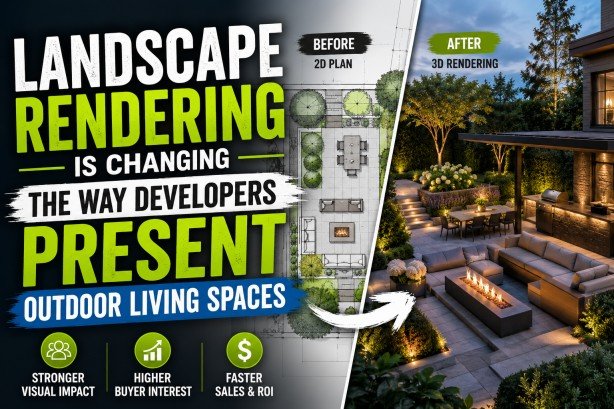
Landscape rendering transforms how developers and architects present outdoor spaces by replacing flat blueprints with photorealistic 3D visuals. Landscape 3D Rendering Services help clients visualize finished designs before construction begins, reducing costly revisions and accelerating sales approvals. Providers like Archdraw outsourcing make these capabilities accessible to teams of all sizes.
Selling a vision has always been the hardest part of property development. A client staring at a two-dimensional floor plan sees lines and measurements. What they need to see is the morning light filtering through a pergola, the clean edge of a pool deck, or the layered texture of a planted garden border. That gap between technical drawing and lived experience is exactly where landscape rendering steps in.
The shift has been swift. Developers who once relied on hand-drawn sketches or basic digital drafts now present fully realized outdoor environments—complete with seasonal lighting, plant growth simulation, and material finishes—before a single shovel breaks ground. The impact on client confidence, approval timelines, and sales conversion is hard to overstate.
What Is Landscape Rendering and Why Does It Matter to Developers?
Landscape rendering is the process of producing photorealistic digital images or animations of outdoor spaces based on architectural and design plans. Unlike interior renderings, landscape renders must account for dynamic elements: vegetation growth cycles, natural light angles, water features, and how hardscape materials age. The complexity is real, and so is the payoff.
For developers, the value proposition is straightforward. Clients make faster, more confident decisions when they can see exactly what they're buying. Revisions that would normally surface post-construction—a patio that feels too exposed, a planting scheme that clashes with the facade—get caught in the visual review stage instead. That saves time and money on both sides.
Landscape 3D Rendering Services take this a step further by building interactive or multi-angle views that allow stakeholders to explore a space from multiple perspectives. A rooftop terrace, a community garden, a resort pool area—each environment can be presented in full detail, across different times of day and weather conditions, long before construction begins.
How Have Client Expectations Around Outdoor Spaces Changed?
Outdoor living has moved from afterthought to centrepiece. Post-pandemic buyer behavior accelerated a trend that was already underway: people now treat exterior spaces as functional extensions of the home, not just landscaping. Gardens, terraces, pool areas, and outdoor kitchens command serious attention in purchase decisions.
Developers have had to respond. A rendered kitchen interior is now table stakes; a rendered outdoor entertainment area is quickly becoming just as essential. Buyers and investors want to see curated outdoor environments with the same level of detail they expect indoors—furniture placement, lighting mood, plant maturity, and material texture all included.
This shift puts pressure on presentation quality. Flat site plans no longer communicate the lifestyle a development promises. Photorealistic landscape renders do.
What Are the Core Benefits of Landscape 3D Rendering Services?
The benefits cluster around three business-critical areas: communication, efficiency, and sales.
Clearer Communication with Clients and Councils
Photorealistic renders eliminate ambiguity. When a client approves a rendered image, everyone involved has a shared, precise reference point. The same applies to planning authorities—submissions supported by detailed landscape renders tend to move through review processes more smoothly because reviewers can assess spatial impact without needing to interpret technical drawings.
Faster Design Iteration
Revisions in 3D are far less disruptive than revisions on-site. A designer can swap materials, reposition plantings, or adjust lighting within a render in hours. The same change during construction can take days and cost significantly more. Landscape 3D Rendering Services compress the feedback loop between design intent and client approval.
Stronger Sales Performance
Marketing teams that lead with high-quality renders—particularly for off-the-plan developments—consistently report stronger early sales. Buyers respond to environments they can emotionally connect with. A photorealistic render of a sunset terrace or a leafy courtyard creates that connection in a way that no floor plan can.
Why Are Developers Turning to Archdraw Outsourcing for Rendering Work?
Producing high-quality 3D renders in-house requires significant investment: software licenses, hardware, and skilled 3D artists. For many development and architecture firms, particularly small-to-mid-sized teams, that overhead is difficult to justify for project-by-project needs.
Archdraw outsourcing offers a practical solution. By partnering with a specialist rendering provider, developers access professional-grade output without carrying the overhead of a full in-house team. Archdraw outsourcing models typically operate on a per-project basis, giving firms the flexibility to scale their rendering capacity up or down depending on workload.
The quality argument is also compelling. Specialist rendering studios invest heavily in staying current with software advancements—tools like Lumion, V-Ray, and Enscape continue to evolve rapidly. An outsourced partner whose core business is rendering will generally outperform a generalist in-house effort, both in quality and turnaround time.
For developers presenting to high-value clients or seeking planning approvals in competitive markets, that quality difference is not cosmetic. It can be the deciding factor.
What Types of Outdoor Projects Benefit Most from 3D Landscape Rendering?
Almost any outdoor project benefits from rendering, but certain project types see an outsized return on the investment.
Residential Developments: Off-the-plan sales rely entirely on visualizations. A landscaped courtyard or rooftop garden rendered in photorealistic detail gives buyers the confidence to commit before the building exists.
Master-Planned Communities: Large-scale developments with shared green spaces, recreational areas, and streetscaping need renders to communicate the overall vision to both buyers and local councils.
Hospitality and Resort Projects: Hotels and resorts sell experience above all else. Pool areas, outdoor dining spaces, and garden terraces rendered at the concept stage help secure investment and shape the final design.
Commercial Developments: Office precincts and mixed-use developments increasingly compete on amenity. Rendered outdoor spaces—roof terraces, plaza landscaping, bike storage and end-of-trip facilities—feature prominently in leasing campaigns.
How Should Developers Evaluate a Landscape Rendering Partner?
Not all rendering studios deliver the same result. When assessing a partner—whether through Archdraw outsourcing or another provider—developers should focus on a few key criteria.
Portfolio depth: Look for demonstrated experience with outdoor environments specifically. Landscape rendering requires different expertise than interior or architectural rendering.
Turnaround and revision processes: Understand how many revision rounds are included, what the typical delivery timeline looks like, and how the studio handles feedback.
File format flexibility: Ensure the studio can deliver outputs compatible with your marketing and presentation requirements—still images, animated walkthroughs, interactive panoramas, or VR-ready files.
Communication and briefing process: The quality of a render depends heavily on the quality of the brief. A good rendering partner will have a structured intake process to extract exactly what they need before starting work.
Bringing Outdoor Visions to Life Before Construction Begins
The developers winning attention in competitive markets are those who help clients see—not just imagine—what they're buying. Landscape rendering has made that possible at a quality level that was, not long ago, reserved for major firms with large production budgets.
Landscape 3D Rendering Services have democratized access to that quality, and Archdraw outsourcing models have made it financially viable for development teams of all sizes to deliver photorealistic outdoor environments as a standard part of their presentation toolkit.
The technology will keep advancing. Plant growth simulation, real-time lighting adjustments, and fully interactive renders are already reshaping what clients expect. The developers who embed these capabilities into their sales and planning processes now will be better positioned to meet those expectations as they grow.
Frequently Asked Questions
What is the difference between landscape rendering and landscape design?
Landscape design is the planning process—deciding what goes where and why. Landscape rendering is the visualization of that plan as a photorealistic image or animation. Rendering communicates the design to clients, investors, and planning authorities in a format they can immediately understand.
How much do Landscape 3D Rendering Services typically cost?
Costs vary depending on project complexity, number of views, and level of detail required. Simple residential renders may start at a few hundred dollars per image, while complex multi-angle projects with animation can run into several thousand. Outsourcing to a specialist like Archdraw outsourcing generally offers better value than building in-house capacity for occasional projects.
How long does a landscape rendering project take to complete?
Turnaround depends on complexity and revision rounds. A standard still render typically takes three to seven business days. Animated walkthroughs or large-scale projects may require two to four weeks. Discussing timelines upfront with your rendering partner helps align expectations.
Can landscape renders be updated as the design evolves?
Yes. One of the key advantages of 3D rendering is that design changes can be reflected in the renders without starting from scratch—provided the studio retains the original 3D scene files. Always confirm file retention and revision policies with your provider.
Is Archdraw outsourcing suitable for small development firms?
Archdraw outsourcing is particularly well-suited to small and mid-sized firms that need professional rendering quality without the overhead of a full in-house 3D team. The per-project model allows firms to access high-quality output on an as-needed basis.