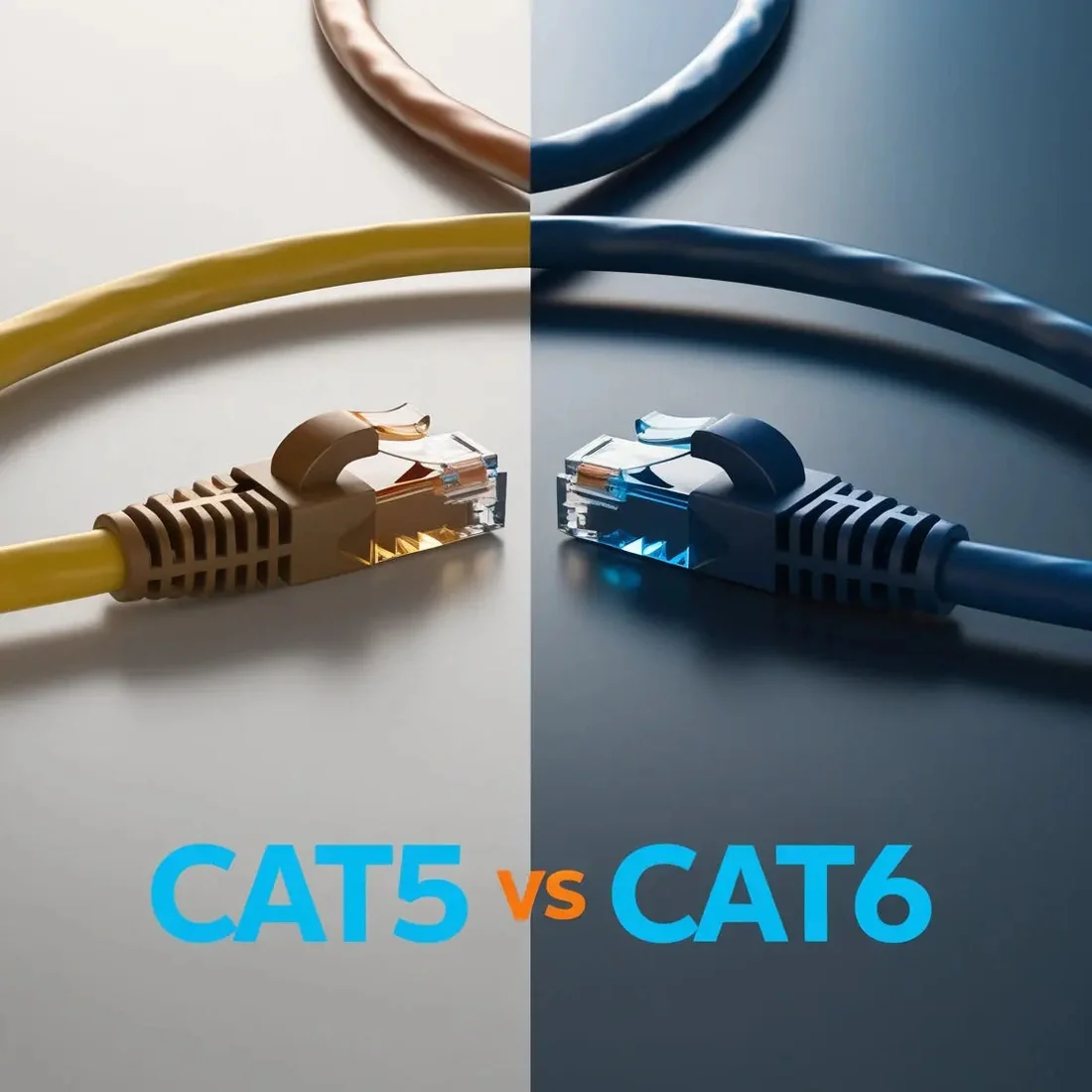
Why Is It Important to Understand Cat5 vs Cat6 Ethernet Cables?
A reliable wired network depends heavily on the quality and category of the Ethernet cables being used. Computers, routers, switches, smart TVs, gaming consoles, IP cameras and other network devices rely on Ethernet cabling to transfer data efficiently.
Ethernet cables are divided into different categories based on their electrical and transmission performance. Cat5 and Cat6 are two categories that are often compared when choosing network cabling for homes, offices and other installations.
Although both use twisted-pair construction, they differ in bandwidth, crosstalk performance, speed capabilities and recommended applications. Understanding these differences can help you select the appropriate cable for your current network and future requirements.
What Is a Cat5 Cable?
Cat5, or Category 5, is an older Ethernet cable category that was widely used for networking during the 1990s and early 2000s.
It was designed primarily for Fast Ethernet applications and is rated for frequencies up to 100 MHz. Traditional Cat5 can support Ethernet speeds up to 100 Mbps over standard distances.
Although newer categories have largely replaced original Cat5 in modern installations, existing networks may still contain these cables.
It is important to distinguish Cat5 from Cat5e. Cat5e is an improved version of the category and is commonly used for Gigabit Ethernet.
What Are the Main Features of Cat5 Cable?
What Bandwidth Does Cat5 Support?
Original Cat5 is rated for frequencies up to 100 MHz.
Bandwidth in this context refers to the frequency range specified for the cable and should not be confused directly with internet speed.
What Speed Can Cat5 Provide?
Traditional Cat5 is primarily associated with 100 Mbps Ethernet.
Actual network performance also depends on the connected hardware, cable quality, installation and environmental conditions.
How Is Cat5 Constructed?
Cat5 uses four twisted pairs of conductors. The twisting helps reduce interference between the wires and supports reliable signal transmission.
What Is a Cat6 Cable?
Cat6 is a newer Ethernet cable category designed with tighter electrical specifications than Cat5 and Cat5e.
It is rated for frequencies up to 250 MHz and is widely used for Gigabit Ethernet networks. Under suitable conditions, Cat6 can also support 10 Gigabit Ethernet over shorter distances.
Because of its improved crosstalk performance and higher bandwidth rating, it has become a popular choice for residential, commercial and structured network installations.
What Are the Main Features of Cat6 Cable?
What Bandwidth Does Cat6 Support?
Cat6 is rated up to 250 MHz, providing a higher frequency specification than traditional Cat5.
This makes it better suited to modern networks that require reliable high-speed data transmission.
What Speed Can Cat6 Support?
Cat6 is commonly used for 1 Gbps Ethernet over standard channel distances.
It can also support 10 Gbps Ethernet over shorter distances, commonly around 55 meters depending on cable quality, installation conditions and the networking equipment being used.
Why Does Cat6 Have Better Crosstalk Performance?
Cat6 has tighter manufacturing requirements that help reduce crosstalk between twisted pairs.
Some designs also use a separator or spline between the pairs to provide additional physical separation. These features can help maintain signal quality in high-speed networking applications.
What Are the Key Differences Between Cat5 and Cat6?
Which Has Higher Bandwidth: Cat5 or Cat6?
Cat6 has the higher bandwidth rating.
Cat5: Up to 100 MHz
Cat6: Up to 250 MHz
The higher frequency specification makes Cat6 more suitable for modern high-speed networking applications.
Which Is Faster: Cat5 or Cat6?
Cat6 offers significantly greater performance potential than traditional Cat5.
Original Cat5 is generally associated with Fast Ethernet speeds up to 100 Mbps, while Cat6 is commonly used for Gigabit Ethernet and can support 10 Gbps over suitable shorter distances.
It is important to remember that the cable does not determine network speed by itself. The router, switch, network adapter, service plan and other components also matter.
Which Has Better Protection Against Crosstalk?
Cat6 generally provides better crosstalk performance than traditional Cat5.
Its stricter construction requirements help reduce interference between the twisted pairs. This becomes increasingly important as transmission speeds increase.
For environments where electromagnetic interference is a concern, shielded cable versions can also be considered, depending on the installation requirements.
Which Cable Is Better for Long-Distance Networking?
Both cable categories are associated with Ethernet channel lengths up to approximately 100 meters when the complete installation meets the applicable requirements.
However, the supported speed depends on the cable category and Ethernet standard.
Cat6 is commonly used for Gigabit Ethernet over standard channel distances, while its 10 Gbps capability is intended for shorter runs.
Is Cat6 More Future-Ready Than Cat5?
For new installations, Cat6 is generally a better choice than original Cat5 because it provides higher bandwidth and supports more modern Ethernet applications.
Original Cat5 has largely been replaced by Cat5e, Cat6 and newer categories.
If you are installing new cabling today, choosing a cable category that supports current and anticipated network requirements can reduce the need for an early upgrade.
Which Cable Is More Affordable?
Traditional Cat5 may be less expensive, but it is also an older category with more limited performance.
Cat6 typically costs more because of its improved construction and higher performance specifications.
For many installations, the additional cost of Cat6 can be justified by its greater capability and suitability for modern networking.
Is Cat5 or Cat6 Better for Home Networking?
For a new home network, Cat6 is generally the more practical choice.
Modern homes may have multiple connected devices, including:
Smart TVs
Gaming consoles
Computers
Wi-Fi access points
Network storage
IP cameras
Printers
Streaming devices
Cat6 can provide the wired infrastructure needed for Gigabit Ethernet and certain higher-speed applications.
If an existing home network already contains Cat5, upgrading may not always be necessary unless the current cabling is limiting network performance.
Which Cable Is Better for Office Networking?
Cat6 is usually a better option for new office installations.
Businesses often rely on wired connections for computers, access points, VoIP equipment, printers, servers and network storage.
Its higher bandwidth and improved crosstalk performance make it more appropriate for modern office networks, particularly where large amounts of data are transferred.
Is Cat6 Better for Gaming?
Cat6 can be an excellent choice for gaming because it supports reliable high-speed wired connectivity.
A wired connection can provide consistent communication between the gaming device and local network equipment.
However, upgrading from Cat5 to Cat6 does not automatically reduce internet ping. Latency is influenced by the internet connection, router, ISP, server location and network configuration.
Is Cat6 Suitable for CCTV and PoE?
Yes. Cat6 is widely used for IP CCTV and PoE networking applications.
It can carry both network data and, with compatible PoE equipment, electrical power to supported devices.
For CCTV installations, the cable should be selected based on the required distance, outdoor or indoor environment, PoE requirements and the manufacturer's specifications.
Can Cat6 Replace Cat5?
Yes. Cat6 can generally be used in place of Cat5 in compatible Ethernet networks.
Because Ethernet cabling is backward compatible across many common standards, a Cat6 cable can work with equipment designed for older Ethernet categories.
However, replacing the cable does not increase the speed of hardware that does not support the newer performance level.
Are Cat5 and Cat6 Connectors the Same?
Both cable categories commonly use RJ45-style Ethernet connections, but connector selection should match the cable construction.
Cat6 cables can have larger conductor dimensions and different jacket diameters than older cables, so using a connector designed for the correct cable type can help ensure proper termination.
For installations using shielded cabling, appropriate shielded connectors and grounding practices may also be required.
Is There a Physical Difference Between Cat5 and Cat6?
Yes, although the exact appearance depends on the manufacturer.
Cat6 cables are often thicker and may include additional insulation or a pair separator. Their twisted pairs can also have tighter and more controlled construction.
However, you should not identify the cable category purely by appearance. The most reliable method is to check the category printed on the cable jacket and the product specifications.
What Should You Check Before Buying Cat6 Cable?
If you decide that Cat6 is appropriate for your network, check more than just the category name.
Consider:
What Is the Conductor Material?
For reliable Ethernet performance, check whether the cable uses copper conductors. Be cautious with products using copper-clad aluminum (CCA), particularly for permanent structured cabling applications.
Is the Cable Shielded or Unshielded?
UTP can be suitable for many residential and office environments, while shielded versions may be useful where electromagnetic interference is higher.
What Cable Length Do You Need?
Measure the actual cable route before purchasing. Avoid unnecessary excess cable and always consider the distance limitations associated with the intended Ethernet speed.
Is the Cable Designed for Indoor or Outdoor Use?
Outdoor installations require cable specifically designed and rated for environmental exposure.
Does the Cable Meet Applicable Standards?
Check the manufacturer's specifications and compliance information for the relevant cabling standards and intended application.
Is Cat5 Still Useful Today?
Original Cat5 has limited relevance for new network installations because newer categories offer better performance.
However, existing Cat5 cabling may continue to work for basic networking requirements where the equipment and network speed remain within its capabilities.
For a new installation, Cat5e or Cat6 is generally a more practical choice.
Can Cat6 Improve Internet Speed?
Cat6 can support higher-speed wired networking, but it cannot increase an internet plan beyond what your ISP and networking equipment provide.
For example, if your router supports only 100 Mbps Ethernet, replacing a cable with Cat6 will not make the router deliver Gigabit speeds.
The cable should therefore be considered as one part of the complete network path.
Which Is Better for Future-Proofing: Cat5 or Cat6?
Cat6 is the stronger choice for future-proofing between these two categories.
Its higher bandwidth rating and support for Gigabit Ethernet provide more flexibility for modern networks. It also offers the potential for higher-speed Ethernet over shorter distances.
For a new structured cabling project, Cat6 is generally more suitable than installing original Cat5.
What Is the Difference Between Cat5, Cat5e and Cat6?
Understanding these three categories can make cable selection easier.
Cat5 is an older category primarily associated with 100 Mbps Ethernet.
Cat5e is an improved version commonly used for Gigabit Ethernet and remains widely deployed.
Cat6 provides a higher 250 MHz frequency rating and improved crosstalk performance, while supporting Gigabit Ethernet and certain 10 Gbps applications over shorter distances.
For most new installations, Cat6 provides additional performance headroom compared with legacy Cat5.
Which Cable Should You Choose for Your Network?
The best choice depends on your current equipment, desired speed, cable length and future requirements.
If you are maintaining an older basic network, existing Cat5 may still be adequate.
For a new home or office installation, Cat6 is usually the more practical option because it offers better performance, greater bandwidth and broader suitability for modern networking applications.
The goal should be to select a cable that matches the complete network rather than choosing solely on the category number.
Conclusion: Is Cat6 Better Than Cat5?
Cat5 and Cat6 serve similar basic purposes, but their performance capabilities are different.
Traditional Cat5 is an older Ethernet category with a 100 MHz rating and is primarily associated with 100 Mbps networking. Cat6 is rated up to 250 MHz, provides improved crosstalk performance and is widely used for Gigabit Ethernet, with 10 Gbps support possible over shorter distances under suitable conditions.
For new installations, Cat6 is generally the better choice because it offers greater performance headroom, better suitability for modern devices and stronger long-term value.
However, replacing every existing cable is not always necessary. If your current network meets your requirements, an upgrade may provide little practical benefit until faster equipment or higher bandwidth demands are introduced.
In simple terms, Cat5 can still work for basic existing networks, but Cat6 is the more suitable choice for most new and future-ready Ethernet installations.
Frequently Asked Questions About Cat5 vs Cat6
1. Should I use Cat5 or Cat6 cable?
For a new installation, Cat6 is generally the better choice because it provides higher bandwidth and improved crosstalk performance.
2. How do I know if my LAN cable is Cat5 or Cat6?
Check the text printed along the cable jacket. It normally identifies the category, such as Cat5, Cat5e or Cat6.
3. Can I use a Cat6 cable in a Cat5 port?
Yes. Cat6 cabling can generally work with compatible Ethernet equipment using older standards, although the network speed will depend on the equipment.
4. How much faster is Cat6 than Cat5?
Traditional Cat5 is primarily associated with 100 Mbps Ethernet, while Cat6 is commonly used for Gigabit Ethernet and can support 10 Gbps over suitable shorter distances.
5. Does Cat5 vs Cat6 make a difference?
Yes. Cat6 provides a higher frequency rating and improved crosstalk performance, making it better suited to modern high-speed networks.
6. How can I differentiate Cat5 and Cat6 cables?
Check the category printed on the cable jacket and product specifications. Cat6 may also have a thicker construction or internal separator, but appearance alone is not a reliable identification method.
7. Can I use a Cat6 cable instead of Cat5e?
Yes. Cat6 can generally be used with equipment that supports Cat5e and older Ethernet standards.
8. Should I use Cat5 or Cat6 in my house?
For a new home installation, Cat6 is generally recommended because it provides better performance and more room for future upgrades.
9. What is the difference between Cat5, Cat6, Cat7 and Cat8?
The categories differ in bandwidth ratings, shielding requirements, supported Ethernet applications and intended use. Cat6 is widely used for homes and businesses, while higher categories are designed for more specialized high-performance applications.
10. What is the speed difference between Cat5 and Cat6?
Traditional Cat5 is associated with up to 100 Mbps Ethernet, while Cat6 is commonly used for 1 Gbps Ethernet and can support 10 Gbps over shorter distances under suitable conditions.
11. Is there a physical difference between Cat5 and Cat6 cables?
Often, yes. Cat6 may have thicker insulation, tighter pair construction or a separator, but physical appearance varies by manufacturer.
12. Are Cat5 and Cat6 RJ45 connectors different?
The connection type is commonly RJ45-style, but the connector should match the cable's conductor size, jacket diameter and construction.
13. What is the difference between Cat5 and Cat6 connectors?
The main consideration is compatibility with the specific cable construction. Cat6 cables may require connectors designed for their conductor and jacket dimensions.
14. Is Cat6 better for security cameras?
Cat6 is commonly used for IP CCTV and PoE applications because it supports reliable high-speed Ethernet connectivity.
15. Which Ethernet cable is best for future-proof networking?
For most new home and office installations, Cat6 is a practical future-ready option because it offers higher bandwidth, Gigabit Ethernet support and the ability to handle certain higher-speed applications over shorter distances.